Study Guide: Preparing for the Agentic Web and the WordPress AI Plugin
This study guide provides a comprehensive overview of the foundational changes introduced in WordPress 7.0 and the experimental features of the AI plugin for WordPress. It explores how standardized APIs and a provider-agnostic architecture are preparing the ecosystem for an AI-driven and agentic era.
Quiz: Understanding WordPress AI Infrastructure
Instructions: Answer the following questions in two to three sentences based on the provided text.
- What are the two primary foundational APIs introduced in WordPress 7.0 to handle AI interactions?
- How does the “provider-agnostic” nature of the AI Client benefit plugin developers?
- What is the specific role of the Connectors API in the WordPress AI architecture?
- List three editorial workflow features provided by the AI plugin experiments in the block editor.
- Describe the relationship between the AI plugin and the WordPress core AI APIs.
- How does the AI plugin streamline image creation within the WordPress publishing workflow?
- What is the difference between the “Editorial Notes” and “Editorial Updates” experiments?
- Why is a “capability-based” AI architecture considered more durable than hard-coding specific providers?
- According to the text, which foundational web practices are currently more important for AI agents than experimental agent-specific techniques?
- What specific AI capability is required for the “Alt Text Generation” feature compared to most other editor experiments?
Quiz Answer Key
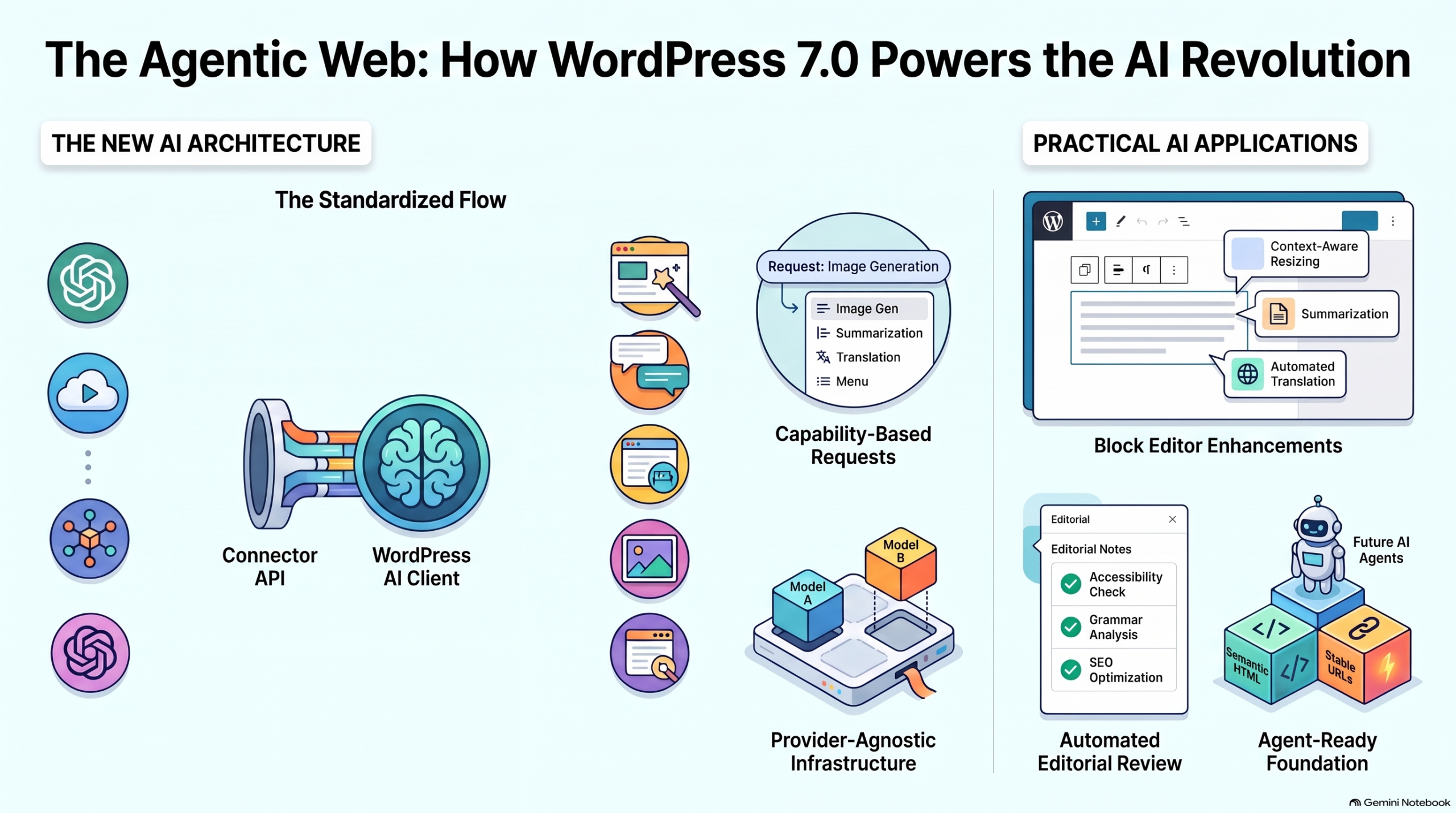
- What are the two primary foundational APIs introduced in WordPress 7.0 to handle AI interactions? The two foundational APIs are the AI Client and the Connector API. Together, they establish a standardized way for WordPress to interact with various AI models and manage external service credentials.
- How does the “provider-agnostic” nature of the AI Client benefit plugin developers? Developers can describe the specific capability they need (such as text generation) rather than implementing a custom integration for every provider like OpenAI or Google. This allows WordPress to route requests to a compatible model automatically, simplifying the development process.
- What is the specific role of the Connectors API in the WordPress AI architecture? The Connectors API handles the relationship between WordPress and external services by managing credentials and API keys. It introduces a standardized settings screen where users can configure featured connectors for providers like Anthropic, Google, and OpenAI.
- List three editorial workflow features provided by the AI plugin experiments in the block editor. The AI plugin offers several experiments including Content Summarization, which generates overviews of long-form content, and Content Translation for blocks. Additionally, Title Generation and Slug Generation suggest SEO-friendly titles and permalinks based on the post content.
- Describe the relationship between the AI plugin and the WordPress core AI APIs. The AI plugin serves as a “feature plugin” that uses the core infrastructure—the AI Client and Connectors API—to power its experiments. It acts as a practical demonstration of what can be built on the new foundation while testing new capabilities at scale.
- How does the AI plugin streamline image creation within the WordPress publishing workflow? It allows users to generate and modify images using generative AI directly within the block editor from a prompt. This eliminates the need for authors to use separate applications or manual upload processes during the content creation phase.
- What is the difference between the “Editorial Notes” and “Editorial Updates” experiments? Editorial Notes analyzes content to provide suggestions regarding grammar, SEO, accessibility, and readability. Editorial Updates takes this further by automatically applying those pending editorial changes to the content.
- Why is a “capability-based” AI architecture considered more durable than hard-coding specific providers? This architecture allows the underlying AI model to be swapped or updated without requiring the feature itself to be rebuilt. By requesting a “capability” (like text generation) instead of a specific provider, the foundation remains stable even as the AI landscape shifts.
- According to the text, which foundational web practices are currently more important for AI agents than experimental agent-specific techniques? Foundational practices like stable URLs, semantic HTML, structured data, and accessible markup remain the most critical for AI agent interaction. While experimental techniques like llms.txt are worth exploring, agents still primarily rely on existing web standards.
- What specific AI capability is required for the “Alt Text Generation” feature compared to most other editor experiments? Unlike most editor experiments that require text generation models, Alt Text Generation requires an AI connector that supports vision-based image analysis. This allows the AI to “see” the image and generate descriptive text for accessibility.
Essay Questions
Instructions: Use the information from the source context to develop comprehensive responses to the following prompts.
- The Evolution of the Editorial Workflow: Analyze how the AI plugin for WordPress attempts to automate routine publishing tasks. Discuss the balance between AI-generated suggestions and the necessity of human review in areas like Alt Text Generation and Editorial Notes.
- Architectural Standardisation: Explain the significance of the shift from proprietary AI integrations to a standardized, provider-agnostic framework in WordPress 7.0. How does this shift affect the long-term sustainability of the WordPress plugin ecosystem?
- The Concept of “Capability over Provider”: Discuss the implications of developers requesting “capabilities” rather than specific AI models. How does this abstraction layer protect developers from rapid changes in the AI industry?
- WordPress and the Agentic Web: Evaluate the current state of WordPress’s readiness for the “agentic web.” Contrast the available infrastructure (like the Abilities API and MCP Adapter) with the actual readiness of the broader plugin ecosystem.
- Practical AI vs. Experimental Features: The text suggests that some AI features do not fundamentally change how publishing works, which may be why they are “useful experiments.” Argue for or against the idea that AI should focus on repetitive, narrowly defined tasks rather than radical transformations of the CMS.
Glossary of Key Terms
Term Definition
AI Client A provider-agnostic API built into WordPress 7.0 that allows developers to request AI capabilities (like text generation) without coding for a specific AI model.
Connector API A system introduced in WordPress 7.0 for managing credentials and connections to external AI services like OpenAI, Google, and Anthropic.
Abilities API An interface (introduced in 6.9 and expanded in 7.0) that provides a common way to expose WordPress functionality to external systems.
MCP Adapter A tool that makes WordPress “abilities” available to external AI systems via the Model Context Protocol.
Agentic Web An emerging era of the internet where AI agents proactively read websites, understand structures, and perform actions on behalf of users.
Feature Plugin A plugin (such as the AI plugin) used to test and explore new capabilities at scale before they are considered for core integration.
Provider-Agnostic An architectural design that does not depend on a specific service provider, allowing for the switching of underlying models without breaking functionality.
Capability-Based A request system where a plugin asks for a specific function (e.g., “image generation”) rather than a specific product or model name.
Semantic HTML Standardized web code that provides meaning to the content, which remains a primary foundation for how AI agents understand websites.
Structured Data Organized information on a webpage that helps search engines and AI agents interpret the context and relationships of the content.