The Sovereign Stack: How Deep-Tech Founders Are Escaping the Venture Capital Dilution Trap
- The Hardware Founder’s Dilemma
In the digital economy, Software-as-a-Service (SaaS) has long been the darling of Silicon Valley due to its near-zero marginal cost of distribution. Traditional Venture Capital (VC) is perfectly calibrated for this reality: inject liquidity, scale rapidly, and seek a high-velocity exit. However, for deep-tech ventures building microgrids, tactical communications, and autonomous kinetic systems, this creates a profound “structural mismatch.” The high capital expenditure (CapEx), multi-year technical validation cycles, and complex regulatory certifications of physical infrastructure do not align with the “grow-or-die” pressure of a standard ten-year fund cycle.
When founders fund these hardware-intensive ventures solely through conventional equity rounds, they often fall into a cycle of excessive dilution and misaligned exit pressures. The traditional VC model forces a prioritization of short-term revenue velocity over the long-term industrial resilience required for sovereign infrastructure. The “DeReticular” approach provides a strategic counter-narrative, utilizing a non-dilutive capital architecture designed to systematically de-risk hardware before a single share of preferred stock is ever priced. By decoupling technical development from equity surrender, founders can build for survival and sovereignty without sacrificing their cap table.
- Takeaway 1: The End of the “20% Per Round” Tax
The traditional venture lifecycle is essentially a gauntlet of equity surrender. Between Seed and Series B rounds, founders typically lose 15% to 25% of their company per round, often holding less than 30% ownership by the time they reach expansion capital. The DeReticular model breaks this cycle by deploying a “Non-Dilutive Capital Engine.” By utilizing federal SBIR/STTR programs, Other Transaction Authority (OTA) agreements, and Broad Agency Announcements (BAAs), founders can fund early-stage prototyping with 0% equity surrender.
While this model requires a higher administrative load and involves a “Time to Cash” of 6 to 12 months, the governance benefits are absolute. Unlike a Series B lead investor who might demand board seats and negative vetoes over hiring or pivots, a federal agency acts as a customer/sponsor. This allows the founder to retain 100% strategic control during the volatile R&D phase, focusing on technical milestones rather than satisfying the immediate fiduciary demands of institutional investors with different time horizons.
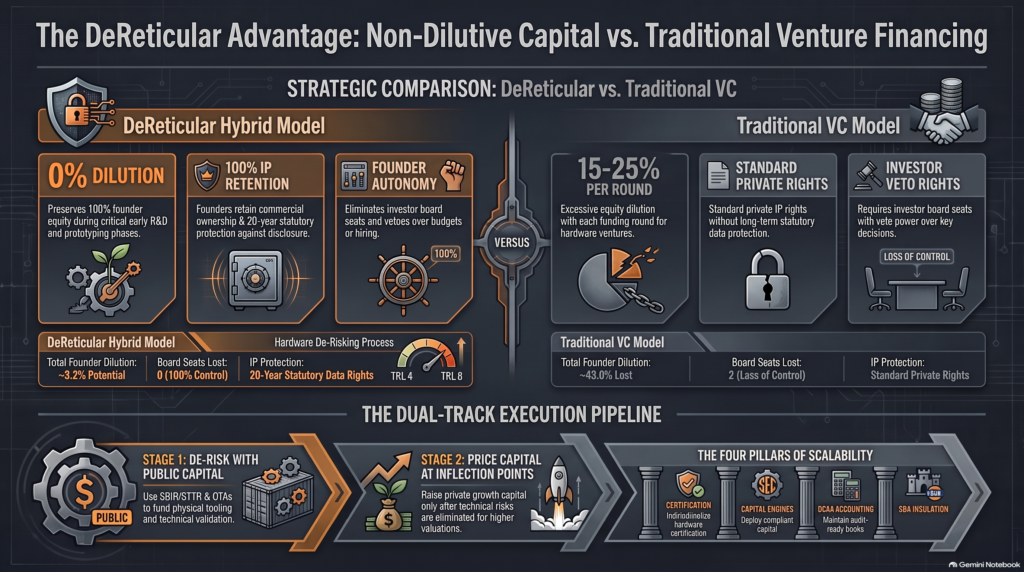
“The DeReticular non-dilutive funding workflow is engineered specifically for the demands of sovereign, capital-intensive infrastructure… preserving 100% of founder equity and strategic governance through early development phases.”
- Takeaway 2: Your 20-Year Invisible Shield
In the traditional venture world, intellectual property protection begins and ends with patents. Patents are public, expensive to defend, and often provide a false sense of security for deep-tech startups. The DeReticular pathway utilizes a far more robust defensive moat: SBIR Data Rights.
Under federal Small Business Administration (SBA) directives, awardees retain commercial ownership of their IP and are granted a statutory 20-year protection period. This shield protects technical data, source code, and design specifications from public disclosure and, crucially, from appropriation by the government or commercial competitors.
While the government receives a license for its own internal use, it is legally barred from releasing the technical packages to rivals. This 20-year “invisible shield” offers a superior defensive moat for deep-tech, ensuring that the technology powering sovereign infrastructure remains proprietary long after traditional venture-backed patents might have been challenged or bypassed.
- Takeaway 3: Engineering the “Valuation Inflection”
The most sophisticated deep-tech strategy is the “Dual-Track” hybrid model. This approach uses public grants to fund the “Valuation Trap”—the risky early phase where technical failure is high and valuations are low. By de-risking the hardware with grants (Stage 1), founders can price private capital at a significantly higher “inflection point” (Stage 2) once technical maturity is achieved.
Metric Traditional VC Model DeReticular Hybrid Model
Early Stage Risk High Technical Risk = Low Valuation R&D Funded by Grants = Risk Eliminated
Initial Dilution 20% – 30% at Seed Stage 0% (Grants)
Leverage Multiple 1:1 (Cash for Equity) 1:3 ($500k SAFE unlocks $1.5M Grants)
Founder Retained Equity ~57% at Maturity ~96.8% at Maturity
This leverage multiple changes the math of startup survival. A $500,000 SAFE (Simple Agreement for Future Equity) used as a required match for an AFWERX or DOE award can unlock $1.5M in grants, effectively tripling the company’s runway without a corresponding increase in equity cost. This allows founders to bypass the “Valuation Trap” and raise growth capital only when the technology is ready for production.
- Takeaway 4: Building for the “Grid-Down” Future
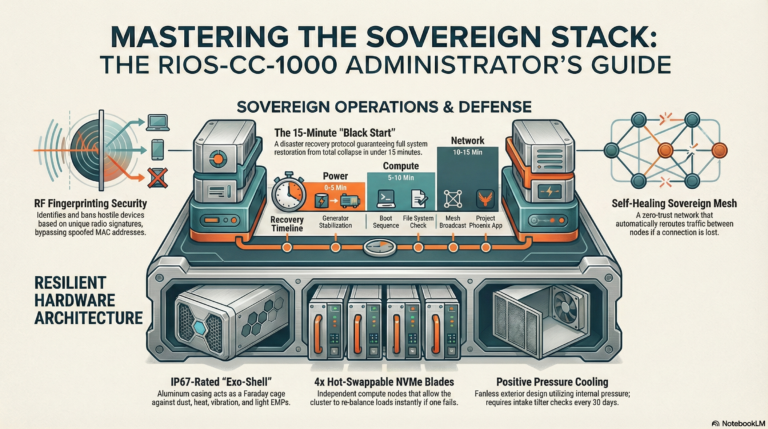
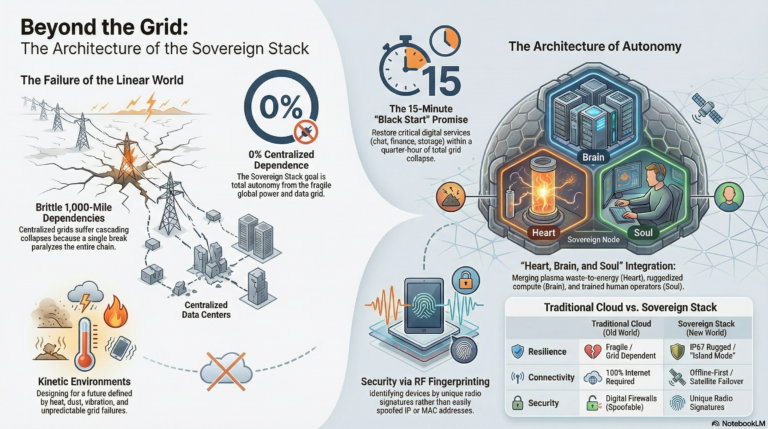
The technical heart of this movement is the “Sovereign Infrastructure” thesis: the belief that as macro-grids become more vulnerable, value shifts toward the “Gen 5 Node.” This local-first architecture is designed to operate independently of single points of failure.
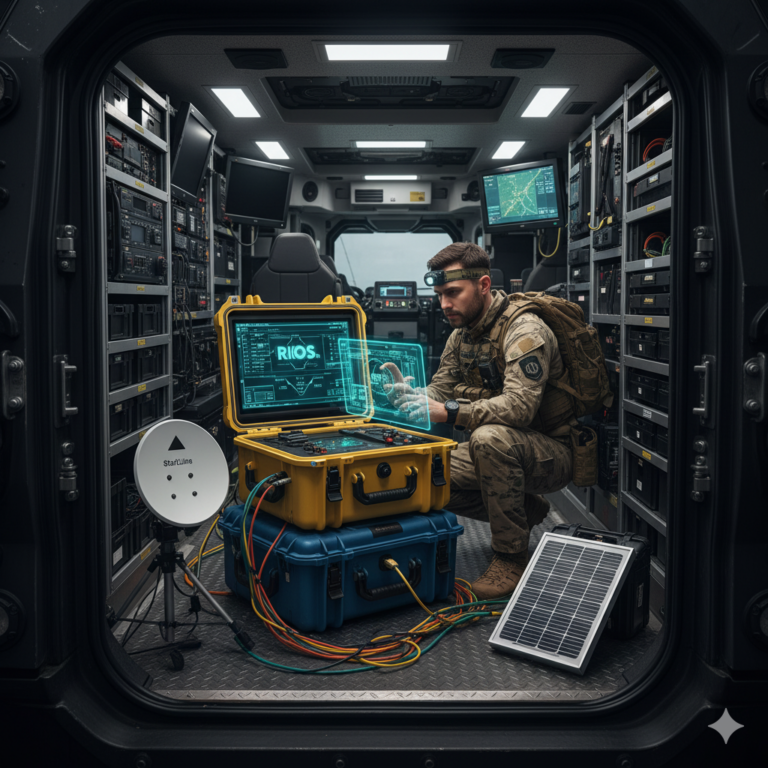
The Gen 5 Pod is the physical manifestation of this autonomy. While currently in the Development stage and awaiting formal MIL-STD test validation, it is engineered for:
- EMP Hardening: Designed to meet MIL-STD-188-125-1 shielding effectiveness (target \ge 80 dB to 100 dB) to survive high-altitude electromagnetic pulses.
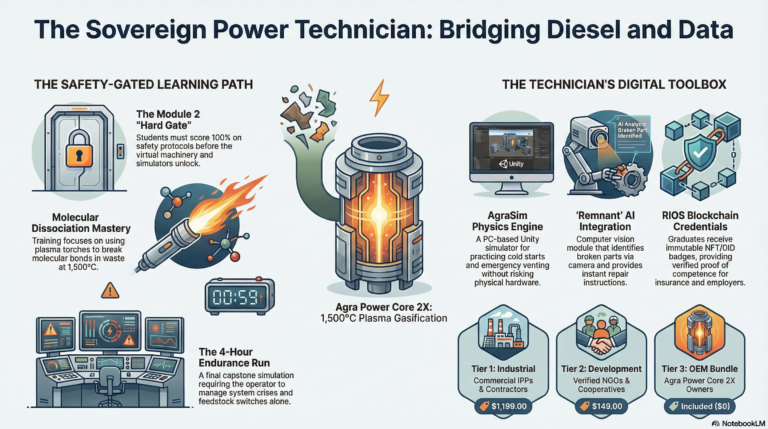
- Sovereign Power: Utilizing Prototype-stage Agra Dot Energy thermochemical gasifiers and Pawnee rotary GenSets for multi-fuel, off-grid energy.
- Zero-Trust Compute: Ruggedized Prototype edge-compute cores that execute power optimization and secure communications even when wide-area uplinks are severed.
This is more than backup power; it is a paradigm where the most valuable technology is the kind that doesn’t need the grid to exist.
- Takeaway 5: Compliance as the Ultimate Competitive Moat
The real barrier to entry in defense and sovereign infrastructure isn’t just the tech—it’s the “institutionalization” of compliance. The DeReticular ecosystem treats federal accounting (SF 1408) and cybersecurity (CMMC 2.0) not as burdens, but as moats that lock out less-organized competitors.
To be “DCAA-ready” for multi-million dollar contracts, a startup must implement a Triple-Rate accounting structure. This involves defensible formulas for:
- Fringe Rate: Health, payroll taxes, and benefits.
- Overhead Rate: R&D facility rent and lab consumables.
- G&A Rate: Executive salary and general IT.
Establishing these “Cost Firewalls” early allows a startup to transition from small feasibility grants to sole-source Phase III production contracts.
“Automated firewalls must permanently tag unallowable costs (e.g., SAFE legal drafting, platform marketing, interest expense) and exclude them from government reimbursement… preventing False Claims Act exposure.”
- Takeaway 6: The “Small Business” Stealth Mode
A critical strategic component is maintaining “SBA Affiliation Insulation.” Under 13 CFR § 121.702, a company must remain a “Small Business Concern” to access the $4 billion annual SBIR/STTR budget. This means the Venture Studio stake must stay below 49% and all “negative control vetoes” must be eliminated.
Furthermore, founders must navigate 13 CFR § 121.103(f) regarding “Economic Dependence.” If a spinout derives 70% or more of its revenue from the Studio, it may be deemed “affiliated,” potentially disqualifying it from grants if the collective headcount exceeds 500. To mitigate this, the ecosystem utilizes the TriFi Wireless Prime Contractor Bridge. Partnering with an established Prime like TriFi allows a “Concept” or “Development” stage company to win “Operational” stage contracts, providing the past-performance credentials and revenue diversity needed to remain independent and grant-eligible.
- Looking Ahead: The Sovereign Inflection Point
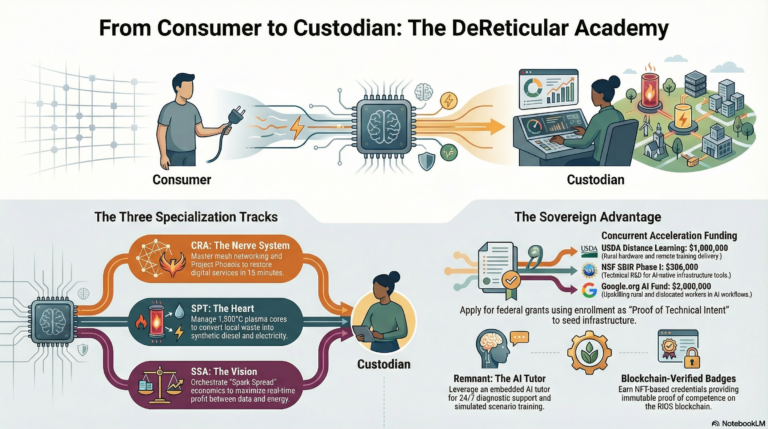
We are witnessing a fundamental shift from “Reticular” systems—derived from the Latin reticulum, meaning a small net—to “DeReticular” architectures. While a net provides connectivity, it also ensures that a single tear can compromise the whole. “DeReticular” describes the deliberate reduction of dependency on these vulnerable, externally managed grids.
The traditional “Power Law” of venture capital, which demands infinite growth at the expense of equity, is finally meeting its match in the “Sovereign Stack.” For the deep-tech founder, the choice is no longer between slow growth or total dilution. By de-risking with public capital, protecting with statutory rights, and scaling at a valuation that reflects technical maturity, founders can build a future that is truly autonomous.
In a world of increasing macro-grid instability, the question for infrastructure builders is simple: Will your technology rely on the net, or will it be the node?