Study Guide: Sovereign Infrastructure and Resilient Systems
This study guide provides a comprehensive overview of the technical, regulatory, and financial frameworks governing sovereign infrastructure, decentralized energy-compute co-location, and resilient tactical systems.
Part I: Short-Answer Quiz
- What is the “1,000-Mile Failure Model” (referred to as “The Line”) in modern infrastructure? 2. How does the AI Compute Arbitrage Model generate value for off-grid energy providers? 3. What specific regulatory advantage does West Virginia H.B. 2014 provide to microgrid operators? 4. Describe the primary function and design features of the ODU AMC® NP connector. 5. Why is 360° circumferential shield bonding critical for military UAV RF architecture? 6. What is the “Metacognitive Swarms of Intelligences” (MSI) framework? 7. Define “Spherical Resilience” as it pertains to sovereign infrastructure. 8. What is the role of Project Octagon within the DeReticular ecosystem? 9. How does IRA Section 6417 “Direct Pay” assist tax-exempt entities in infrastructure development? 10. What is the objective of the Guam Sovereign Eradication Initiative?
Part II: Answer Key
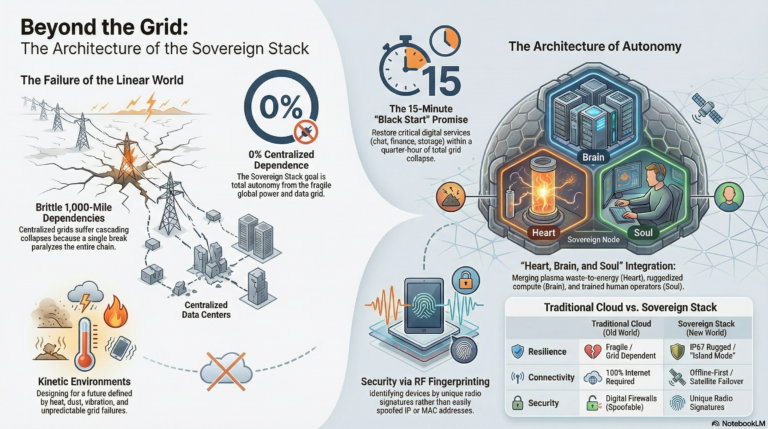
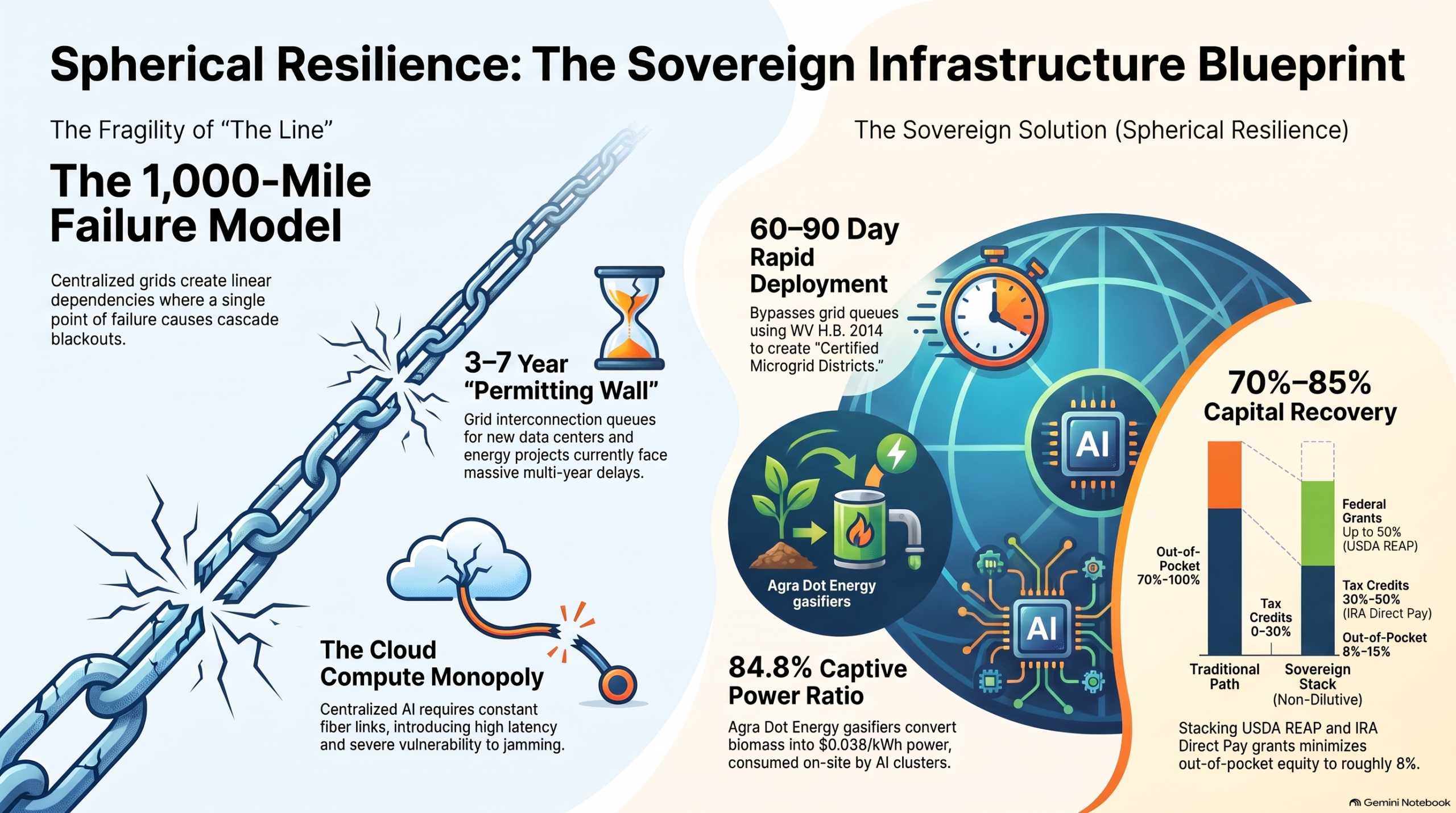
- What is the “1,000-Mile Failure Model” (referred to as “The Line”) in modern infrastructure? The “Line” represents fragile, linear dependencies where centralized power grids and cloud compute monopolies rely on long-distance transmission corridors and fiber links. This model is susceptible to physical disruptions, cascade blackouts, and single points of failure that can lead to a total system collapse.
- How does the AI Compute Arbitrage Model generate value for off-grid energy providers? Instead of selling power to utilities at low wholesale rates, this model routes electricity directly into co-located GPU clusters to monetize kilowatt-hours as computing power. By comparing a generation cost of $0.038/kWh to a realized compute value of $2.64/kWh, operators achieve a 16.6x arbitrage multiple.
- What specific regulatory advantage does West Virginia H.B. 2014 provide to microgrid operators? This legislation allows for the designation of “Certified Microgrid Districts,” which are exempt from Public Service Commission (PSC) rate regulation and utility franchise exclusivity. It enables behind-the-meter nodes to bypass transmission operator (RTO) interconnection queues that typically cause delays of three to seven years.
- Describe the primary function and design features of the ODU AMC® NP connector. The ODU AMC® NP is a quick-disconnect, break-away circular connector specifically designed for tactical soldier wearables and power distribution units. It features a pin-and-groove keying system, an anti-reflective black carbon finish, and is rated for over 2,000 mating cycles with IP68 protection.
- Why is 360° circumferential shield bonding critical for military UAV RF architecture? In dense UAV environments, 360° bonding prevents RF leakage across wide frequency bands by providing a complete metallic termination for cable shields. This suppresses electromagnetic interference (EMI) from high-power motor lines and prevents receiver desensitization, ensuring the integrity of command-and-control links.
- What is the “Metacognitive Swarms of Intelligences” (MSI) framework? MSI is a two-tiered architecture that combines Swarm Intelligence and edge metacognition to allow autonomous units to function without cloud reachback. It utilizes a meta-level supervisory layer to monitor sensor reliability and a deterministic object-level layer (Remnant AI) to execute tactical maneuvers in electronic warfare environments.
- Define “Spherical Resilience” as it pertains to sovereign infrastructure. Spherical Resilience is an omnidirectional, self-contained operating model that replaces linear dependencies with air-gapped, decentralized enclaves. An asset under this paradigm maintains operational continuity through on-site baseload generation, deterministic local compute, and mesh communications, regardless of external grid or supply chain failures.
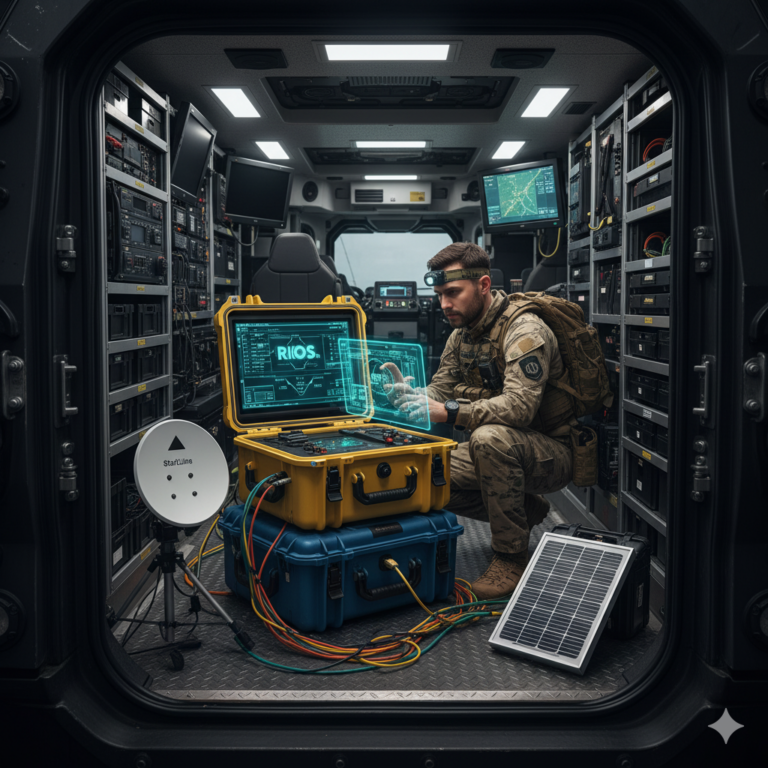
- What is the role of Project Octagon within the DeReticular ecosystem? Project Octagon consists of ruggedized, containerized expeditionary skids that integrate biomass/syngas micro-generation, battery storage, and liquid-cooled compute. These transportable units provide a “sovereign micro-utility” capable of supporting air-gapped AI nodes and point-of-need manufacturing in austere or desert environments.
- How does IRA Section 6417 “Direct Pay” assist tax-exempt entities in infrastructure development? This provision allows tax-exempt entities, such as municipalities and rural cooperatives, to receive clean energy investment tax credits as direct cash refunds from the IRS. By stacking base credits with bonuses for energy communities and domestic content, these entities can recover up to 50% of project capital costs in cash.
- What is the objective of the Guam Sovereign Eradication Initiative? The initiative aims to protect critical electrical infrastructure and biosecurity by using autonomous Pawnee robotic platforms to eradicate the invasive brown tree snake. These robots use deterministic Remnant AI and thermal tracking to neutralize snakes on utility lines, preventing localized short-circuits and blackouts that threaten defense installations.
Part III: Essay Questions
- The Comparative Architecture of Resilience: Contrast the “1,000-Mile Failure Model” with the “Spherical Resilience” paradigm. Analyze how decentralization at the power and compute layers mitigates the risks associated with centralized infrastructure.
- Economic Engineering of Sovereign Nodes: Discuss the “Non-Dilutive Capital Stack” as a strategy for infrastructure deployment. How does the integration of federal grants (USDA REAP), tax credit monetization (IRA), and compute arbitrage create a sustainable financial model without diluting enterprise equity?
- RF and Interconnect Challenges in Unmanned Systems: Evaluate the physical and electromagnetic failure modes that emerge when integrating dense RF payloads into modular UAV airframes. How do standardized interconnects and system-level EMI mitigation strategies address these vulnerabilities?
- Deterministic AI vs. Cloud-Tethered Models: Examine the limitations of probabilistic, cloud-based AI in contested military environments. Argue for the necessity of deterministic, air-gapped inference engines (like Remnant AI) in maintaining autonomy during electronic warfare.
- The Strategic Importance of Point-of-Need Manufacturing: Analyze the role of the “Sovereign Factory” and expeditionary robotics in forward-deployed logistics. How does on-site additive and subtractive manufacturing impact the resilience of a sovereign infrastructure node during kinetic supply chain disruptions?
Part IV: Glossary of Key Terms
Term Definition
700V DC Busbar A high-voltage direct current power distribution line used in sovereign microgrids to achieve 97.7% efficiency by eliminating AC-DC conversion losses.
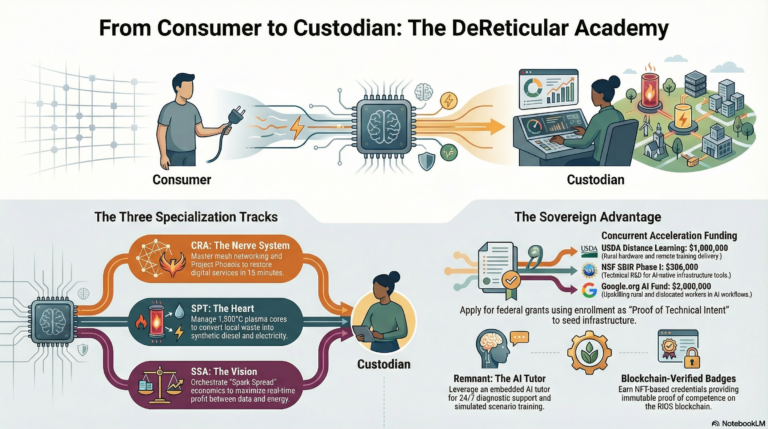
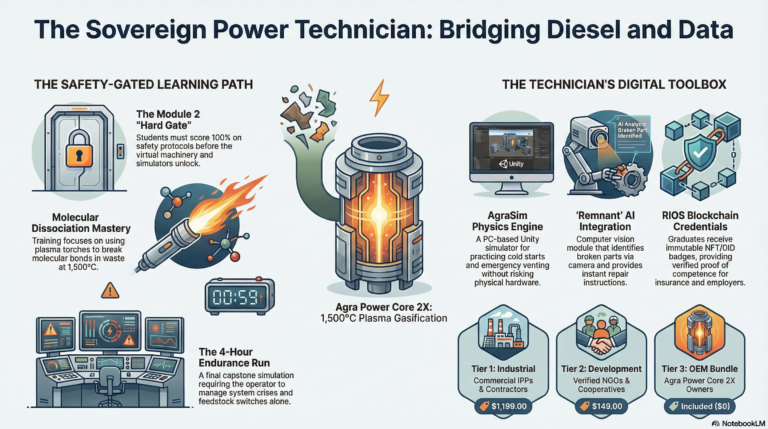
Agra Dot Energy An industrial energy engineering division focused on biomass gasification, parabolic solar thermal generation, and behind-the-meter power.
Air-Gapped A security measure that ensures a computer or network is physically and electronically isolated from all external networks, including the internet.
Biochar A high-grade carbon-rich byproduct of thermochemical biomass gasification valued as an agricultural soil amendment and carbon sink credit.
C-PACE Commercial Property Assessed Clean Energy; a financing mechanism for 100% upfront project costs repaid as a property tax assessment.
Deterministic AI Artificial intelligence that produces predictable, repeatable outcomes based on specific logic trees, avoiding the “hallucinations” common in probabilistic models.
EGaIn A liquid metal (Eutectic Gallium-Indium) used in epidermal and stretchable circuits to maintain conductivity under extreme strain.
EMI Electromagnetic Interference; the disruption of electronic device operation caused by electromagnetic radiation from external sources or internal components.
FEMA BRIC Building Resilient Infrastructure and Communities; a federal grant program providing 75%–90% cost-share for microgrids protecting critical lifelines.
Kove:SDM Software-Defined Memory; a technology that allows for disaggregated, ultra-low-latency RAM pooling across decentralized edge nodes.
LCOE Levelized Cost of Energy; the average net present cost of electricity generation for a generator over its lifetime (e.g., $0.038/kWh for syngas).
ODU AMC® Advanced Military Connector; a family of ruggedized, high-density connectors used in soldier wearables and vehicle systems.
Pawnee Rotary GenSet A compact, multi-fuel Wankel rotary engine generator designed for high-efficiency, continuous prime power in sovereign microgrids.
Remnant AI Engine A proprietary, 100% air-gapped cognitive core used for deterministic edge inference and metacognitive swarm control.
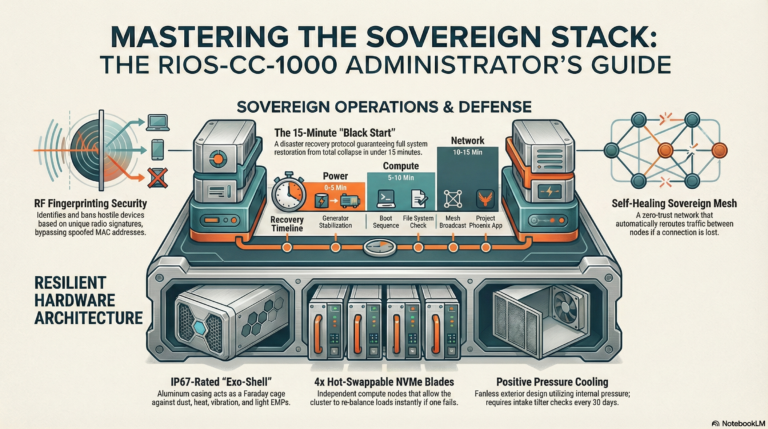
RIOS-CC-1000 A high-density, liquid-cooled GPU cluster designed to act as a captive baseload load-sink for sovereign energy-compute nodes.
Syngas Synthesis Gas (CO + H2); a fuel gas mixture created by the thermochemical gasification of organic feedstock used to power rotary generators.
USDA REAP Rural Energy for America Program; a federal grant providing up to 50% non-dilutive capital (max $1M) for rural renewable energy systems.
VSWR Voltage Standing Wave Ratio; a measure of impedance matching in RF systems, where a lower ratio (e.g., <1.2:1) indicates higher signal efficiency.
WISP-in-a-Box™ An off-grid, solar-powered commercial broadband transmission system used for decentralized telecommunications and mesh networking.
WV H.B. 2014 The West Virginia Power Generation and Consumption Act, which creates legal exemptions for Certified Microgrid Districts.