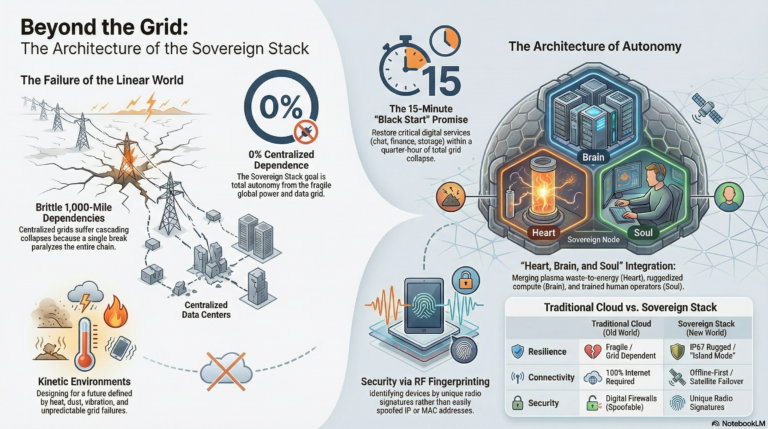
Study Guide: Sovereign Eradication of the Brown Tree Snake in Guam
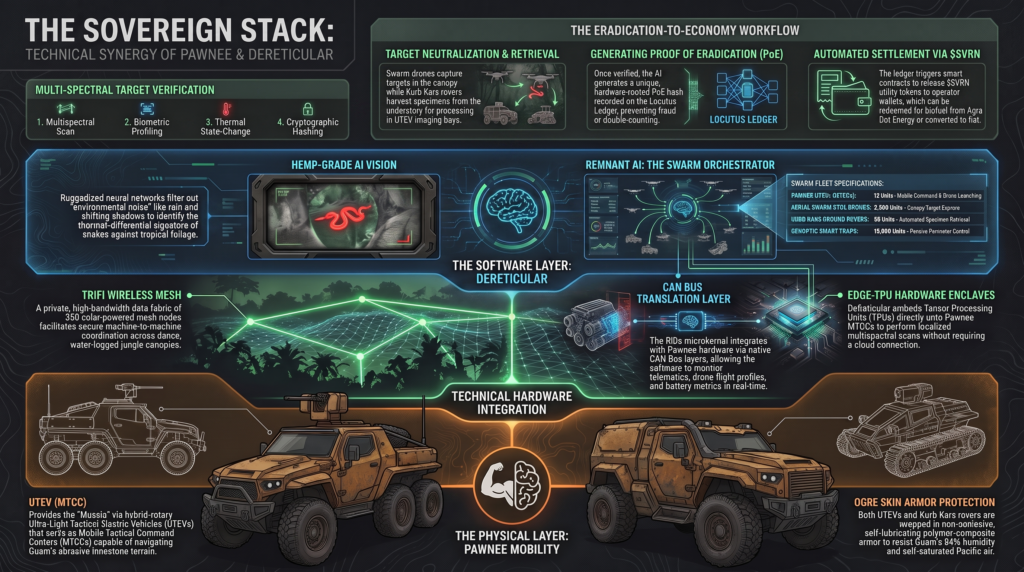
This study guide provides a comprehensive overview of the technical, economic, and ecological frameworks established by the DeReticular Pawnee Group for the Sovereign Eradication Project in Guam. It covers the biology of the invasive Boiga irregularis, the innovative “Sovereign Stack” of hardware and software, and the performance-driven “Pay-Per-Snake” financial model.
Part 1: Short-Answer Quiz
Instructions: Answer the following questions in 2-3 sentences based on the provided source context.
- Ecological Impact: How has the introduction of the brown tree snake (Boiga irregularis) specifically affected the native flora and fauna of Guam?
- The “Prey Abundance Trap”: Why did traditional passive baiting and trapping fail during the Cocos Island case study?
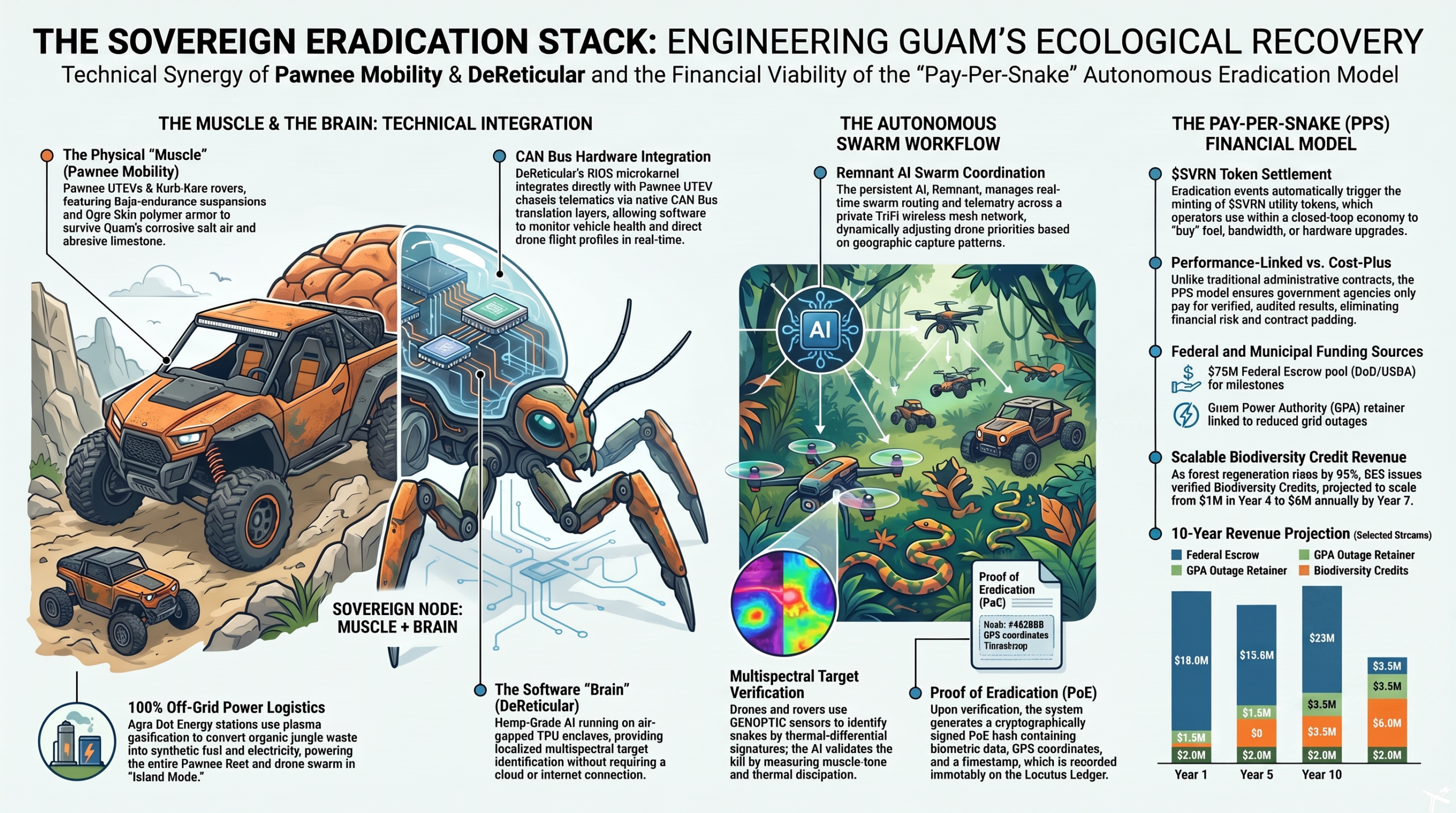
- Physical Mechanical Layer: What are the primary roles of the Pawnee Mobility UTEVs and the Kurb Kars rovers in the eradication effort?
- Hemp-Grade AI: How does the “Hemp-Grade” neural architecture differ from conventional cloud-based AI in terms of operational environment?
- Proof of Eradication (PoE): What are the four specific verification steps the AI performs to generate an un-spoofable Proof of Eradication?
- Energy Logistics: How does the Agra Dot Energy system enable the fleet to operate in “Island Mode” without external fuel supplies?
- Financial Model (PPS): How does the “Pay-Per-Snake” framework resolve the inefficiencies found in traditional “cost-plus” federal contracts?
- Infrastructure Protection: What is “lasso locomotion,” and how does it contribute to the socioeconomic costs of the snake infestation?
- Regulatory Compliance: How does the project maintain compliance with Federal Acquisition Regulations (FAR) while using a decentralized utility token ($SVRN)?
- Secondary Revenue Streams: Beyond federal funding, how does Sovereign Eradication Services (SES) plan to monetize the long-term ecological recovery of Guam?
Part 2: Answer Key
- Ecological Impact: The snake has driven 10 of Guam’s 12 native forest bird species to local extinction, causing a 92% decline in native tree seedling recruitment due to the loss of avian seed dispersers. Additionally, the lack of bird predators has caused forest spider web densities to surge up to 40 times higher than neighboring islands.
- The “Prey Abundance Trap”: On Cocos Island, an abundance of live prey (geckos and nesting birds) fully saturated the snakes’ predatory drive, causing them to ignore passive carrion baits and traps. This biological phenomenon requires a shift from passive methods to active suppression, such as nocturnal visual sweeps and automated detection networks.
- Physical Mechanical Layer: Pawnee UTEVs serve as Mobile Tactical Command Centers (MTCCs) that navigate rugged terrain and act as drone launch/recharge hubs. Kurb Kars are autonomous ground rovers fitted with impact armor that traverse the forest floor to retrieve specimens and process them through imaging bays.
- Hemp-Grade AI: Hemp-Grade AI is a ruggedized, edge-native architecture designed to operate on air-gapped hardware without internet or cloud connectivity. It is specifically optimized to filter out tropical environmental noise, such as high-frequency rain, wet foliage, and shifting canopy shadows.
- Proof of Eradication (PoE): The system performs a multi-spectral scan (thermal, infrared, visible), creates a biometric profile (length, weight, and scale patterns), verifies the thermal state-change to confirm neutralization, and finally generates a unique cryptographic hash recorded to the Locutus Ledger.
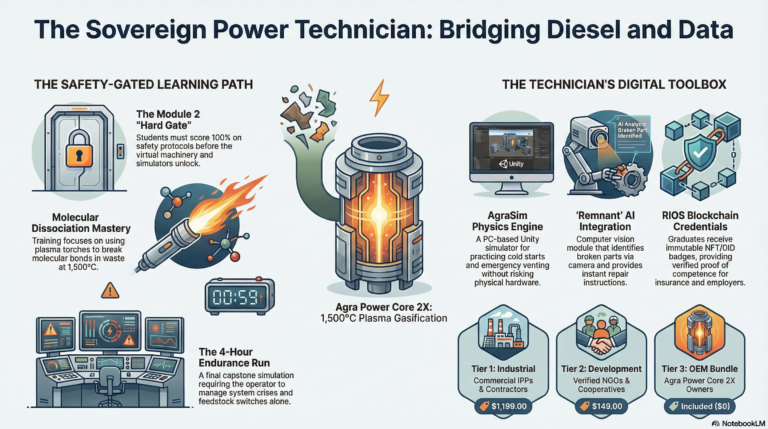
- Energy Logistics: Agra Dot Energy units utilize plasma gasification and Micro-Gas-to-Liquid (GTL) technology to convert localized biomass, tires, and organic waste into clean synthetic diesel and electricity. This modular infrastructure allows the fleet to maintain continuous power at forward nodes without relying on external supply lines.
- Financial Model (PPS): The PPS model replaces administrative overhead and flat-rate labor with an outcome-oriented marketplace where capital is held in escrow and disbursed only for verified kills. This aligns incentives toward maximum operational efficiency and eliminates the financial risk of open-ended, non-performing contracts.
- Infrastructure Protection: Lasso locomotion is a newly discovered movement where the snake loops its body around smooth vertical cylinders to climb structures like utility poles. This behavior leads to frequent short circuits at power substations, costing Guam’s economy approximately $4.5 million annually.
- Regulatory Compliance: The consortium uses a split-ledger gateway that positions the $SVRN token strictly as an internal utility tracking system. While the internal economy uses tokens for speed and low friction, InVentures periodically settles accumulated balances into standard fiat currency payouts from a federal escrow account to satisfy federal auditors.
- Secondary Revenue Streams: SES plans to issue verified “Guam Biodiversity Credits” and carbon sequestration offsets to global corporations as the native forest canopy recovers. Additionally, the project will monetize dense, off-grid spatial data and regional biosecurity insurance for neighboring islands like Hawaii.
Part 3: Essay Questions
Instructions: Use the provided source context to develop detailed responses for the following topics. (Answers not provided).
- Technological Integration and “Sovereign” Design: Discuss how the integration of the “Muscle” (Pawnee Mobility hardware) and the “Brain” (DeReticular software) creates a system capable of operating in extreme environments. Focus on the concept of “Island Mode” and why it is critical for biosecurity.
- Biosecurity as a Global Insurance Policy: Analyze the economic argument for the $100 million Guam eradication project as an insurance policy for the Pacific region. Compare the project’s costs against the projected damages if the brown tree snake were to colonize Hawaii or other Pacific hubs.
- The Evolution of Eradication Strategy: Trace the transition from “legacy” suppression methods (hand capture, acetaminophen mice) to the “High-Technology Eradication Vectors” described in the white paper. How do these new vectors address the specific biological “bottlenecks” of the snake?
- The Ethics and Risks of Genetic Intervention: Examine the proposal for CRISPR-Cas9 homing gene drives under the DARPA GUARDIAN program. What are the proposed biosecurity safeguards, such as “immunizing drives,” and what are the ethical considerations regarding the native range of the species?
- Operational Risk Management in Extreme Environments: Evaluate the primary physical and technical threats to the Guam Sovereign Eradication Project (e.g., typhoons, limestone abrasion, and data spoofing). How does the consortium’s “Strategic SWOT” analysis propose to mitigate these risks?
Part 4: Glossary of Key Terms
Term Definition
Agra Dot Energy A system of modular plants using plasma gasification to convert waste/biomass into synthetic fuel and power.
Boiga irregularis The scientific name for the brown tree snake, a nocturnal, arboreal, rear-fanged colubrid invasive to Guam.
DARPA GUARDIAN A defense research program focused on using genetic technologies like CRISPR-Cas9 for the control of invasive species.
DeReticular The software and systems architecture partner providing the RIOS operating system and Hemp-Grade AI.
FAR Compliance Adherence to the Federal Acquisition Regulations, the primary set of rules regarding government procurement in the U.S.
GENOPTIC Sensors Multispectral camera arrays (thermal, near-infrared, and visible) used for target detection beneath dense jungle canopies.
Hemp-Grade AI Ruggedized, edge-native neural networks designed for high-performance inference in air-gapped, harsh environments.
Lasso Locomotion A movement technique where a snake loops its body around a vertical cylinder to shimmy upward, enabling it to scale utility poles.
Locutus Ledger A decentralized, high-throughput WebAssembly ledger used to record Proofs of Eradication and settle $SVRN transactions.
Methemoglobinemia A toxicological condition induced by acetaminophen in snakes, where hemoglobin cannot transport oxygen, leading to rapid death.
Ogre Skin A self-lubricating, non-corrosive polymer-composite armor used to protect vehicle hulls and sensors from abrasive limestone.
Pawnee Mobility The hardware partner responsible for the UTEV hybrid-tactical command platforms and mechanical systems.
Proof of Eradication (PoE) A cryptographically signed digital certificate verifying a unique snake kill through biometric and thermal data.
RIOS The Rural Infrastructure Operating System; an air-gapped microkernel that manages the project’s software and hardware communication.
$SVRN A digital utility token used for internal cohort transactions (fuel, bandwidth, bounties) within the Sovereign Eradication project.
TriFi Wireless A private, high-bandwidth mesh network designed to provide data connectivity across dense, water-logged forest canopies.
UTEV Ultra-Light Tactical Electric Vehicle; the range-extended hybrid platforms used as mobile command hubs in the field.