Study Guide: DeReticular, RIOS, and the Sovereign Agentic Economy
This study guide provides a comprehensive review of the DeReticular ecosystem, the Sovereign Agentic Economy, and specialized infrastructure projects like Project Oasis and Kove:SDM. It is designed to assist researchers and practitioners in mastering the technical, strategic, and philosophical foundations of sovereign, decentralized infrastructure.
Part 1: Quiz
Instructions: Answer the following questions using 2-3 sentences based on the provided source context.
- What is Kove:SDM, and why is it considered incompatible with “Nomad” fleet hardware like the Raspberry Pi?
- Explain the structural difference between “Legacy Commerce” and “Agentic Commerce.”
- What is the “Trinity Stack” in the context of a RIOS deployment?
- How does Project Oasis utilize “Thermal Symbiosis” to improve energy and operational efficiency?
- Define the “Hardware Oracle” concept within the Split-Ledger Architecture.
- What is the “Karamoja Diamond,” and how does it address environmental challenges in the Karamoja region?
- Identify the four layers of the “Trust Stack” required for autonomous software agents to exchange value safely.
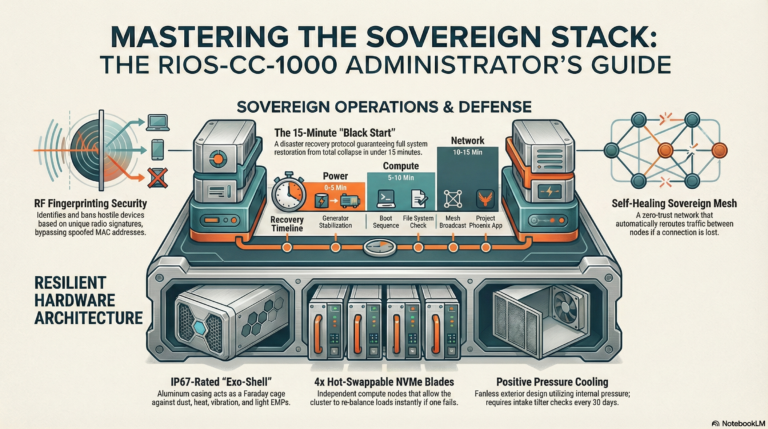
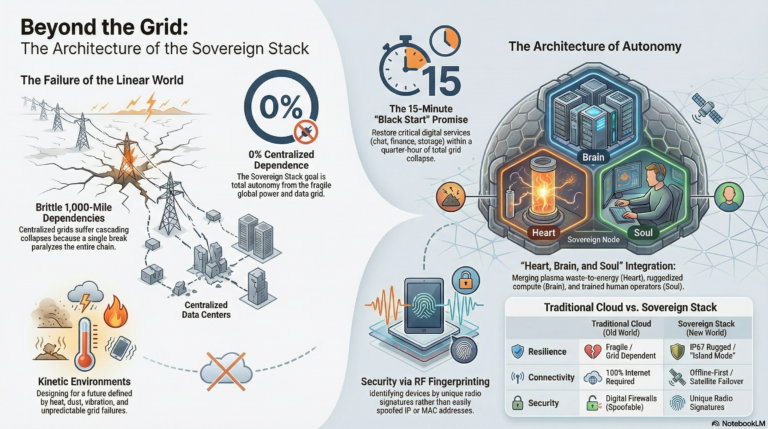
- What is “Island Mode,” and how does it support the philosophy of “Spherical Resilience”?
- Describe “Radio Frequency Fingerprinting” (RFF) and its role in machine security.
- Contrast DeReticular’s “SaaS Engine” and “Perpetual Engine” business models.
Part 2: Answer Key
- Kove:SDM is a software layer that virtualizes RAM, allowing a cluster of servers to pool their memory into a single liquid pool. It is incompatible with “Nomad” hardware like the Raspberry Pi because these devices lack RDMA-capable Network Interface Cards (NICs) required for the Kove data plane, and software emulation would introduce prohibitive latency.
- Legacy Commerce is human-centric, involving users navigating web browsers and checkout UIs to complete transactions. Agentic Commerce is machine-centric, where autonomous AI agents act as proxies to navigate discovery, negotiation, and settlement via API-to-API protocols and stablecoins without real-time human intervention.
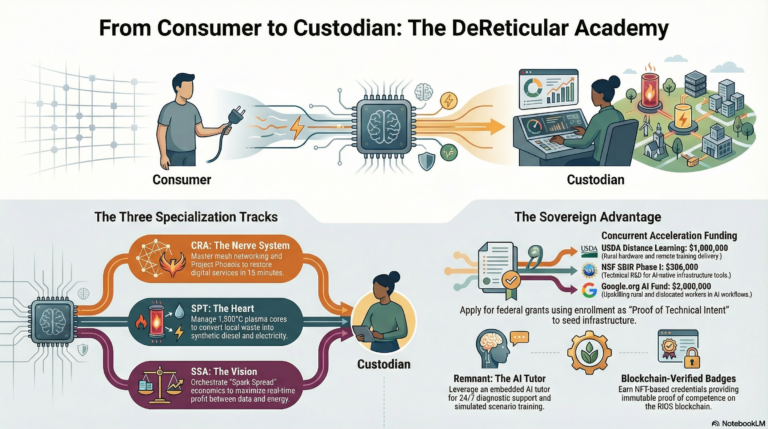
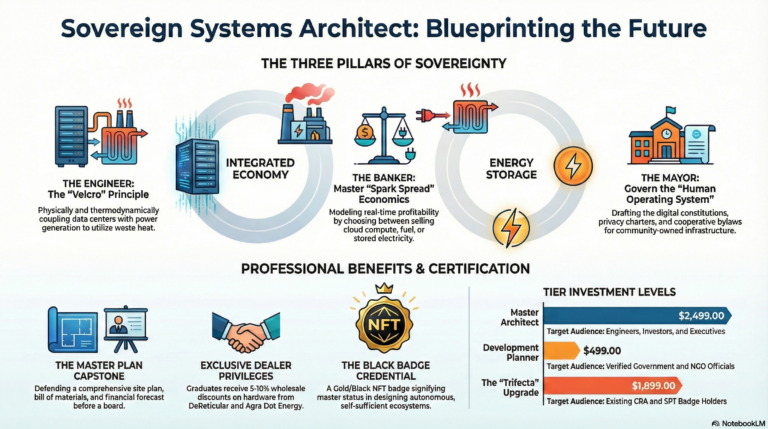
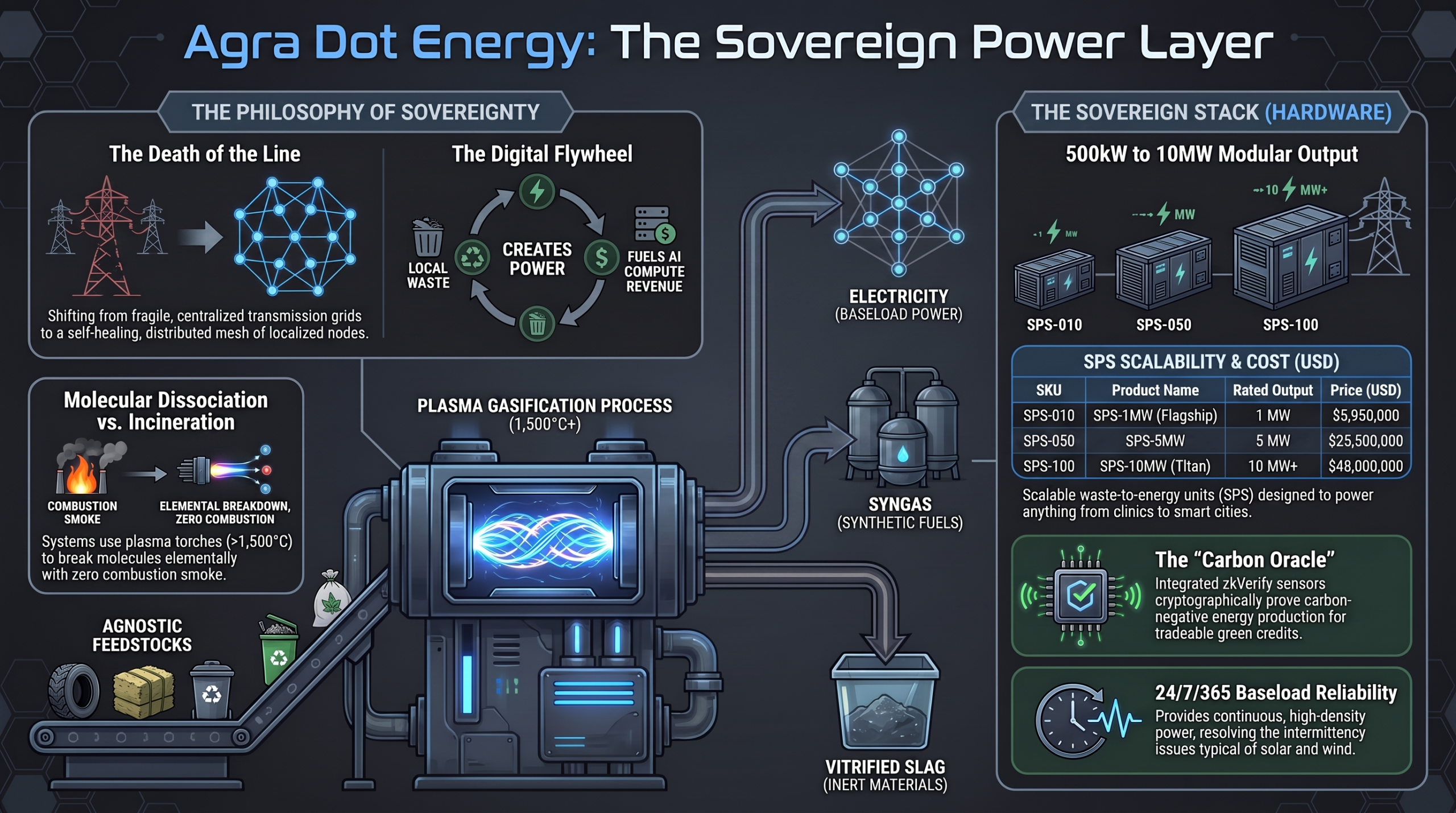
- The Trinity Stack is the three-layer model of a RIOS deployment consisting of “The Heart” (Agra Energy/power), “The Brain” (RIOS OS/intelligence), and “The Soul” (DeReticular Academy/human capital). This framework ensures that local infrastructure has the energy, logic, and trained personnel required for autonomy.
- Thermal Symbiosis is a closed-loop system where waste heat from one facility serves as input for another. For example, Project Oasis pipes waste heat from the Tier 3 Data Center to marble curing rooms and uses heat from refrigeration units to pre-heat water for green hydrogen electrolyzers.
- The Hardware Oracle concept eliminates human bias by using a physical TPM 2.0 chip with a non-exportable private key burned in at the factory. This allows the hardware itself to sign physical measurements (like crop grading), mathematically proving that the data was directly witnessed and processed by a specific machine at a specific location.
- The Karamoja Diamond is a zonal spatial configuration designed to mitigate southeasterly prevailing winds and abrasive stone dust. It places sensitive infrastructure like the Tier 3 Data Center upwind and dust-producing activities like marble processing downwind to protect server cooling systems and solar fields.
- The Trust Stack consists of four layers: 1) Hardware & Execution Foundation (TEEs/TPMs), 2) Identity & Trust (Know Your Agent/KYA), 3) Payment Credentials & Security (SPTs/MPC wallets), and 4) Governance & Guardrails (delegated consent and kill switches).
- Island Mode is an operational state where a node functions with total utility and data sovereignty, independent of centralized grid connections or external internet. This supports Spherical Resilience, a model of decentralized, self-sustaining nodes capable of surviving the failure of centralized, linear grids.
- Radio Frequency Fingerprinting (RFF) is a security mechanism that scans and registers the unique electromagnetic “hum” produced by microscopic physical imperfections in a device’s circuitry. This creates an un-spoofable digital passport, ensuring that machine identities cannot be cloned or replicated.
- The SaaS Engine (RIOS Mobile Pro) is a high-margin, recurring annual subscription (1,200/year) providing resilient connectivity and AI orchestration for mobile units. The Perpetual Engine (Sovereign Cloud Suite) is a high-ticket, one-time perpetual license (200,000) that allows local entities to own and operate their own regional cloud data centers.
Part 3: Essay Questions
Instructions: Use the provided context to develop comprehensive responses to the following prompts. (Answers not provided).
- The Crisis of Capital Flight: Analyze how the DeReticular ecosystem addresses the economic “Crisis of Trust” and the problem of “Capital Flight” in rural communities. Discuss the role of the “Digital Bank” narrative in shifting IT spending from global hyperscalers to local economies.
- The Ethics and Logistics of KYA: Evaluate the “Know Your Agent” (KYA) framework. How does the cryptographically secure Chain of Trust—from the human principal to the digital agent passport—replace legacy KYC, and what are the implications for attributed liability in autonomous transactions?
- Industrial Symbiosis in Project Oasis: Examine the engineering and economic benefits of industrial symbiosis within the Karamoja Eco-Industrial Park. Detail how the “Eco” designation is achieved through water recycling, thermal loops, and agrivoltaics.
- Split-Ledger Architecture: Discuss the strategic necessity of the Split-Ledger Architecture. Why must PII be kept on a private ledger (“The Bank”) while physical attestations are placed on a public ledger (“The Library”), and how does this dualism ensure both regulatory compliance and market trust?
- Standardization of the Machine Web: Compare the various protocols emerging in the agentic economy (ACP, UCP, MCP, x402, A2A). How do these standards collaborate to form a cohesive “Machine Web,” and what role do major players like Stripe and PayPal play in establishing these financial rails?
Part 4: Glossary of Key Terms
Term Definition
A-Commerce Agentic Commerce; a model where autonomous AI software agents perform economic transactions on behalf of humans.
ACP Agentic Commerce Protocol; a transaction layer for searches and checkouts natively inside AI models.
Agrivoltaics “Solar-Plus-Grazing”; the simultaneous use of land for solar energy generation and agriculture/livestock grazing.
BESS Battery Energy Storage System; used in microgrids like Project Oasis to regulate load shifts and handle power spikes.
BTM Behind-the-Meter; a power generation configuration that co-locates generation with consumers, bypassing the national grid.
CBAM Carbon Border Adjustment Mechanism; an EU tax on the “embedded carbon” footprint of industrial imports.
Freenet (Locutus) A public, zero-gas decentralized peer-to-peer network used as “The Library” in split-ledger architectures.
GEO Generative Engine Optimization; the practice of structuring data so it can be parsed by AI “answer engines” and search agents.
Green Marble A certification for marble processed with 100% renewable energy and circular water systems, exempting it from carbon taxes.
Island Mode An operational state where a system remains fully functional without external internet or centralized power.
Kove:SDM Software-Defined Memory; technology that decouples memory from the CPU to create a dynamic, pooled memory resource.
KYA Know Your Agent; an identity standard cryptographically linking an autonomous agent to a verified human principal.
Locutus Ledger A decentralized record-keeping system logging agent actions to create an “Immutable Resume” for machines.
MCP Model Context Protocol; an open standard (“USB-C for AI”) allowing agents to connect securely to external data sources.
MPC Wallet Multi-Party Computation wallet; a security method where private keys are split into shards to eliminate single points of failure.
OpenClaw An execution framework for air-gapped, localized AI agents to manage physical infrastructure and machinery.
RDMA Remote Direct Memory Access; a high-speed data plane required for low-latency memory pooling in Kove:SDM.
RIOS Rural Infrastructure Operating System; an AI-native OS designed to manage energy, data, and logistics at the edge.
Sovereign Key A physical FIDO2 token (e.g., YubiKey 5C) acting as a hardware root of trust for human authorization of machine actions.
SPT Shared Payment Token; a scoped, temporary payment credential that limits agent spending to specific merchants or timeframes.
TPM Trusted Platform Module; a specialized hardware chip used to secure cryptographic keys and sign data at the source.
UAID Universal Agent ID; an interoperable registry identity used to index and locate physical and digital agents.
x402 Protocol An on-chain micropayment protocol optimized for sub-cent machine-to-machine data exchanges.