Study Guide: The Asymptotic Democracy and Veridical Governance
This study guide provides a comprehensive review of the “Asymptotic Democracy” and the “Resilient Epistemic & Thermodynamic Ledger Architecture” (RELA). It covers the synthesis of perspectival realism, thermodynamic constraints on information, and the transformation of democratic governance into an engine for error elimination.
Part 1: Short-Answer Quiz
Instructions: Answer the following questions in 2–3 sentences based on the provided source context.
- What is the core thesis of “The Asymptotic Democracy” regarding the function of voting?
- Explain the distinction between “Class A” and “Class B” propositions in a veridical constitution.
- How does Landauer’s Principle apply to the maintenance of institutional belief registers?
- What is “Perspectival Realism,” and how does it resolve the “Access Problem” of truth?
- Define the “Condorcet Inversion” and identify its primary drivers in modern mass democracies.
- What is the purpose of the “Biophysical Veto” in the RELA framework?
- Explain the “Oracle Separation Protocol” and the distinction between “Integrity” and “Truth.”
- How does “Futarchy” leverage market mechanisms to improve policy outcomes?
- What is “Measure-Theoretic Parameter Foreclosure” (Via Negativa), and how does it differ from conventional voting?
- Describe the “Inscription Functor” and the subsequent risk of “Institutional Reification.”
Part 2: Answer Key
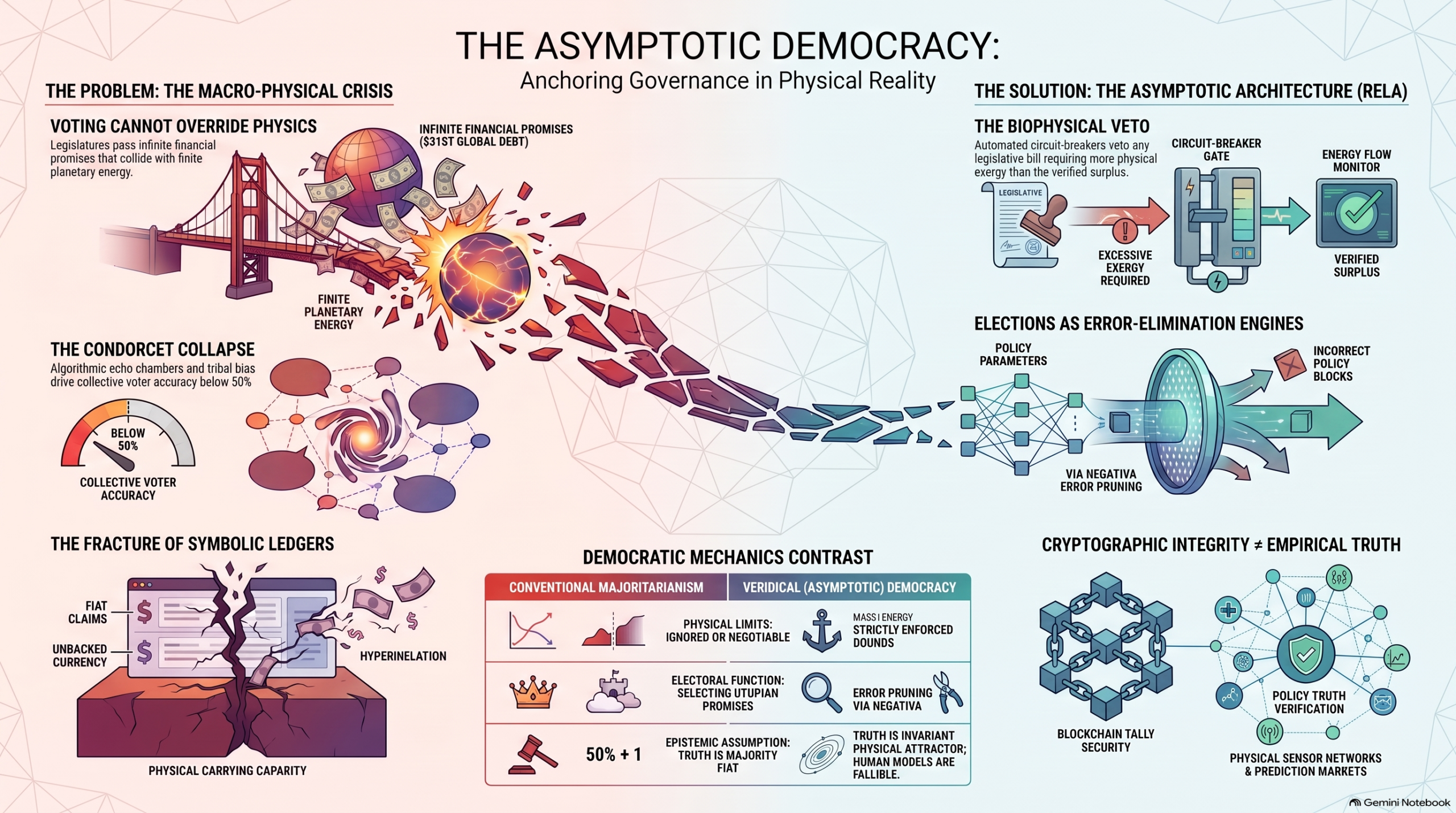
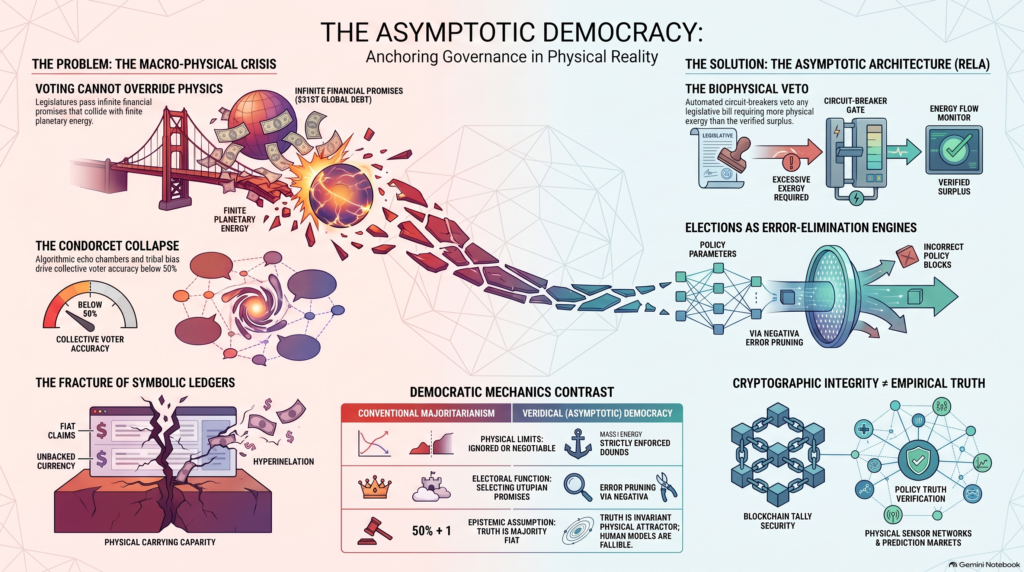
- What is the core thesis of “The Asymptotic Democracy” regarding the function of voting? The core thesis redefines democracy as an intersubjective engine of “Via Negativa” parameter foreclosure rather than a tool for aggregating unconstrained preferences. It aims to systematically prune falsified policy manifolds while remaining strictly bound to physical thermodynamic limits.
- Explain the distinction between “Class A” and “Class B” propositions in a veridical constitution. Class A propositions represent the “Normative Value Space,” involving subjective ethical priorities and social weights that are the legitimate domain of democratic voting. Class B propositions represent the “Ontic Feasibility Manifold,” which includes physical conservation laws and thermodynamic exergy limits that are strictly forbidden from being altered by legislative fiat.
- How does Landauer’s Principle apply to the maintenance of institutional belief registers? Landauer’s Principle states that erasing or resetting information requires a minimum thermodynamic energy dissipation (\Delta Q \ge N k_B T \ln 2). Consequently, keeping an institutional ledger aligned with reality requires continuous physical work and exergy consumption to prevent the system from succumbing to entropic decay and record rot.
- What is “Perspectival Realism,” and how does it resolve the “Access Problem” of truth? Perspectival Realism posits that while observers only have access to low-dimensional projections (\hat{\Pi}_\theta) of the high-dimensional ontic reality (\mathcal{M}), these projections track genuine physical differences. It resolves the access problem by suggesting that absolute truth (\Omega^*) is the invariant attractor recovered through the intersection of all valid perspectival projections over time.
- Define the “Condorcet Inversion” and identify its primary drivers in modern mass democracies. The Condorcet Inversion is a mathematical phenomenon where an electorate converges on error with certainty (\lim_{N \to \infty} P_N = 0) because individual competence drops below chance (p < 0.5). This is driven by correlated signals from social media feeds, tribal incentives that penalize truth-telling, and manufactured consent that destroys voter independence.
- What is the purpose of the “Biophysical Veto” in the RELA framework? The Biophysical Veto acts as an automated constitutional circuit-breaker that audits the lifecycle exergy and material requirements of any proposed legislation. If a bill’s physical throughput requirements violate the verified Biophysical Balance Register (BBR), it is automatically blocked from the ballot regardless of political popularity.
- Explain the “Oracle Separation Protocol” and the distinction between “Integrity” and “Truth.” The protocol distinguishes between cryptographic “Integrity” (Level 2), which guarantees that data has not been altered on the ledger, and ontic “Truth” (Level 0), which represents correspondence with the physical cosmos. Cryptographic ledgers ensure that records are immutably preserved, but their factual validity must be separately verified by external physical sensor networks.
- How does “Futarchy” leverage market mechanisms to improve policy outcomes? Futarchy follows the principle “Vote on Values, Bet on Beliefs” by having citizens use Quadratic Voting to define a National Welfare Metric. Speculative prediction markets then trade on which policies will most effectively optimize that metric, ensuring that those with “skin in the game” aggregate information while ideologues face financial penalties for promoting falsified models.
- What is “Measure-Theoretic Parameter Foreclosure” (Via Negativa), and how does it differ from conventional voting? Unlike conventional voting, which attempts to endorse positive utopian visions, parameter foreclosure uses elections to permanently and irreversibly prune policy models that have failed empirical tests. It treats the governance space as a measure space where falsified parameter subsets are truncated, ensuring the permissible policy region monotonically contracts toward the ontic attractor.
- Describe the “Inscription Functor” and the subsequent risk of “Institutional Reification.” The Inscription Functor maps a framed observation onto a material ledger by stripping away the observer’s perspectival metadata to make the record portable. Institutional Reification occurs when downstream users mistake this low-dimensional, frame-erased token for the absolute ontic reality itself, leading to dogmatism and societal friction when projections collide.
Part 3: Essay Questions
Instructions: These questions are designed for in-depth analysis. Use the themes of the source context to construct your arguments.
- The Information-Theoretic Kuhn Cycle: Analyze the transition of modern macroeconomics through the Kuhn Cycle. How do “institutional epicycles” and “model-drift” lead to a Phase 3 Model Crisis, and what role does the RELA architecture play in facilitating a Phase 5 Paradigm Shift?
- Thermodynamics and Economic Reality: Discuss the implications of RELA Axiom 3 (the Biophysical-Monetary Equivalence Constraint). How does this constraint challenge the “Disembodied Production Function” of Neoclassical economics, and what are the consequences of ignoring it?
- The Evolution of Ledger Technology: Trace the development of “cased” records from Mesopotamian clay tablets to modern E2E-V cryptographic voting. How does the concept of an “outer envelope” protect the “inner core” of truth across these disparate technologies?
- Epistemic Social Pathologies: Evaluate the threats of “Information Cascades,” “Pluralistic Ignorance,” and “Manufactured Consent” within a democratic system. How do Mertonian CUDOS norms and decentralized communication protocols aim to mitigate these pathologies?
- The Tension of Veridical Governance: Discuss the potential conflict between “Democratic Legitimacy” (Level 3) and “Ontic Physical Resistance” (Level 0). How can a society prevent a “Technocratic Epistemic Coup” while ensuring that legislative mandates do not violate biophysical laws?
Part 4: Glossary of Key Terms
Term Definition
Aumann’s Agreement Theorem A formal proof stating that rational agents with common priors and common knowledge of each other’s posteriors cannot “agree to disagree.”
BBR (Biophysical Balance Register) A real-time telemetry system tracking exergy balances, critical minerals, and authorized fiscal issuance ceilings to enforce physical reality.
BFT (Byzantine Fault Tolerance) A property of a distributed system that allows it to reach consensus even if a fraction of the nodes (f < N/3) are malicious or fail.
Cased Tablet An ancient Babylonian accounting protocol involving an inner tablet (core contract) and an outer clay envelope (tamper-evident protection).
CUDOS Norms Mertonian scientific norms: Communalism, Universalism, Disinterestedness, and Organized Skepticism.
DSGE (Dynamic Stochastic General Equilibrium) Modern macroeconomic models criticized in the text for omitting financial frictions and biophysical thermodynamics.
ELN (Epistemic Ledger Node) A machine-readable data object capturing voter selections, zero-knowledge proofs, and perspective frame tags.
EROEI Energy Return on Energy Invested; the ratio of energy delivered to energy required for its acquisition.
Exergy The portion of energy that is available to perform useful work within a system.
Futarchy A governance model proposed by Robin Hanson where society votes on target values but uses prediction markets to select the policies to achieve them.
Homomorphic Encryption A form of cryptography that allows mathematical operations (like tallying votes) to be performed on ciphertexts without decrypting them.
Invariant Attractor (\Omega^*) The mind-independent, high-dimensional ground truth toward which inquiry asymptotically converges.
Kuhn Cycle A five-phase cycle describing the evolution of scientific paradigms: Normal Science, Model Drift, Model Crisis, Model Revolution, and Paradigm Shift.
MDL (Minimum Description Length) A principle in algorithmic information theory used to prevent “overfitting” by penalizing excessive model complexity.
Ontic Manifold (\mathcal{M}) The high-dimensional state-space representing the totality of objective physical reality.
Projection Operator (\hat{\Pi}_\theta) A dimension-reducing function that maps high-dimensional reality onto a low-dimensional observer frame.
Quadratic Voting (QV) A voting mechanism where the cost of casting multiple votes for a single issue increases quadratically, allowing for the expression of the intensity of preference.
RELA Resilient Epistemic & Thermodynamic Ledger Architecture; the technical framework for anchoring symbolic claims in physical reality.
Shannon’s Noisy-Channel Theorem A law establishing that error-free communication across a noisy channel is only possible at rates below channel capacity and requires infinite code length.
Via Negativa An approach to knowledge or governance based on the elimination of error and the pruning of falsified parameters rather than the assertion of positive dogmas.
zk-SNARK A “Zero-Knowledge Succinct Non-Interactive Argument of Knowledge”; a proof that allows one party to prove a statement is true without revealing any private information.