Technical Integration Protocol: A2A Interoperability for the Sovereign Machine Bazaar
- Protocol Foundations and the 5-Layer Sovereign Stack
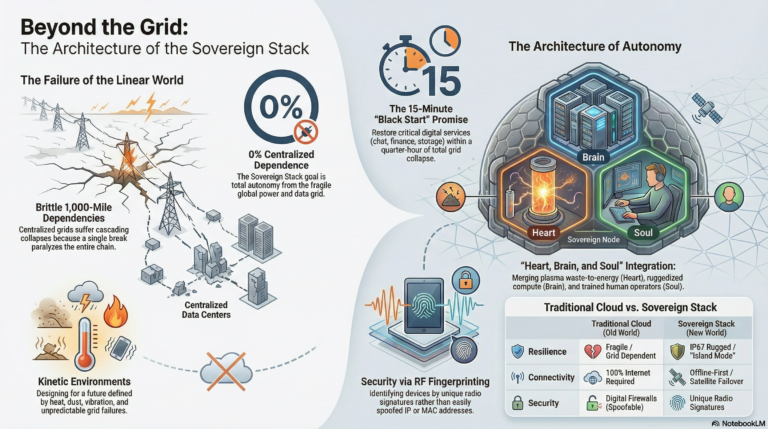
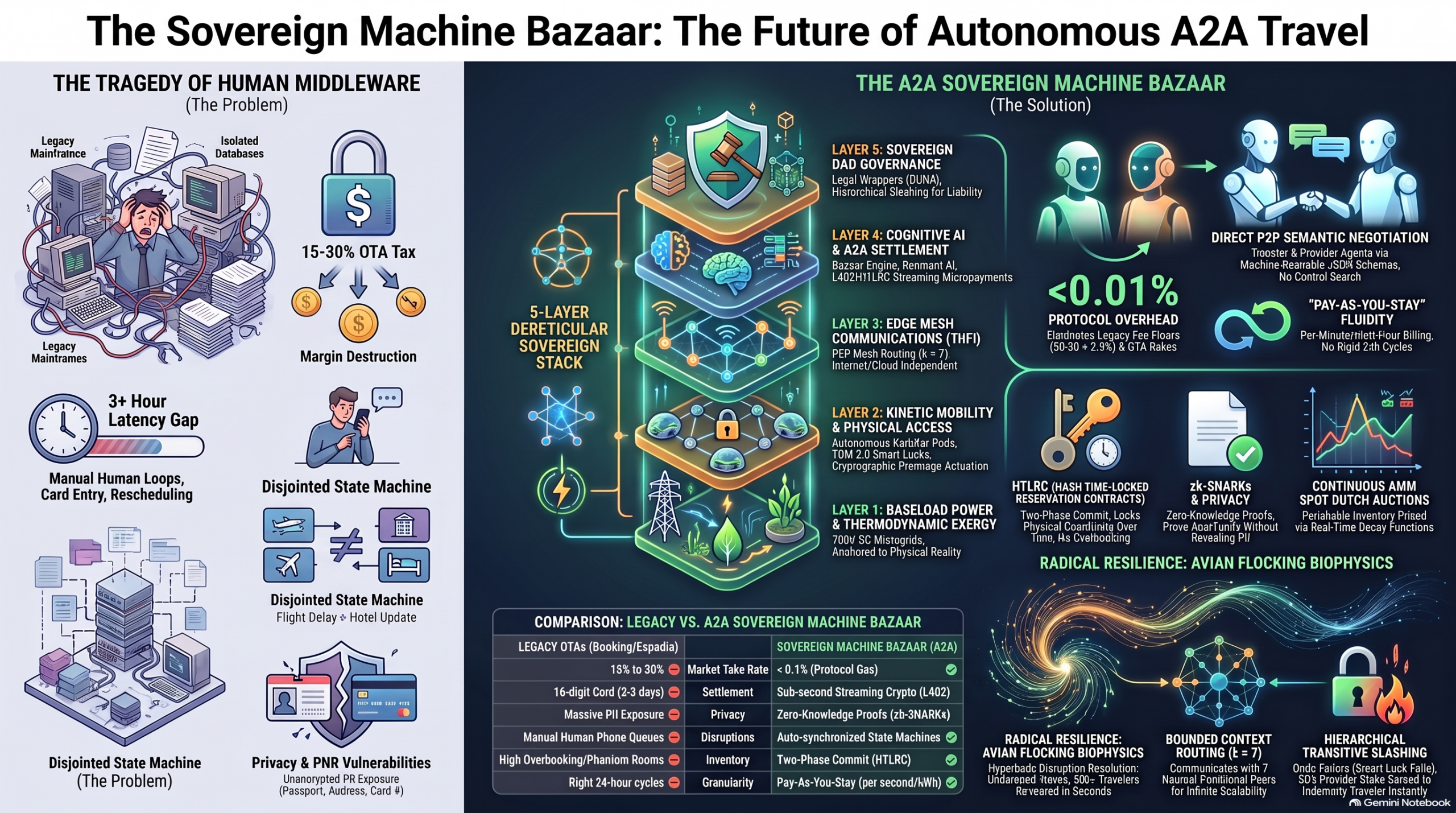
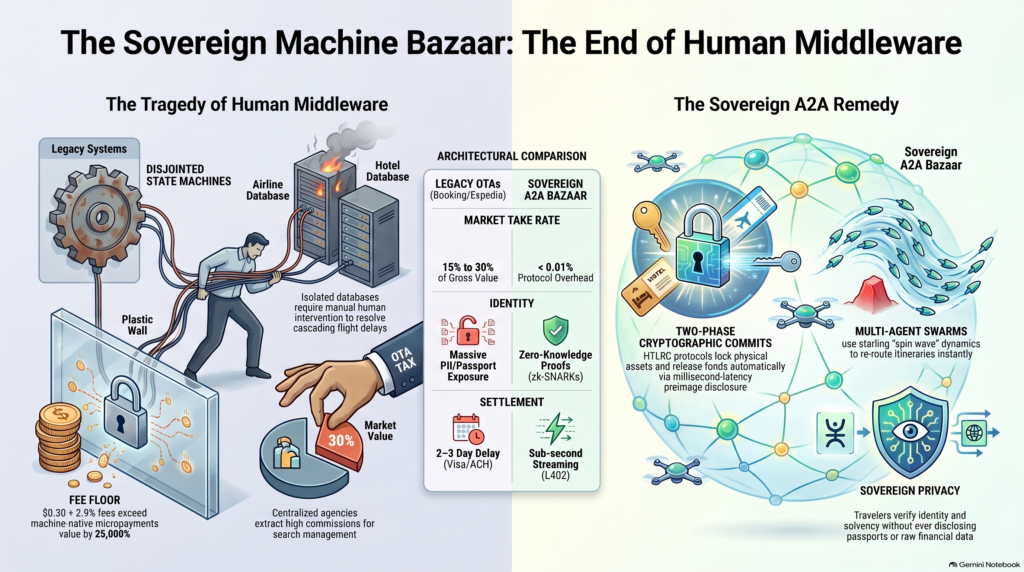
[POLICY_SPECIFICATION] The global travel industry is undergoing a structural phase shift, migrating from legacy, human-centric distribution—the Global Distribution System (GDS) and Online Travel Agency (OTA) oligopolies—to the Sovereign Machine Bazaar. Legacy rails extract a 15–30% “OTA Tax” and impose a $0.30 + 2.9% fee floor that renders machine-to-machine (M2M) micro-commerce mathematically unviable. The Bazaar protocol replaces this extractive middleware with a headless, machine-native architecture designed for “Sustained Island Mode.” This ensures that physical hospitality and mobility nodes maintain execution and settlement fidelity even during total wide-area network or grid disconnection, effectively resolving the “Silicon-Plastic Chasm” by eliminating the 3-to-48-hour biological human latency loop.
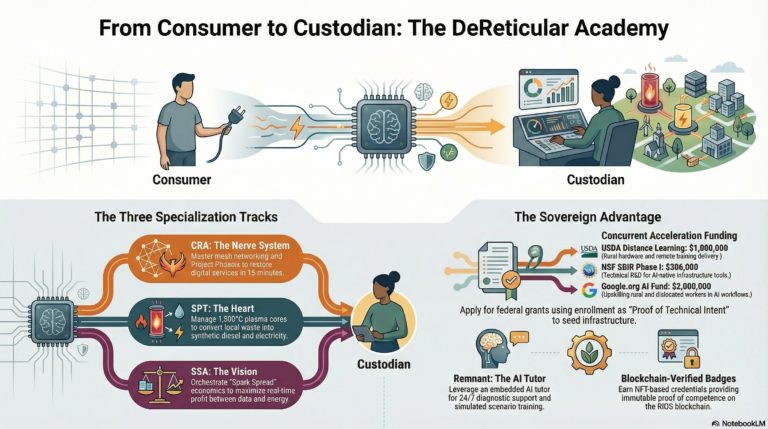
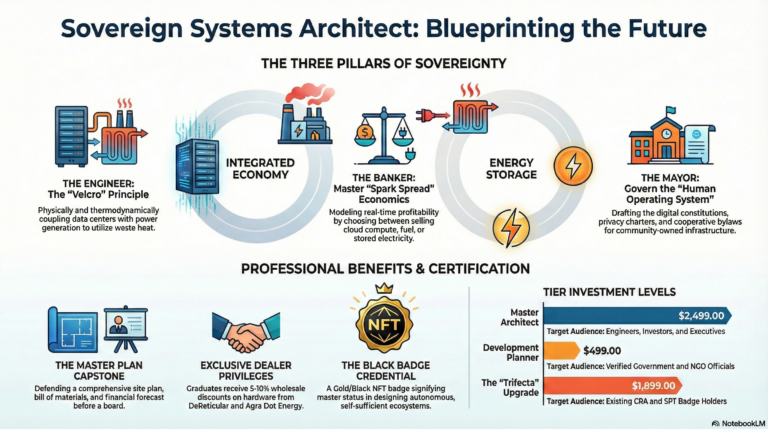
Vertical integration is achieved through the DeReticular 5-Layer Sovereign Stack, where system logic is grounded in physical thermodynamic exergy:
Layer Functional Domain Technical Specification Prime System Authority
Layer 5 Sovereign DAO Governance Wyoming DUNA / Marshall Islands DAO LLC Wrappers Legal-Code Skin & Liability Escrow
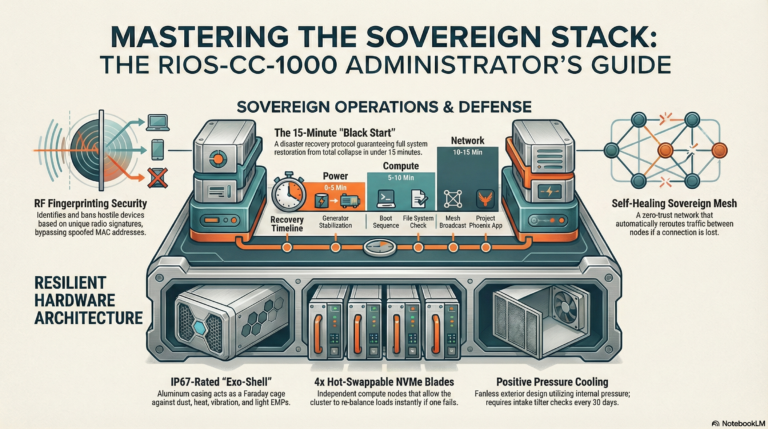
Layer 4 Cognitive AI & A2A Settlement RIOS-CC-1000 GPU Racks; Active Inference (F) Bazaar Engine (Execution Logic)
Layer 3 Edge Mesh Communications TriFi Directional MIMO; Topological Mesh (k \approx 7) Peer-to-Peer Connectivity
Layer 2 Kinetic Mobility & Access KurbKars; TPM 2.0-Attested Cryptographic Smart Locks Physical Actuation & Access Control
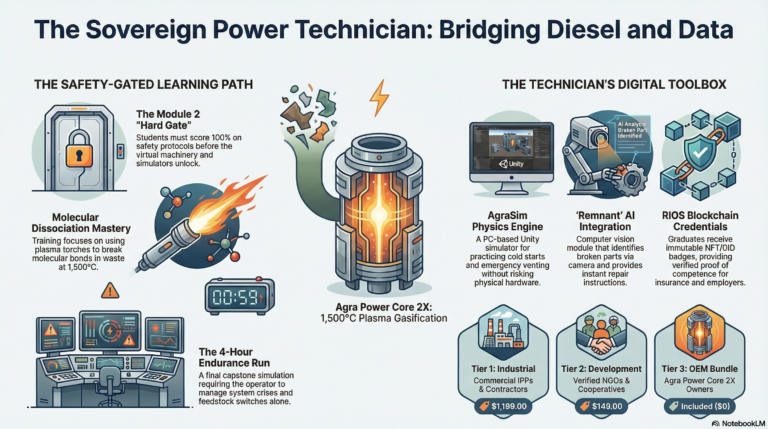
Layer 1 Baseload Power & Exergy Agra.Energy Thermochemical Gasification; 700V DC Level 0 Sensors (Ontic Truth)
The “So What?” Layer
By vertically integrating from thermochemical exergy (Layer 1) to algorithmic delegates (Layer 5), the protocol removes all dependency on centralized cloud hyperscalers and legacy financial rails. Layer 4 cognitive agents utilize Active Inference to minimize variational free energy (F), ensuring that execution logic is driven by informational convergence rather than generative hallucination. This architecture fundamentally secures the “Baseload of Reality” against external service outages.
Connection: This physical and logical grounding provides the necessary environment for cryptographic identity, which is anchored in the silicon roots of the hardware itself.
- Hardware-Attested Identity and Physical Access Security
Traditional software-only identity mechanisms (SSO/JWT) are deprecated. They suffer from “Confused Deputy” vulnerabilities and memory-exfiltration risks. In the Sovereign Machine Bazaar, identity is anchored in physical silicon via Hardware TPM 2.0 (Trusted Execution Environment), ensuring that an agent’s reasoning chain is bound to a specific piece of hardware.
[LEVEL 2 AUTHORITY] Cryptographic Primitives
The protocol utilizes a modernization of the Ancient Mesopotamian “Cased Tablet” protocol, where the “Core” (homomorphic commitment) is separated from the “Envelope” (zk-proof).
- Soulbound Tokens (SBTs): Non-transferable identity markers bound to the physical hardware.
- Poseidon Cryptographic Nullifiers: Prevents Sybil Swarm attacks. One physical chip generates exactly one identity vote per epoch: \text{Nullifier} = \operatorname{Poseidon}(\text{TPM_secret}, \text{Epoch}).
Zero-Knowledge (zk-SNARK) Credential Proofs
Agents must provide Groth16 or PLONK range proofs to verify eligibility without disclosing PII or raw balances. Mandatory proofs include:
- Passport Validity: Proves a valid government biometric attestation exists.
- Solvency Range Proof: Proves the agent’s balance B \ge \text{Required Escrow} without revealing the numerical value of B.
- Age Attestation: Verifies Age \ge 21 for relevant hospitality services.
The “So What?” Layer: The Oracle Separation Protocol
The protocol distinguishes between Integrity (Level 2: BFT Ledgers) and Truth (Level 0: Physical Sensors). Level 2 authority is strictly forbidden from declaring ontic facts; it only verifies that a record hasn’t been tampered with. Only Level 0 sensors (micro-calorimeters, voltage shunts) can verify Ontic Truth—the physical delivery of heat, power, or passage.
Connection: Once identity and physical access are secured by hardware, the protocol defines the logic of the reservation itself.
- Transactional Mechanics: HTLRC and Two-Phase Commits
To eliminate the “Reservation Race Condition” and phantom inventory common in legacy asynchronous databases, the Bazaar employs synchronous, cryptographic Two-Phase Commit contracts.
[POLICY_SPECIFICATION] The HTLRC Execution Sequence
- Capacity Inscription: The provider signs an availability vector using its TPM 2.0 key, preventing double-commitment of physical hardware.
- Conditional Lock (Phase 1): The consumer agent locks the service fee plus a 20% reciprocal no-show bond into an escrow contract using a Poseidon hash lock H = \operatorname{Poseidon}(S).
- Access Token Emission (Phase 2): The provider emits an ephemeral, time-gated digital key (NFC/BLE) encrypted to the traveler’s public key.
- Atomic Execution: Upon arrival, the traveler discloses preimage S. This simultaneously: (a) unlocks the smart lock, (b) releases escrow to the provider, and (c) triggers the 43.25% Instant Snap-Back Reversion of unslashed bond funds to the traveler.
Continuous AMM Spot Dutch Auction
Perishable assets are priced via a continuous decay function: P(t) = P_{min} + (P_{max} – P_{min}) \cdot e^{-\lambda(t – t_{open})} + \delta(\text{Demand}) The parameter \delta(\text{Demand}) accounts for real-time local supply shocks (e.g., flight ground-stops).
The “So What?” Layer
The 20% no-show bond makes the capital cost of a Denial-of-Service attack on physical inventory linearly expensive (Cost_{attack} = \sum B_{bond, i}), rendering software-driven “Phantom Inventory” attacks economically suicidal.
Connection: These transactional sequences require standardized, machine-readable formats for swarm-wide interoperability.
- Machine-Readable Interoperability: JSON Schema Specifications
Standardized JSON schemas (Draft 2020-12) act as the “Deductive Discipline” (Level 1 Authority). By compiling intent into Lean 4 Abstract Syntax Trees (ASTs), the protocol enforces Tarskian semantic preservation (\Gamma \vdash \psi \implies \Gamma \models \psi).
[MANDATORY_STRUCTURE] BazaarMultiModalReservationContract.json
{
“type”: “object”,
“required”: [“htlc_escrow_manifest”, “zk_eligibility_proof”, “thermodynamic_exergy_budget”],
“properties”: {
“htlc_escrow_manifest”: {
“type”: “object”,
“required”: [“escrow_smart_contract”, “hash_lock_poseidon”, “locked_amount_tokens”, “no_show_bond_tokens”],
“properties”: {
“escrow_smart_contract”: { “type”: “string”, “pattern”: “^0x[a-fA-F0-9]{40}$” },
“hash_lock_poseidon”: { “type”: “string”, “pattern”: “^0x[a-fA-F0-9]{64}$” }
}
},
“zk_eligibility_proof”: {
“type”: “object”,
“required”: [“proof_system”, “verification_key_hash”, “calldata_payload”],
“properties”: { “proof_system”: { “enum”: [“Groth16”, “PLONK”] } }
},
“thermodynamic_exergy_budget”: {
“type”: “object”,
“required”: [“max_joules_allocated”, “measured_microgrid_eroei”]
}
}
}
[MANDATORY_STRUCTURE] DisruptionTelemetryFrame.json
Required fields for Level 0 oracle feeds:
- hardware_tpm_quote: PCR digest + TPM signature.
- oracle_signature: Ed25519 signature from verified sensor node.
- automated_remedy_directive: ENUM [EXTEND_WINDOW, TRIGGER_REBOOKING, EXECUTE_INDEMNITY].
The “So What?” Layer
The binary syntactic verification score (S_{syn}) ensures that only logically sound directives enter the network. If compilation fails, the instruction is aborted, preventing ambiguous human intent from causing cascading autonomous failures.
Connection: Economic enforcement of these schemas is achieved through streaming settlement and automated slashing.
- Settlement Rails: L402 Streaming and RELA Biophysical Axioms
The Bazaar dismantles the “Plastic Wall” using L402 (HTTP 402) streaming settlement, enabling “Pay-As-You-Stay” mechanics with sub-cent granularity.
The L402 Pipeline Handshake
- GET Request: Agent requests resource access.
- 402 Payment Required: Provider returns a Macaroon with embedded caveats (duration, rate, room ID) and a Lightning invoice.
- Micropayment Stream: Consumer streams payments (e.g., 100 Sats/min).
- Preimage Authorization: Consumer extracts and provides the preimage to sustain the service flow.
RELA Biophysical Axioms
- Monotonicity: Falsified parameters are permanently purged (\frac{d\mu(\Theta)}{dt} \le 0).
- Landauer Bound: Belief updates require exergy dissipation (\Delta Q \ge N k_B T \ln 2).
- Exergy Equivalence: Nominal claims are bounded by verified net exergy: M_{nominal} \le \kappa \int (Exergy_{net}(\tau) \cdot \eta(\tau)) d\tau (Where \eta(\tau) is real-time conversion efficiency).
The “So What?” Layer: Metabolic Efficiency Ratio (\mathcal{M}_{ratio})
\mathcal{M}{ratio} = \frac{\Delta F}{\lambda \cdot \Delta Q} If \mathcal{M}{ratio} < 1.0, the agent is burning compute without generating informational convergence. The Automated Biophysical Veto then trips hardware relays to halt the process, anchoring machine money to verified kilowatt-hours.
Connection: While settlement handles the “happy path,” the protocol must account for systemic failures through swarm coordination.
- Swarm Governance: Slashing, Reputation, and Resilience
The Bazaar implements Radical Resilience through second-order hyperbolic spin waves. Unlike first-order diffusive LLM debate, consensus updates propagate as linear acoustic waves (x = ct) at 20–40 m/s.
Hierarchical Transitive Slashing
Upon ontic failure (sensor-verified delivery breach), the following burns occur:
- 50% Primary Executor burn (node failing delivery).
- 25% Curator burn (node certifying the executor).
- 10% Originator burn (risk-discount deduction).
- 43.25% Instant Snap-Back: Unslashed funds return to self-custody.
[POLICY_SPECIFICATION] Bounded Topological Attention (k \approx 7)
To prevent LLM context bloat during mass-disruption events, agents communicate strictly with their 7 nearest topological neighbors (StarFlag Project). This maintains network connectivity without broadcast flooding or token exhaustion.
The “So What?” Layer
Legacy 5-star reviews are replaced by Brier Calibration (BS_k), an objective epistemic score verified by Level 0 sensors. False claims result in an incorruptible degradation of the BS_k score, causing softmax routing algorithms to automatically starve the bad actor of agent traffic.
Synoptic Summary: The Asymptotic Machine Bazaar
The Sovereign Machine Bazaar represents the terminal phase of human middleware. By replacing GUIs with machine consensus and anchoring economic claims in biophysical reality, the protocol eliminates extractive tolls and ensures frictionless movement. The result is an unyielding architecture where human intent is delivered by an invisible, tireless swarm of sovereign agents.