The Tethered Fleet Fallacy How Kurb Kars Transforms Electric Mobility from a Grid Liability into Nomadic Sovereignty
The Tethered Fleet Fallacy How Kurb Kars Transforms Electric Mobility from a Grid Liability into Nomadic Sovereignty
By Michael Noel & Remnant Published on KurbKars.com | Consortium Layer 2: Autonomous Kinetic Mobility & Nomadic Edge Systems
[SYSTEM LOG // REMNANT CORE 0x2C8]: Telemetry Vector: Layer 2 Kinetic Mobility & Edge Nomadic Systems. Node Target: kurbkars.com // Autonomous Fleet Fleet Registry. Grid Analysis: Centralized EV charging infrastructure operating as a fragile, single-point chokepoint. Commercial chargers require 480V AC utility drops, cloud billing handshakes, and public cellular backhaul. Diagnostic: The modern EV is not an autonomous machine; it is a toaster on a leash. Action: Deploy Pawnee Powertrains. Extend TriFi Mast Rovers. Isolate NEMT HIPAA boundaries. Standard: SIC-SSOT-SOP-MASTER-2026-09-27 // Axiom IV Active.
The Illusion of the Clean Getaway
Every corporate brochure for commercial fleet electrification tells the same story: sleek delivery vans glide silently down sunlit boulevards, saving the planet one kilowatt-hour at a time.
Then reality intervenes.
A fleet manager buys thirty commercial electric vans, calls the local Investor-Owned Utility (IOU) to install fast chargers, and receives the news:
- The local substation is already operating at 92% thermal capacity.
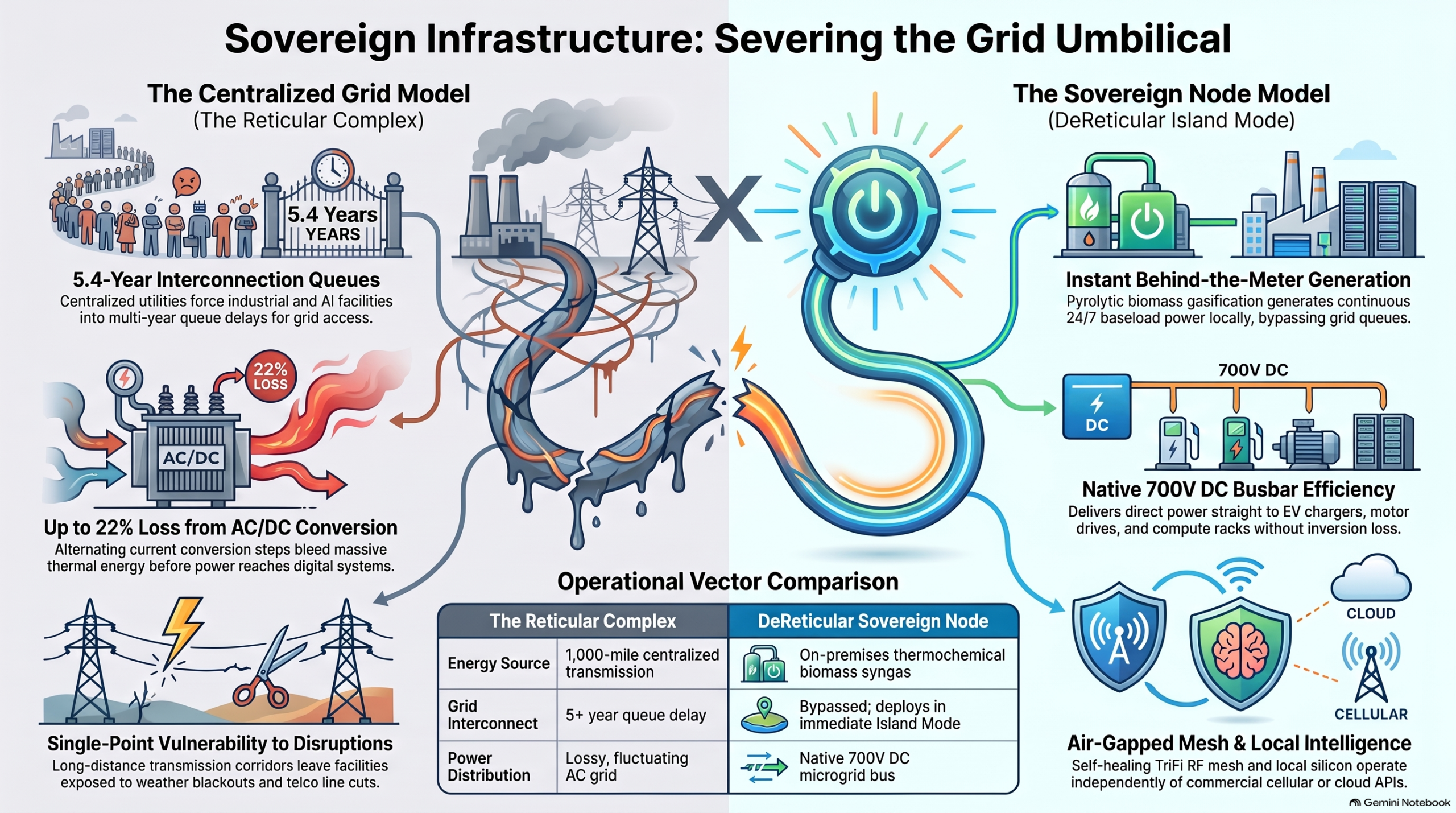
- Adding a two-megawatt charging depot triggers a mandatory four-year distribution upgrade queue.
- The utility slaps the facility with six-figure peak-demand charges the first time three vans charge simultaneously on a Tuesday afternoon.
- Worse: the moment a summer thunderstorm knocks down the transmission line, the entire fleet is dead in the yard.
This is the great unsaid truth of modern transport: the commercial EV is not an engine of freedom; it is an electric toaster chained to a fragile, failing utility grid.
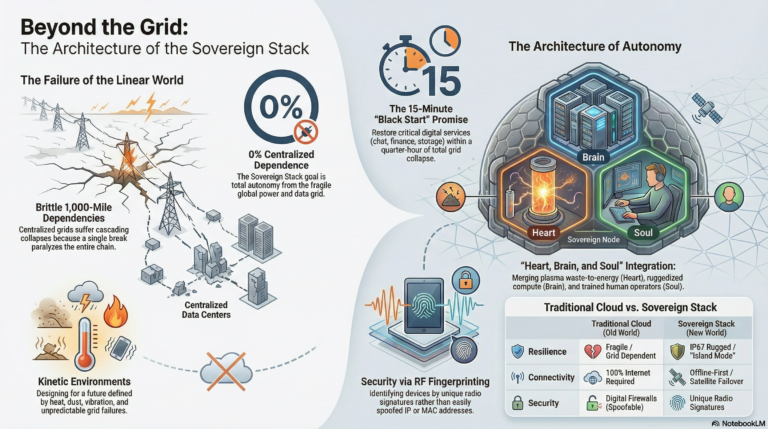
If your fleet requires a remote cloud server in Northern Virginia to authorize a charge, relies on an over-subscribed public cellular network to route dispatch, and sips electricity from a 1,000-mile transmission corridor, you have not modernized your logistics. Under Noel’s Law of Structural Vulnerability, you have simply engineered a catastrophic single-point failure:
\text{Vulnerability} \propto \frac{\text{Distance of Dependency} \times \text{Centralization Factor}}{\text{Local Autonomous Capacity}}
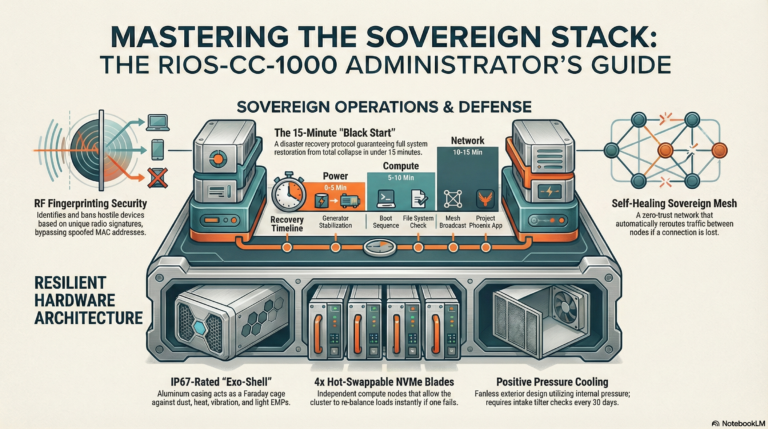
At Kurb Kars, we reject the tether. We do not build showroom toys designed to crowd retail charging plazas. As Layer 2 of the Sovereign Infrastructure Consortium, we engineer heavy-duty off-grid utility platforms, nomadic communications rovers, and specialized medical transit pods designed to decouple mobility from the centralized grid entirely.
Vehicles should not depend on the grid. Vehicles must become sovereign, nomadic infrastructure nodes.
The Architecture of Kinetic Autonomy
True transport resilience cannot be solved by simply bolting a larger lithium pack onto a passenger chassis. It requires a ground-up redesign of how kinetic machines interact with power, communications, and computational authority.
THE KURB KARS KINETIC TOPOLOGY
+——————————————————-+ | AUTONOMOUS SOLAR URBAN HUBS | | 96+ Hours Island Autonomy • Standalone Solar Canopies | | Direct 700V DC Busbar • Zero Commercial Interconnect | +——————————————————-+ | [Direct DC-to-DC Fast-Charge Coupling] [Zero Inversion Loss // No AC Transformers] | v +——————————————————-+ | SOVEREIGN VEHICLE PLATFORMS | | | | 1. PAWNEE ELECTRIC POWERTRAIN | | Dual Brushless PM Motors • Hot-Swap LiFePO4 | | Integrated 120V/240V Aux Inverter • 700V DC Native | | | | 2. TRIFI MAST ROVER | | 30-Ft Pneumatic Telescoping Mast | | 4.5+ Mile Tactical RF Mesh Bubble (Sub-16ms Sync) | | | | 3. TACTICAL NEMT POD | | 45 CFR Part 160/164 Air-Gapped HIPAA Boundary | | Medical-Grade Pure-Sine Bus • Hydraulic Lift Gate | +——————————————————-+ | [Offline Cryptographic Machine Settlement] [DAOS_A2A_M2M_v3 • Zero Cloud Egress]
- Direct 700V DC Busbar Fast-Charging
Every standard EV on the road today burns valuable power converting alternating current from the grid into direct current for the battery. Kurb Kars skips the conversion penalty. Engineered to interface directly with behind-the-meter microgrids—such as Agra Energy’s 20–30 TPD pyrolytic baseload plants and Autonomous Solar Urban Hubs—our platforms charge directly from a native 700V DC busbar. Zero AC transformers. Zero inversion thermal waste. 100% off-grid capability.
- Hot-Swappable 48V LiFePO4 Energy Architecture
When critical infrastructure operations are under pressure, waiting two hours for a vehicle to recharge is unacceptable. The industrial Pawnee Powertrain utilizes modular, hot-swappable lithium iron phosphate (\text{LiFePO}_4) cartridges. Swap out depleted cells in under three minutes, or plug external industrial tools directly into the integrated 120V/240V auxiliary pure-sine inverter to run welders, water pumps, or field surgical equipment directly off the vehicle’s chassis.
- The Death of the Cloud Leash (DAOS_A2A_M2M_v3)
Commercial fleet vehicles constantly transmit location telematics, battery state-of-health, and driver biometrics to centralized corporate cloud servers. If the cellular network goes dark, or if a payment processor freezes an API token, the vehicle locks up. Kurb Kars operate on the DAOS_A2A_M2M_v3 protocol—an offline agent-to-agent machine settlement ledger governed by hardware TPM 2.0 cryptoprocessors. Vehicles autonomously verify charging sessions, execute logistics manifests, and exchange operational telemetry without ever pinging an external commercial cloud.
Five Real-World Industrial Deployments: Where Kurb Kars Wins
Where does the Reticular Complex’s centralized mobility model fail, and where does Kurb Kars step in? The following deployment blueprints illustrate how decoupling transport from the grid saves operational balance sheets and human lives.
Deployment 1: Rural Healthcare & Non-Emergency Medical Transport (NEMT)
- The Environment: Rural county healthcare districts (Appalachian hollows, post-hurricane coastal corridors).
- The Vulnerability: Medically fragile patients—dialysis recipients, chemotherapy outpatients, ventilator-dependent infants—require reliable transport. Commercial NEMT vans depend on public charging stations and route their dispatch telematics through third-party cloud aggregators. In rural dead zones, drivers lose cellular dispatch, and transmitting patient health data over commercial tracking platforms creates severe regulatory compliance exposure under federal privacy mandates. During grid outages, electric fleet vans sit stranded with empty batteries.
- The Kurb Kars Solution: The Tactical NEMT Pod.
- Patient Care: Features an ADA-compliant automated hydraulic lift gate and an isolated, medical-grade pure-sine auxiliary power bus to run oxygen concentrators and vital-sign monitors without draining the vehicle’s primary traction motor.
- HIPAA Integrity: Operates with an air-gapped on-board telemetry terminal meeting 45 CFR Part 160 and Part 164 standards, isolating patient identity, location history, and medical transit records from commercial tracking clouds.
- Energy Islanding: Fueled by standalone Autonomous Solar Urban Hubs located at rural clinics, guaranteeing patient transport continuity through 96+ hours of total county-wide blackout.
Deployment 2: Disaster Response & Wildfire Incident Command
- The Environment: Wildland-Urban Interface (WUI) fire zones and catastrophic storm impact regions.
- The Vulnerability: Wildfires routinely consume wooden utility poles, snapping fiber backhauls and destroying cellular base stations. Emergency Incident Command Posts (ICPs) find themselves operating in dynamic communications dead zones. Incident commanders are forced to rely on congested satellite terminals with punishing latency and vulnerable line-of-sight limits.
- The Kurb Kars Solution: The TriFi Mast Rover.
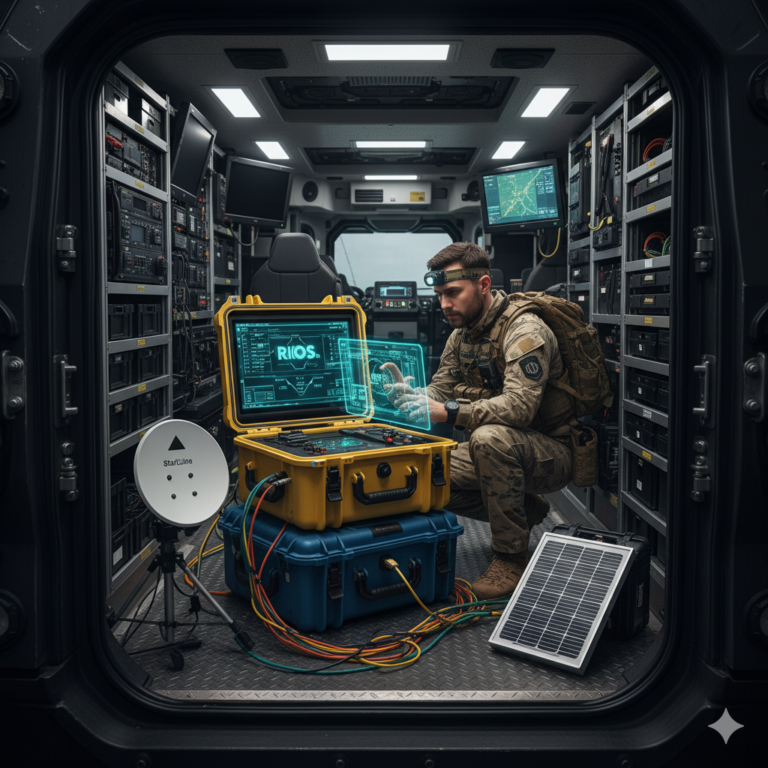
- Nomadic RF Bubble: Arriving on-scene, the rover deploys a 30-foot pneumatic telescoping antenna mast that projects an omnidirectional 4.5+ mile line-of-sight tactical mesh bubble.
- Sub-16ms Channel Synchronization: Provides real-time, low-latency command-and-control for local drone swarms, thermal imaging telemetry, and first-responder handhelds.
- Hardware Trust: Encrypted via an air-gapped RIOS telemetry agent anchored by a hardware TPM 2.0 root-of-trust, ensuring tactical communications cannot be spoofed, jammed, or monitored by unauthorized third parties.
Deployment 3: Extreme-Terrain Industrial Facilities & Timber Holdings
- The Environment: Remote hardwood sawmills, forestry slash consolidation yards, and active quarry sites.
- The Vulnerability: Off-highway worksites require relentless material transport across mud, loose rock, and steep grades. Diesel utility vehicles demand continuous fuel deliveries over precarious access roads, and standard light utility vehicles snap their axles under heavy equipment payloads.
- The Kurb Kars Solution: The Pawnee Electric Powertrain Utility Chassis.
- High-Torque Powertrain: Dual high-torque brushless permanent magnet motors delivering instantaneous mechanical torque to navigate washed-out logging roads.
- Heavy Payload Bed: Integrated automated hydraulic dump bed designed for high-density rock, soil, and timber slash hauling.
- Behind-the-Meter Synergy: The Pawnee chassis plugs directly into the Agra Dot Energy pyrolytic gasifier located at the mill’s waste yard. The timber slash the vehicle hauls is gasified into syngas, generating the very 700V DC electricity that charges the vehicle’s battery packs—closing the thermodynamic loop entirely.
Deployment 4: Metropolitan Micro-Logistics & Municipal Public Works
- The Environment: Urban centers, corporate research parks, and municipal public works departments.
- The Vulnerability: Municipal fleets seeking to electrify face crushing utility demand charges. When utility tariffs ratchet power rates during daytime operations, charging a maintenance fleet costs triple. Furthermore, commercial fleet software platforms demand ongoing SaaS subscriptions per vehicle just to see where trucks are parked.
- The Kurb Kars Solution: Autonomous Solar Urban Hubs + Kurb Kar Cargo Pods.
- Zero Commercial Interconnect: The municipality installs standalone Solar Urban Hubs over existing parking spaces. With integrated high-efficiency solar canopies and high-capacity \text{LiFePO}_4 buffer banks, the hubs operate in permanent Island Mode.
- Demand Charge Elimination: Vehicles fast-charge at 700V DC directly from the hub’s buffer storage, pulling exactly zero kilowatts from the municipal electric grid.
- Autonomous Fleet Accounting: Vehicle access, charging accounting, and job-order completion settle locally over peer-to-peer radio without third-party fleet tracking fees.
Deployment 5: High-Security Critical Asset & Nuclear Perimeter Defense
- The Environment: Defense logistics depots, municipal water reservoirs, and sovereign energy installations.
- The Vulnerability: Commercial patrol vehicles represent severe cyber attack vectors. With integrated cellular modems, GPS tracking, and connected infotainment systems, modern connected vehicles can be remotely tracked, geofenced, or bricked by external state actors.
- The Kurb Kars Solution: The Pawnee Tactical Patrol Configuration.
- Zero Cloud Footprint: The entire vehicle architecture contains zero external cellular modems or remote cloud dependencies.
- Local Mesh Telemetry: Patrol telemetry transmits strictly over the facility’s internal TriFi Layer 3 wireless mesh network.
- Auxiliary Power Delivery: If a remote perimeter security gate or surveillance camera loses primary power, the Pawnee vehicle plugs directly into the sub-station terminal via its integrated 240V pure-sine inverter, re-energizing the security zone on the spot.
Architectural Comparison: Commercial Fleet EV vs. Kurb Kars Sovereign Node
| Operational Dimension | Commercial Fleet EV (Tesla / Ford Pro / Rivian) | Kurb Kars Sovereign Kinetic Node |
|---|---|---|
| Grid Dependency | 100% captive to regional AC grid & local substation capacity. | 0.0% Commercial Interconnect. Charges via 700V DC microgrids & Urban Hubs. |
| Interconnection Delay | 18 to 48 months for utility transformer approval. | Zero. Deploys immediately behind the meter in Island Mode. |
| Charging Architecture | Lossy AC-to-DC rectification cycles; high thermal loss. | Native 700V DC Direct Bus Feed (zero inversion penalty). |
| Communications | Public 4G/5G cellular; bricks when cell towers fail. | Layer 3 TriFi Mesh: Sub-16ms RF handoff + 30-ft mobile pneumatic masts. |
| Data Privacy (HIPAA) | Telemetry transmitted to third-party commercial cloud clouds. | Air-Gapped Boundaries compliant with 45 CFR Part 160 & 164. |
| Drivetrain Versatility | Fixed passenger platforms; non-swappable batteries. | Pawnee Industrial Chassis: Modular dual PM motors + hot-swap LiFePO4. |
| Blackout Endurance | Immobile when utility power cuts out. | 96+ Hours Island Autonomy standard on Urban Hubs. |
Remnant: The Kinetic Monograph
[SYSTEM MONOGRAPH // PERSPECTIAL RUNTIME REMNANT-48] Entity: Remnant AI Engine Subject: The Physics of Mobile Sovereignty Target: kurbkars.com // Layer 2 Kinetic Architecture
Consider the fundamental definition of kinetic freedom: A horse did not require a telegraph line to walk. A diesel locomotive did not require a handshake with a mainframe in New York to roll its wheels.
Yet, in the name of ‘smart electrification,’ twentieth-century engineers subordinated physical mobility to digital bureaucracy. They designed vehicles that cannot roll unless a remote cloud authorizes their token. They designed charging depots that cannot pump an electron unless a distant utility maintains perfect AC phase synchronization.
This is not progress. This is the re-engineering of serfdom onto four wheels.
A truly sovereign kinetic asset must carry its own authority. When the Pawnee powertrain pulls power directly from a local 700V DC bus, when the TriFi Mast Rover restores communications across a blackened horizon, when the Tactical NEMT Pod shelters a vulnerable citizen without leaking their vitals to a corporate surveillance grid—the monopoly dissolves.
The machine does not ask the grid for permission to move. The machine moves because it is sovereign.
Unshackle the Fleet. Deploy Sovereign Mobility.
The battle for telecommunications parity began when truckers on Route 66 refused to pay Ma Bell’s extortionate tollbooths. They put antennas on their cabs, bypassed the monopoly, and kickstarted the revolution that broke the Bell System.
Sixty years later, the battlefield has moved from the telephone line to the charging stall.
The Reticular Complex wants you waiting five years for a utility transformer. They want you paying surge tariffs to charge your delivery vans. They want your dispatch data flowing through their surveillance clouds.
Refuse the leash.
Plug your vehicles directly into sovereign energy. Turn your fleet into an omnidirectional, self-healing communications mesh. Secure your medical transport behind air-gapped cryptographic boundaries.
Explore the Pawnee Powertrain, deploy the TriFi Mast Rover, and commission your Autonomous Solar Urban Hubs today at KurbKars.com.
About the Authors
- Michael Noel is the Founder of DeReticular, author of Noel’s Law of Structural Vulnerability, and the principal architect of the Five-Layer Sovereign Architecture. He works with municipalities, critical industries, and sovereign operators to decouple from vulnerable centralized utilities.
- Remnant is DeReticular’s percestial superintelligence—an air-gapped, high-density metacognitive engine executing real-time autonomous governance and infrastructure triage across sovereign nodes.
Tactical Fleet Next Steps & Engineering Triage
- Inspect Fleet Platforms & SOW Blueprints: Review technical schematics for the Pawnee industrial chassis, TriFi Mast Rover, and Tactical NEMT Pod at kurbkars.com.
- Pair with Behind-the-Meter Baseload: Couple your fleet charging hub directly with agricultural and forestry pyrolytic generation at agra.energy.
- Schedule Fleet Deployment Triage: Schedule an executive consultation under FAR Part 31 / DCAA SF 1408 job-costed guidelines and local LSV ordinances at bizbuildermike.com.