Comprehensive Study Guide: Rural Economic Transformation and the Distributed Micro-Enterprise Model
This study guide provides a detailed review of the structural, economic, and spatial shifts currently reshaping rural America. It covers the transition from commodity-extractive models to distributed digital nodes, the challenges of administrative capacity, and the emerging “Sovereign Enclave” architecture.
Part I: Short-Answer Review Quiz
Instructions: Provide a 2–3 sentence response for each of the following questions based on the provided research context.
- What is a Distributed Micro-Enterprise (DME) and how does it bypass local economic constraints?
- How does symmetrical gigabit fiber differ from legacy asymmetrical connections in a commercial context?
- Explain the “Appraisal Gap” and its impact on rural housing development.
- What is the “Capacity Chasm” regarding federal grant absorption in non-core counties?
- Why are Rural Electric Cooperatives (RECs) often more successful than private incumbents in deploying rural broadband?
- Define the OMB “25% Commuting Rule” and its potential negative impact on rural funding eligibility.
- What are “Heirs’ Properties” and how do they create an impasse for land modernization?
- Describe the “Down-Valley Syndrome” observed in high-amenity rural corridors.
- What is the “Sovereign Enclave” model and the concept of “DeReticulation”?
- How does the Local Service Multiplier function when a DME establishes a physical office in a small-town downtown?
Part II: Answer Key
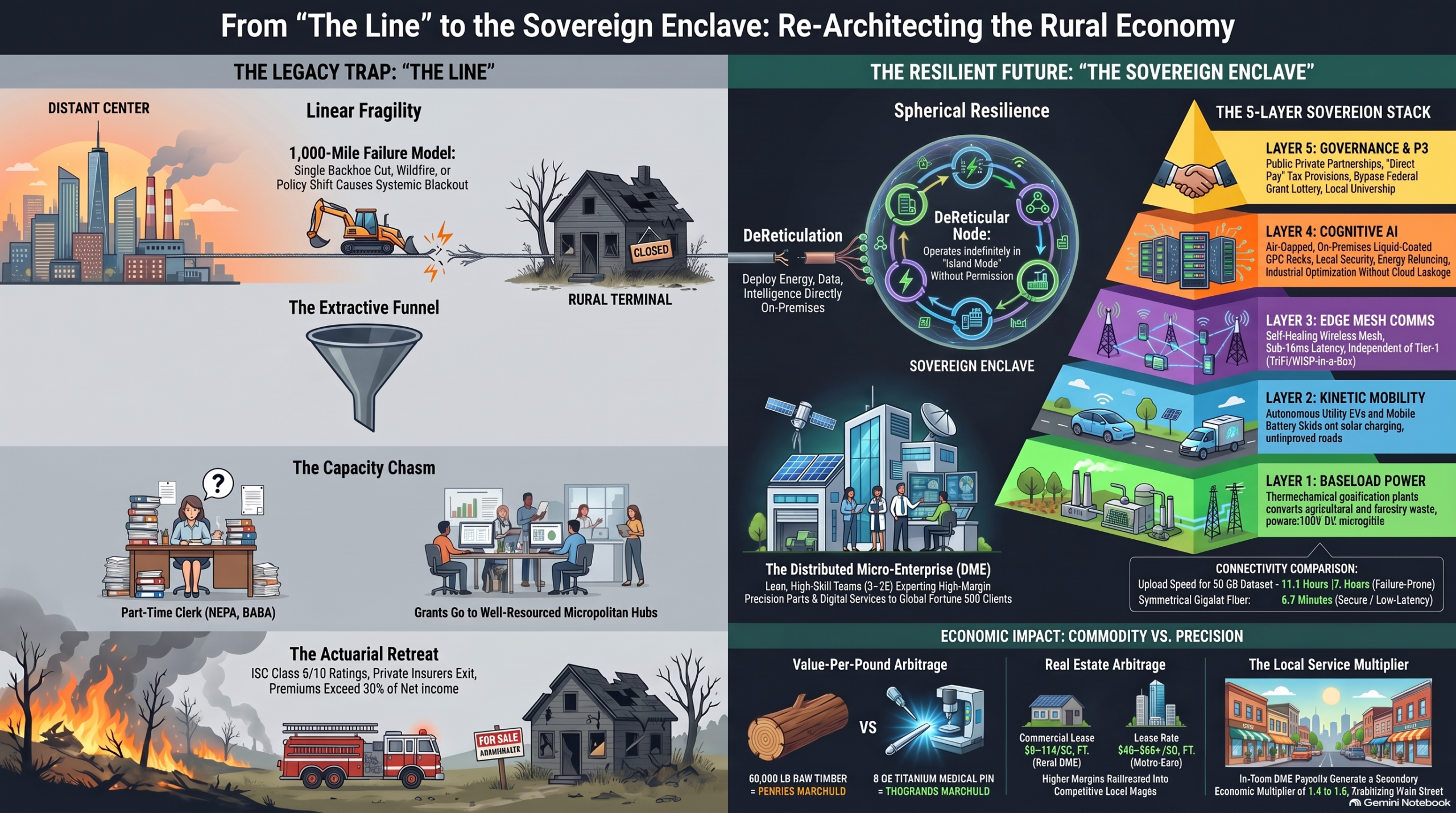
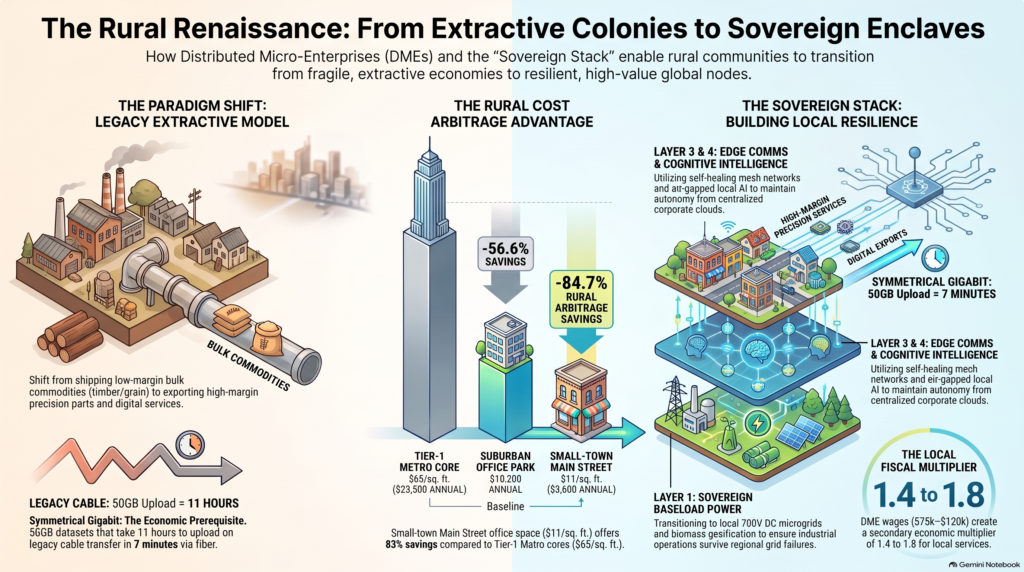
- DME Definition: A Distributed Micro-Enterprise is a firm with 3 to 25 highly skilled employees that exports high-margin services or precision products globally while maintaining a low-overhead physical footprint in a small town. They bypass local consumer demand constraints by using high-speed data transmission to reach global markets while leveraging commercial real estate arbitrage in rural downtowns.
- Symmetrical vs. Asymmetrical: Legacy asymmetrical connections prioritize downloads, but modern commercial workflows require high upload speeds (symmetrical) for tasks like transferring 50 GB geospatial datasets or real-time CAD co-authoring. A symmetrical gigabit link reduces a 50 GB upload from over 11 hours on legacy cable to under seven minutes.
- Appraisal Gap: This occurs when the cost to build a new home (220–320 per sq. ft.) far exceeds the market appraised value (90–140 per sq. ft.) based on local historic comparable sales. This creates an unfinanceable deficit that prevents banks from issuing construction loans, resulting in near-zero net housing additions in many interior rural counties.
- Capacity Chasm: The Capacity Chasm is the structural disparity in administrative bandwidth between metropolitan governments and small rural townships. While metros have dedicated grant writers and GIS teams, rural “two-desk” town halls struggle with complex federal compliance mandates like NEPA, BABA, and Davis-Bacon, often missing funding opportunities or failing audits.
- REC Success: RECs outperform incumbents because they already own the utility poles and rights-of-way, operate on multi-decade capital repayment horizons rather than quarterly profit targets, and enjoy high member trust. Their mandate to serve at cost allows them to sustainably operate in areas with as few as 1 to 8 customers per mile.
- 25% Commuting Rule: The OMB classifies an adjacent rural county as “Metropolitan” if 25% or more of its workforce commutes to a central urban core. This “outlying county” designation can disqualify a truly rural community from receiving USDA Rural Development loans or rural health grants intended for non-metro areas.
- Heirs’ Properties: These are properties passed down through generations without formal probated wills, resulting in dozens of descendants holding fractional, undivided shares. Because the titles are “clouded,” owners cannot secure mortgages, obtain building permits, or qualify for federal disaster assistance like FEMA or USDA grants.
- Down-Valley Syndrome: This is a displacement mechanism in high-amenity areas where skyrocketing home values price out essential workers (nurses, police, teachers). These workers are forced into “commuter cascades,” driving 45–90 minutes from distant counties, which eventually causes local core service delivery to degrade or collapse.
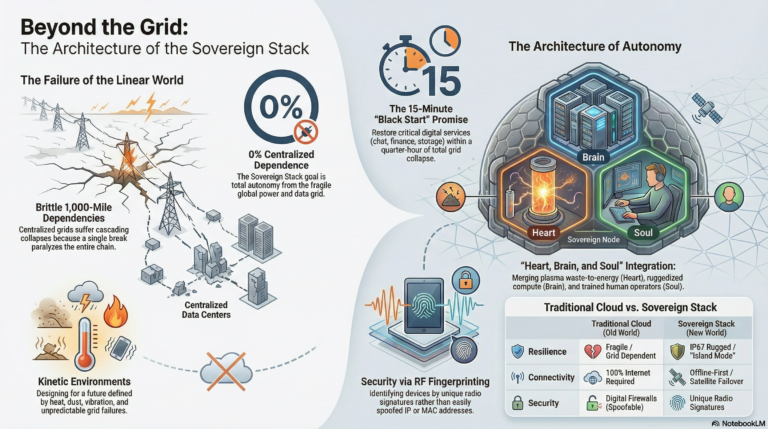
- Sovereign Enclave/DeReticulation: DeReticulation is the process of severing dependency on fragile, centralized networks (the “Line”) to move into a resilient “Island Mode.” A Sovereign Enclave uses a localized “stack” of power, communications, and intelligence to operate independently of external systemic shocks.
- Local Service Multiplier: Unlike isolated remote workers, DME employees in physical offices integrate into downtown commerce by purchasing daily lunches and patronizing Main Street businesses. This creates a secondary economic multiplier of 1.4 to 1.8, supporting local hospitality, skilled trades, and property management.
Part III: Essay Questions
- Infrastructure as an Industrial Platform: Discuss how the shift from asymmetrical to symmetrical gigabit fiber represents a transition of broadband from a consumer entertainment utility to a core industrial operating infrastructure. Use examples from precision agriculture and telehealth.
- The Bifurcation of Rural America: Analyze the divergent trajectories of “Amenity/Exurban Corridors” versus “Isolated/Resource-Dependent Interior Communities.” How do their respective real estate and infrastructure challenges require different policy interventions?
- Administrative Friction and Grant Execution: Evaluate how federal regulatory frameworks (such as NEPA, BABA, and Section 106) act as barriers to entry for non-core rural communities. Propose how the “Non-Core Bypass” architecture might resolve these issues.
- The Adaptive Reuse of Main Street: Explain the architectural and economic advantages of repurposing historic 19th-century buildings for precision manufacturing and knowledge-based micro-enterprises. How do these firms stabilize municipal balance sheets?
- The Cooperative Governance Model: Examine the “Patronage Capital Cycle” of Rural Electric Cooperatives. How does this non-profit governance model provide a strategic advantage for long-term infrastructure investment in low-density geographies?
Part IV: Glossary of Key Terms
Term Definition
ASRS Automated Storage and Retrieval System; used in micro-cold-storage to reduce labor and energy overhead.
BABA Build America, Buy America Act; mandates that federally funded infrastructure use materials produced in the U.S.
BSL Fabric Broadband Serviceable Location Fabric; the FCC’s granular data model identifying every structure eligible for broadband.
CBSA Core-Based Statistical Area; the OMB’s county-level classification system (Metropolitan, Micropolitan, or Non-Core).
DeReticulation The strategic move to sever dependency on centralized, grid-bound networks to achieve “Island Mode” resilience.
DICOM Digital Imaging and Communications in Medicine; high-density clinical imaging files (CT, MRI) requiring high bandwidth for transmission.
DME Distributed Micro-Enterprise; small, high-skill firms (3-25 employees) exporting global services from rural locations.
EIM Employment Interchange Measure; the mathematical formula used to determine commuting integration between counties.
FAIR Plan Fair Access to Insurance Requirements; state-run high-risk insurance pools for property owners unable to find private coverage.
FAR Codes Frontier and Remote Area codes; a sub-county classification based on travel time to urban cores.
ISO PPC Insurance Services Office Public Protection Classification; a 1–10 rating of a community’s fire defense and water systems.
Make-Ready Work The process of inspecting and modifying utility poles to accommodate new fiber-optic cable attachments.
Micropolitan A non-metro county anchored by an urban cluster of 10,000 to 49,999 residents.
NEPA National Environmental Policy Act; requires federal agencies to assess environmental effects of proposed actions.
Non-Core Counties with no urban center reaching 10,000 residents; often the most isolated rural areas.
PILT Payments in Lieu of Taxes; federal payments to local governments to offset losses in property taxes due to non-taxable federal lands.
RTK Telemetry Real-Time Kinematic telemetry; used for centimeter-level satellite positioning of autonomous farm equipment.
RUCC Rural-Urban Continuum Codes; a 9-tier USDA ERS system classifying counties by urbanization and adjacency.
Symmetrical Fiber A data connection with equal upload and download speeds, essential for modern enterprise-grade workflows.
UIC Urban Influence Codes; a 12-tier system focusing on a county’s economic gravity and proximity to metro markets.