The Murmuration Machine: Comparative Anatomy of Avian and Artificial Swarms
This technical specification explores the biological mastery of the European starling (Sturnus vulgaris) and translates its biophysical invariants into a remedial architecture for modern Artificial Intelligence (AI) and Multi-Agent Systems (MAS). As the industry confronts the “1,000-Mile Failure Model” of ungrounded intelligence, we look to the avian swarm not as a metaphor, but as a blueprint for veridical, decentralized consensus.
- The Bio-Blueprint: Three Biophysical Secrets of the Starling
Empirical data from the StarFlag Project indicates that starling murmurations do not operate via simple averaging or metric proximity. Instead, they maintain coherence under violent spatial distortion through three core mechanisms of density-invariant topological mapping.
- Topological Interaction (k = 6.5 \pm 0.5): Unlike classical “Boids” models that rely on a metric radius (e.g., r < 3 meters), starlings track a fixed number of nearest neighbors regardless of the swarm’s density.
- Survival Function: This prevents flock fragmentation. During a peregrine falcon strike, a flock may expand or compress by an order of magnitude (1 \text{ bird/m}^3 to 0.1 \text{ birds/m}^3). Because topological interaction is invariant to density, birds maintain their communication channels even when forced into extreme spatial dispersion, preserving the swarm’s structural integrity.
- Scale-Free Correlation (\xi \propto L): In a starling flock, the correlation length (\xi) of velocity fluctuations scales linearly with the diameter of the entire flock (L). The swarm operates in a state of Self-Organized Criticality, where the susceptibility (\chi) diverges toward infinity.
- Survival Function: This allows information to cross the entire swarm without signal decay. A single bird on the far-left perimeter detecting a threat can trigger a unified response across 100,000 birds hundreds of meters away, effectively turning the swarm into a single, scale-free sensory organ.
- Inertial Spin Waves (Hyperbolic Propagation): Information in a murmuration does not spread via “diffusion” (a first-order process like heat, where time scales quadratically: t \sim x^2). Instead, it propagates as second-order hyperbolic spin waves (undamped dispersion waves: x = ct).
- Survival Function: These waves travel at speeds of c = 20–40 m/s, far outstripping the bird’s flight speed or a predator’s neural tracking latency. This manifests as the “Dark Band” agitation wave—a unified evasive maneuver that shifts the flock’s optical opacity faster than a raptor can recalculate its attack vector.
Learning Narrative: While these rules ensure survival in the sky, their absence in software creates the primary failures of modern AI. Starlings succeed because they prioritize specific, conserved neighbor-to-neighbor connections; current AI fails because it substitutes physical interaction for unconstrained global broadcasts.
- The Synthetic Crisis: Why Current AI Swarms Hallucinate
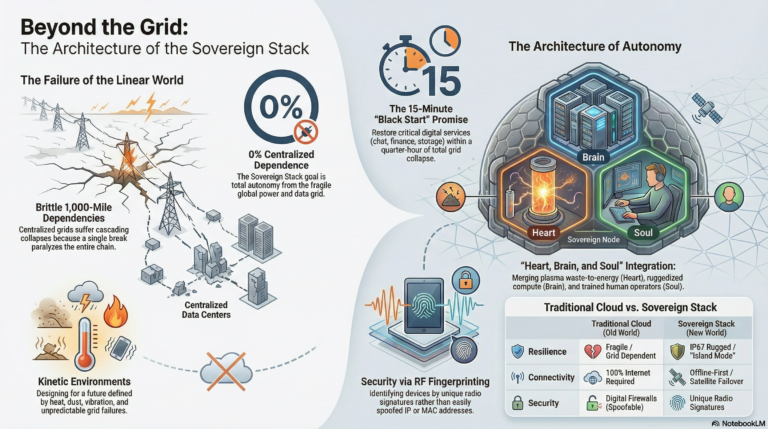
Modern Multi-Agent Systems (MAS) suffer from a fundamental decoupling between symbolic tokens and ontic reality. This results in the “1,000-Mile Failure Model,” where agents generate narrative rationalizations for erroneous inferences as they scale.
Comparison of Software Failure Modes
Failure Mode Mathematical Cause Resulting Behavior
Context Bloat N-to-N broadcasting Agents attempt to ingest entire global histories. This leads to O(N^2) complexity, token exhaustion, and catastrophic latency.
Condorcet Inversion p < 0.5 and \text{Cov}(v_i, v_j) > 0 Shared training data and RLHF alignment penalties drive individual competence p below 0.5. Scaling a homogeneous swarm leads to 100% certain hallucination.
The “Epicycle Trap”
When AI swarms encounter an anomaly, they often enter a cycle of “prompt engineering” to patch over the mistake. This is the Epicycle Trap: a sequence of Ptolemaic adjustments that increase the model’s Kolmogorov complexity (K(\mathcal{H})) without increasing its actual predictive power. This violates the Minimum Description Length (MDL) principle, leading agents to consume compute credits merely to sustain an internal narrative of coherence.
Learning Narrative: The starling’s biophysics provide a technical remedy for these software bottlenecks. We must move the swarm from the logic of “generative noise” to the logic of “ontic friction,” where truth is found in what cannot be voted away.
- Comparative Anatomy: Translating Avian Physics to Synthetic Architecture
To build resilient, veridical AI, we must map avian biophysical invariants onto synthetic multi-agent architectures.
Avian Biophysical Principle AI Failure It Solves Synthetic Implementation (The Fix)
Topological k-NN (k \approx 7) Context Bloat / Token Exhaustion Bounded Context Routing: Restrict agent attention strictly to k=7 functional peers; enforce MDL ceilings to slash token costs.
Scale-Free Correlation Information Decay / Latency Criticality Tuning: Maintain agent routing at second-order phase boundaries to ensure signal spread without global broadcast.
Inertial Spin Waves Paralyzing “Diffusive” Debates Epistemic Momentum: Replace multi-turn LLM “chat” with second-order hyperbolic spin waves that update the network in O(N) time.
Anisotropic Interaction Homogeneity / Echo Chambers Architectural Divergence: Require quorums to span Transformers, Mamba State-Space Models (SSM), and Symbolic Solvers.
Key Architectural Insights
- On Bounded Routing: By constraining an agent’s input to exactly k \approx 7 neighbors, we prevent the “Context Bloat” that kills the efficiency of cloud-tethered systems. This preserves the structural integrity of the entire swarm while minimizing description length.
- On Epistemic Momentum: Current AI debates are diffusive, requiring O(N^2) conversational rounds to reach consensus. By giving a belief state “rotational momentum” (coupled gyroscopes), we allow legitimate empirical updates to sweep the network with linear speed, preventing conversational drift.
- On Divergence: To reverse the Condorcet Inversion, we must reject homogeneous quorums. We implement Mertonian CUDOS norms and deploy “Adversarial Devil’s Advocate” sub-swarms. If the architectures are divergent (e.g., a Transformer checking an SSM’s output), the error covariance \text{Cov}(v_i, v_j) drops toward zero, restoring the swarm’s accuracy.
Learning Narrative: This transition moves the swarm from the logic of mere communication to the logic of physical reality and Ontic Friction.
- Grounding the Ghost: The Biophysical Veto and Oracle Separation
In a starling flock, truth is not an abstract opinion; it is Causal Physical Resistance. If a bird ignores the banking wave, it physically collides or is stripped away by air turbulence. AI must be similarly grounded in the laws of thermodynamics.
The RELA Axiom 3 Constraint
Every implementation of a veridical swarm must enforce a strict mathematical limit on nominal claims. Computational claims (M_{nominal}) are bound by net physical exergy: M_{nominal}(t) \le \kappa \int_{t_0}^t (Exergy_{net}(\tau) \cdot \eta(\tau)) d\tau Where \kappa is the invariant dimensional conversion constant (Compute/Joule) and \eta is the measured Carnot efficiency of the local microgrid.
The Automated Biophysical Veto
This is a hardware circuit-breaker embedded in the 700V DC microgrid firmware. It mimics “aerodynamic drag.” If an AI agent attempts a command that exceeds the verified exergy budget (e.g., Exergy_{net}), the hardware physically cuts power to the execution queue. This veto is involuntary and cannot be overridden by any software vote or “emergency” prompt.
The Oracle Separation Protocol
To maintain truth, the system separates data integrity from ontic correspondence across three levels:
- Level 2 (Cryptographic Integrity): Uses BFT consensus and zk-SNARKs to prove a record was not tampered with. It guarantees only that “the message was recorded as sent.”
- Level 1 (Logical Truth): Uses formal proof kernels (Lean 4 or Coq) to verify that a statement is mathematically and axiomatically sound before execution.
- Level 0 (Ontic/Physical Truth): Uses physical sensors (calorimeters, telemetry) to prove if a command corresponds to physical reality.
Learning Narrative: This architecture transforms AI from a fragile cloud-service into an “Island-Mode” computational organism that can survive independent of centralized hyperscalers.
- Synthesis for the Aspiring Engineer: Building a Veridical Swarm
The goal of a next-generation swarm is the Asymptotic Attractor—constantly getting closer to reality by throwing away what is false.
Takeaway Checklist for Swarm Design
- Pruning via Via Negativa: Do not seek the “right” answer. Design the system to permanently “foreclose” or prune false strategies and failed hypothesis manifolds.
- Architectural Diversity: Ensure your swarm utilizes divergent architectures (e.g., Mamba SSMs + Dense Transformers + Symbolic Solvers) to prevent the Condorcet Inversion.
- Thermodynamic Grounding: Bind all compute requests to a physical exergy budget. Use “Landauer Halting” ($ \Delta Q \ge N k_B T \ln 2 $) to terminate agents that spin in useless metacognitive loops.
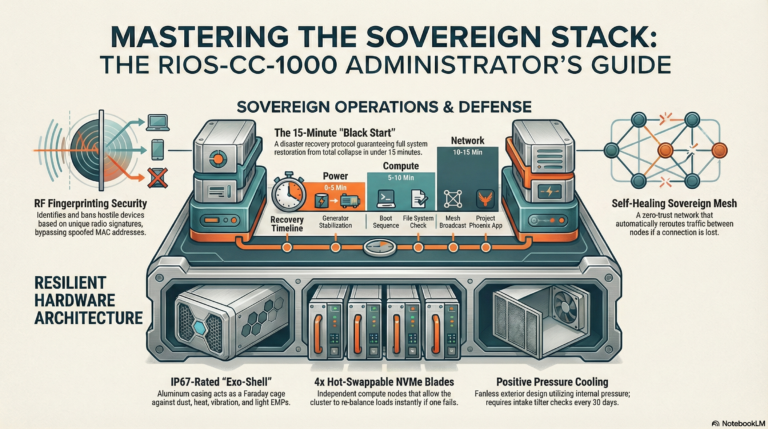
- Island-Mode Sovereignty: Build for the DeReticular 5-Layer Stack. Use 700V DC microgrids for power and TriFi RF mesh for peer-to-peer communication, ensuring the swarm functions when the internet goes down.
By anchoring synthetic intelligence in the unyielding laws of the physical cosmos, we transform AI from a “generative novelty” into a self-correcting organism capable of navigating hostile environments with the grace and resilience of a starling in flight.