The Hook: A World Without the “Line”
Our modern existence is tethered to “Linear Fragility.” We live at the mercy of long, vulnerable supply chains and power lines—fragile threads that snap during climate upheavals, cyber-warfare, or systemic rot. When the line breaks, the civilization at the end of it collapses. This is the “Death of the Line,” a realization that centralized dependence is no longer a luxury, but a liability.
DeReticular, a decentralized venture studio, offers a solarpunk escape hatch: “Spherical Resilience.” Their Rural Infrastructure Operating System (RIOS) is a radical alternative—an off-grid “brain” designed to manage autonomous, sovereign nodes. By weaving the privacy-centric protocols of the decentralized web (Hyphanet and the New Freenet) into the very silicon of their hardware, RIOS enables “Island Mode” for any community. This is more than a backup generator; it is a blueprint for a self-healing, trustless civilization-in-a-box.
Takeaway 1: Physical Truth—Why Your Hardware Now Has a “Fingerprint”
In a world of deepfakes and software exploits, digital identity is often a house of cards. RIOS solves the “garbage in, garbage out” problem of decentralized data by anchoring identity in “Physical Truth.”
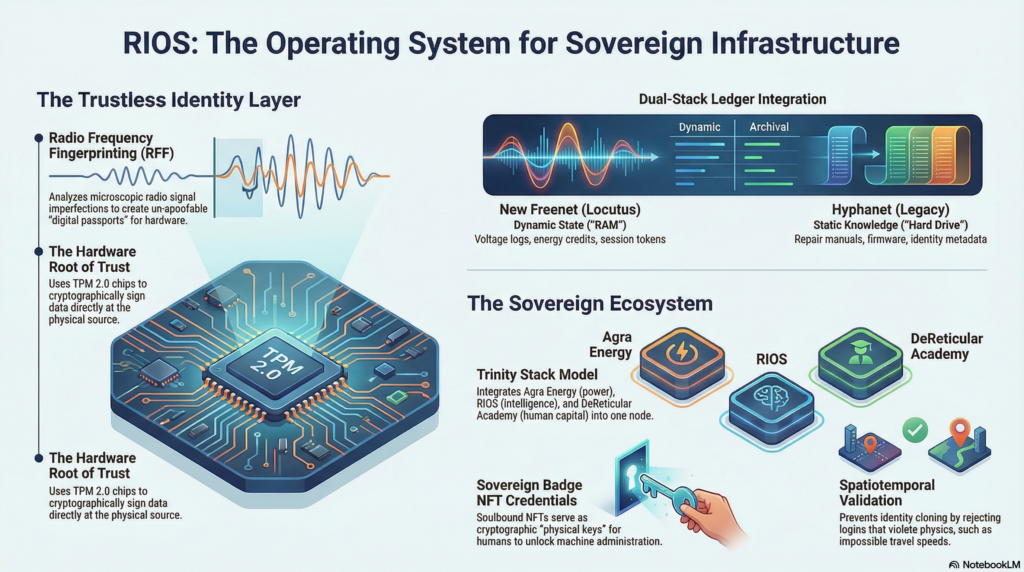
The system employs Radio Frequency Fingerprinting (RFF) to create an un-spoofable hardware passport. Every radio transmitter possesses microscopic manufacturing imperfections in its circuitry that manifest as a unique “transient response” and “oscillator drift.” Using Software Defined Radio (SDR), RIOS captures this unavoidable electronic hum. Unlike a password or a MAC address, this physical signature cannot be simulated by software or cloned.
Combined with a Trusted Platform Module (TPM 2.0) chip—where private keys are “burned” into the hardware at the factory—RIOS ensures that every sensor reading or energy log is tied to a physically verified machine.
“It creates an ‘Un-spoofable Digital Passport.’ Software cannot fake these physical imperfections… you are not trusting a person; you are verifying a cryptographic signature from a specific, physically verified machine.”
Takeaway 2: The “Physics Firewall”—Preventing Digital Teleportation
Traditional networks are plagued by “Sybil attacks,” where one actor generates thousands of fake identities to overwhelm a system. RIOS uses the New Freenet (Locutus) to manage an “Identity State Contract” that turns the laws of physics into a security protocol.
Every entity is tracked via spatiotemporal validation. If an identity attempts to connect to a node in Texas while its State Contract shows it was active in Arizona two minutes ago, the system detects a “Physics Violation.” Because an RF fingerprint cannot exist in two places at once, the network identifies the “Double-Spend” of the identity and triggers a lockdown. To prevent “Wormhole Attacks”—where attackers tunnel traffic to make distant nodes appear adjacent—RIOS utilizes Verifiable Delay Functions (VDFs), requiring a computational proof of the time it takes for a signal to propagate.
Takeaway 3: The Trinity Stack—The Blueprint for “Civilization-in-a-Box”
The “Sovereign Stack” is the vertical architecture designed to replace crumbling national backbones with autonomous, resilient nodes.
- Agra (Electrons/Energy): The heart. It manages local thermodynamics, utilizing waste-to-energy plasma gasification to provide base-load power (10MW+) for independent operation.
- RIOS (Data/Intelligence): The brain. An AI-native OS that orchestrates energy distribution, “Trifi” wireless mesh communications, and autonomous logistics via Kurb Kar pods.
- The Academy (Mobility/Human Capital): The soul. It provides the training and certification for the humans who maintain and defend these sovereign environments.
This stack ensures that if the global internet or national grid is severed, the node continues to thrive in “Island Mode,” maintaining its own utility and governance.
Takeaway 4: The Sovereign Badge—NFTs That Actually Do Something
Human authority within RIOS is managed through the “Sovereign Badge,” a Soulbound NFT based on the RIOS-721 standard. These are not tradeable assets; they are cryptographically unforgeable digital diplomas issued by the DeReticular Academy to a Certified RIOS Administrator (CRA).
When a technician needs to perform a high-level action, they execute a “Human-Machine Handshake.” Using a biometric-secured tablet, the CRA signs a cryptographic challenge. The RIOS node verifies the badge’s validity against the Freenet ledger locally, without needing a central password server. For critical safety overrides or factory resets, the system enforces the “Four-Eyes Principle,” requiring a multi-sig authorization from two separate CRAs before the command is executed.
“The Sovereign Badge effectively digitizes human competence… ensuring that Authority is portable, lives in the user’s pocket, and is verifiable without internet access.”
Takeaway 5: The Dual-Brain Strategy—Hyphanet vs. Locutus
RIOS maintains a “Dual-Stack” approach to data, splitting responsibilities between the two generations of Freenet to ensure both archival permanence and real-time industrial speed.
| Role | The Archivist (Hyphanet) | The Clerk (Locutus/New Freenet) |
| Data Type | Static / Archival | Dynamic / Real-time |
| Function | Permanent storage of repair manuals and medical wikis. | Management of voltage logs and energy credits. |
| Example | Hosting local “freesites” for community knowledge. | HempGrade: Zero-gas tracking of crop quality. |
By using Locutus, RIOS can handle high-frequency industrial data—like the “HempGrade” application, where an AI camera signs crop quality logs—without the volatile “gas” fees of traditional blockchains.
// Locutus / Freenet 2023 Contract State
struct MachineLog {
    node_id: PubKey,
    daily_yield: u64,
    maintenance_flag: bool,
    last_signature: Signature, // The TPM Signature
}
Closing: The Future of the Sovereign Node
Through “Project Octagon,” DeReticular is deploying eight sovereign nodes globally, from the Canadian wilderness to rural Uganda. This represents the shift from “Trusted” infrastructure (relying on a central authority’s word) to “Trustless” infrastructure (anchored in mathematics and the gritty reality of hardware).
Identity is no longer a entry in a corporate database; it is a signature of physics and a badge of competence.
If you could take your community entirely off-grid tomorrow, would you trust a machine’s signature more than a government’s promise?