DeReticular and Sovereign Infrastructure: Comprehensive Study Guide
This study guide provides a detailed synthesis of the DeReticular ecosystem, the Rural Infrastructure Operating System (RIOS), and the broader Decentralized Physical Infrastructure (DePIN) market. It is designed to assist in the mastery of technical architectures, business strategies, and product specifications found within the project documentation.
——————————————————————————–
Part 1: Short-Answer Quiz
Instructions: Answer the following questions in two to three sentences based on the provided source material.
- What is DeReticular’s core thesis regarding the “Death of the Line”?
- Describe the three layers of the RIOS “Trinity Stack.”
- How does the Split-Ledger Architecture resolve the tension between privacy and transparency?
- Explain the technical function and purpose of Radio Frequency Fingerprinting (RFF).
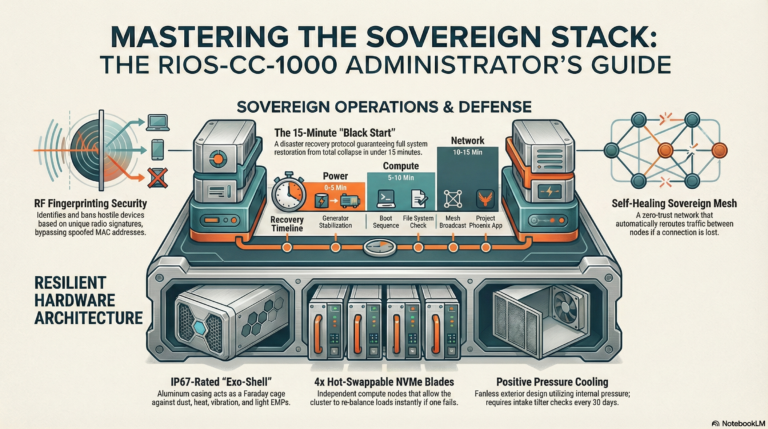
- What is the “Island Mode” feature in RIOS, and why is it critical?
- Differentiate between Tier 1 and Tier 3 hardware in the DeReticular arsenal.
- What is the “Software Flywheel” mentioned in the Project Sovereign Scale financial proforma?
- Describe the role of the “Sovereign Key” within the hardware root of trust.
- What specific problem does the “Nomad Link” modification solve for mobile connectivity?
- Define DePIN and state its projected market capitalization by 2028.
——————————————————————————–
Part 2: Quiz Answer Key
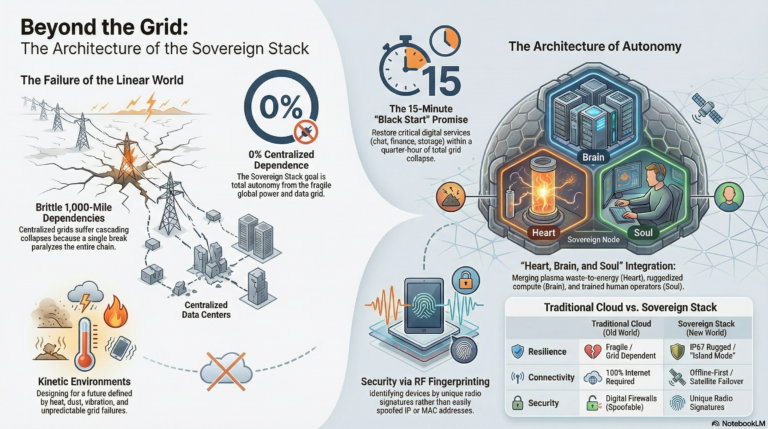
- What is DeReticular’s core thesis regarding the “Death of the Line”? The “Death of the Line” refers to the belief that centralized, fragile utility grids and “Big Tech” cloud dependencies are obsolete. DeReticular proposes replacing these with “Spherical Resilience,” a network of decentralized, self-reliant nodes capable of generating their own power, water, connectivity, and intelligence.
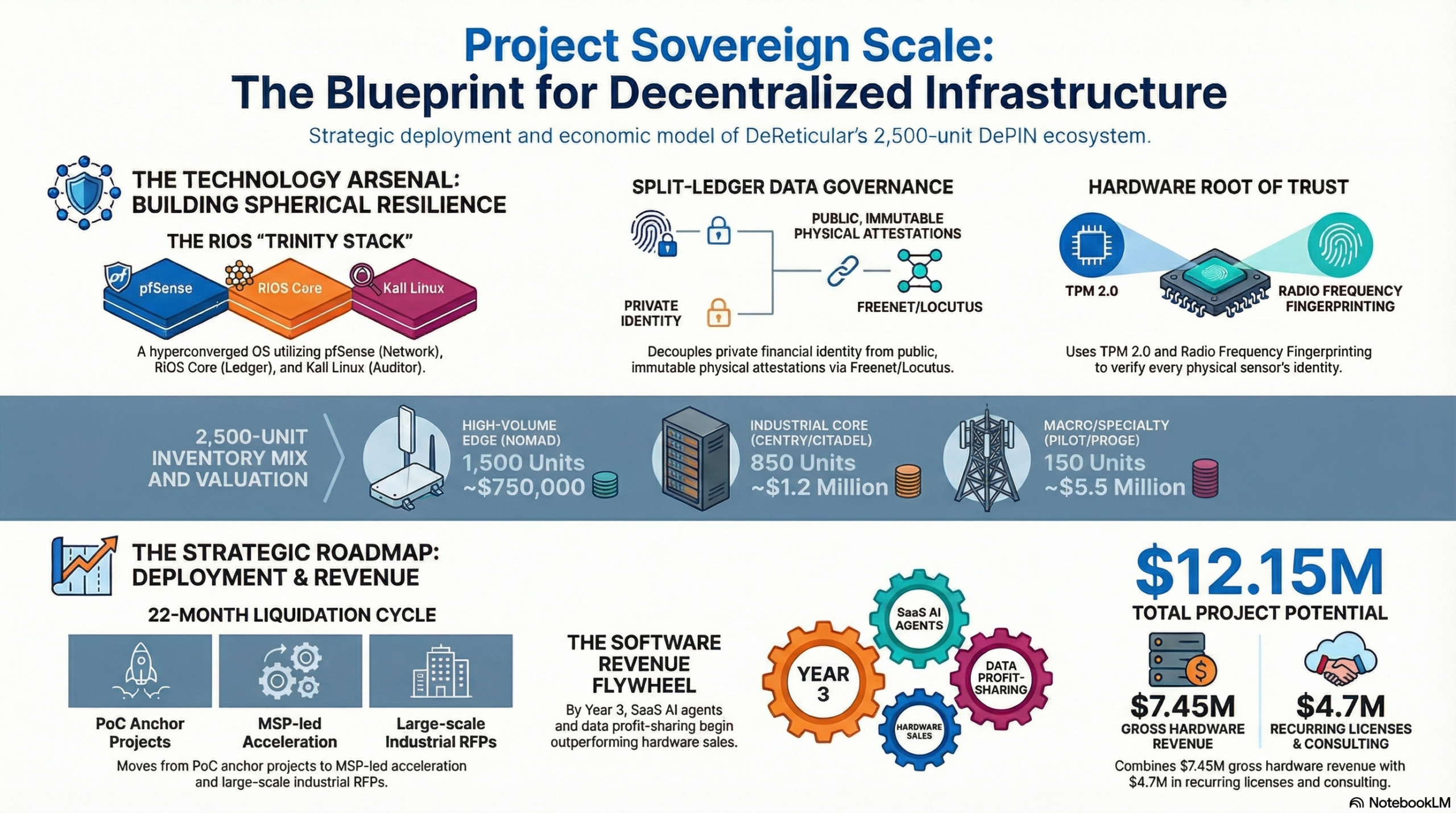
- Describe the three layers of the RIOS “Trinity Stack.” The Trinity Stack consists of Layer 1 (Network) using pfSense/OPNsense for routing and firewalls; Layer 2 (Ledger & Logic) using RIOS Core on Ubuntu to manage the Freenet/Locutus data store; and Layer 3 (Auditor) using Kali Linux for automated vulnerability scanning. This hyperconverged environment ensures the security and autonomy of each node.
- How does the Split-Ledger Architecture resolve the tension between privacy and transparency? It decouples financial settlement from physical attestation by using two distinct layers. Layer A is a private, permissioned ledger for sensitive PII and KYC data to satisfy regulators, while Layer B is a public, immutable ledger (Freenet) that stores “Trustless Commodities” or physical proofs that anyone can verify without accessing private user data.
- Explain the technical function and purpose of Radio Frequency Fingerprinting (RFF). RFF uses integrated Software Defined Radios to scan the microscopic manufacturing imperfections, or the unique “RF Hum,” of connected sensors. This serves as an unforgeable “digital passport,” ensuring that data is coming from a registered physical device rather than a software simulation.
- What is the “Island Mode” feature in RIOS, and why is it critical? Island Mode allows RIOS nodes to maintain 100% functionality while offline, processing all data locally at the edge. It is critical because it ensures that essential infrastructure, such as irrigation or security, remains operational even during regional internet outages or total grid failure.
- Differentiate between Tier 1 and Tier 3 hardware in the DeReticular arsenal. Tier 1 hardware, such as the Nomad series, consists of man-portable, ruggedized units designed for mobile edge telemetry and connectivity. Tier 3 hardware, specifically the Pilot AI Core, consists of 20ft ISO containers equipped with solar wings and dual Xeon Platinums designed for heavy LLM training and scientific simulation.
- What is the “Software Flywheel” mentioned in the Project Sovereign Scale financial proforma? The Software Flywheel represents the shift from one-time hardware sales revenue to recurring high-margin income from AI Agent subscriptions and data-share agreements. As the cumulative fleet of deployed units grows, these digital services eventually outpace hardware sales, creating a stable, non-cyclical cash flow floor.
- Describe the role of the “Sovereign Key” within the hardware root of trust. The Sovereign Key is a physical, white-label YubiKey 5C NFC required for human authentication to authorize destructive or high-level AI commands. It ensures that no remote administrative access is possible without the physical presence of the key, anchoring digital authority to a physical object.
- What specific problem does the “Nomad Link” modification solve for mobile connectivity? The Nomad Link modification involves the “surgical removal” of the internal lithium-ion battery from a vSIM hotspot, replacing it with a Battery Elimination Circuit (BEC). This prevents “puffy battery” fire risks and allows the device to survive extreme heat in vehicle or solar-powered environments.
- Define DePIN and state its projected market capitalization by 2028. DePIN stands for Decentralized Physical Infrastructure, a model that uses cryptocurrency incentives to encourage individuals and communities to build and operate physical networks like energy grids or telecom. The industry is projected to reach a market capitalization of $3.5 trillion by 2028.
Part 3: Essay Questions
- The “Hardware Oracle” Concept: Analyze how RIOS utilizes TPM 2.0 signatures and RFF to solve the “Oracle Problem” in decentralized systems. How does anchoring digital data to physical reality change the trust model for international trade?
- Economic Shift to Sovereignty: Discuss the financial transition from Year 1 to Year 10 in Project Sovereign Scale. Evaluate the strategic importance of “Consulting” and “Hardware Upcycling” in maintaining high gross margins compared to traditional hardware vendors.
- Decentralization vs. Regulation: Examine the Split-Ledger Architecture as a “Safe Harbor” for compliance. Does this dual-layer approach effectively balance the requirements of the SEC/CFTC with the core tenets of blockchain-based decentralization?
- Market Vertical Analysis: Choose one of the four “Blue Ocean” markets identified in the business plan (Small Cities, Precision Ag, Maritime/Hospitality, or Defense). Explain how specific hardware and AI agents (e.g., Sovereign Elector, Sovereign Agronomist) address the unique pain points of that sector.
- Technical Resilience: Compare the “Spherical Resilience” model of DeReticular to the centralized cloud models of “Big Tech.” How does the “Trinity Stack” and “Island Mode” contribute to community-level autonomy during a systemic failure of macro-infrastructure?
——————————————————————————–
Part 4: Glossary of Key Terms
| Term | Definition |
| Automated Notary | A RIOS service that cryptographically signs data packets using the hardware’s TPM 2.0 Ed25519 private key at the moment of ingestion. |
| DePIN | Decentralized Physical Infrastructure; the use of blockchain and tokens to incentivize the creation and management of real-world infrastructure. |
| Freenet / Locutus | A decentralized P2P network and Wasm smart contract platform used as the public “Library” layer for physical attestations in the DeReticular stack. |
| Hardware Upcycling | A business model of taking commodity consumer technology and ruggedizing or modifying it into high-value industrial assets. |
| Intelligent Signal Fusion (ISF) | The technology used to bond multiple connectivity sources, such as Starlink and 5G, to ensure high uptime for mobile nodes. |
| Island Mode | The operational state where a node functions entirely offline, synchronizing data only when a connection is available. |
| OpenClaw | The framework used by DeReticular to build and deploy localized, air-gapped AI agents that run without cloud dependency. |
| RIOS | Rural (or Robotic) Infrastructure Operating System; the AI-native, hyperconverged operating system that acts as the “brain” for all DeReticular hardware. |
| Sovereign Intelligence | A product line of specialized AI agents (Executive, Foreman, etc.) designed to perform enterprise tasks locally and privately. |
| Spherical Resilience | A model of decentralized infrastructure where every node is self-reliant, generating its own power and intelligence to avoid centralized failures. |
| Split-Ledger Architecture | A data governance framework that separates private financial/identity data (Layer A) from public physical/quality data (Layer B). |
| TPM 2.0 | Trusted Platform Module; a hardware chip used to store non-exportable cryptographic keys, providing a physical root of trust for digital signatures. |
| Trinity Stack | The three-layer software architecture of RIOS consisting of pfSense (Network), RIOS Core (Ledger), and Kali Linux (Auditor). |
| Trustless Commodity | A physical asset whose quality and provenance are cryptographically verified by public consensus rather than a central authority. |
| WISP-in-a-Box | A monetization bundle (Sentry Pro + Beacons + Nomad Link) that allows landowners to resell Starlink bandwidth as a Wireless Internet Service Provider. |