Study Guide Node 6 and the Sovereign Mobility Initiative
This study guide provides a comprehensive overview of the Node 6 initiative within the DeReticular ecosystem. It explores the strategic, technological, and economic frameworks designed to solve rural mobility challenges in Western Arizona through autonomous transportation and decentralized infrastructure.
——————————————————————————–
Part 1: Short-Answer Quiz
Instructions: Answer the following questions in 2–3 sentences based on the provided source context.
- What is the “Sovereign Stack” thesis as defined by DeReticular?
- Identify the three foundational pillars of the Sovereign Stack and their specific functions.
- What is the primary mission of Node 6 in La Paz County, Arizona?
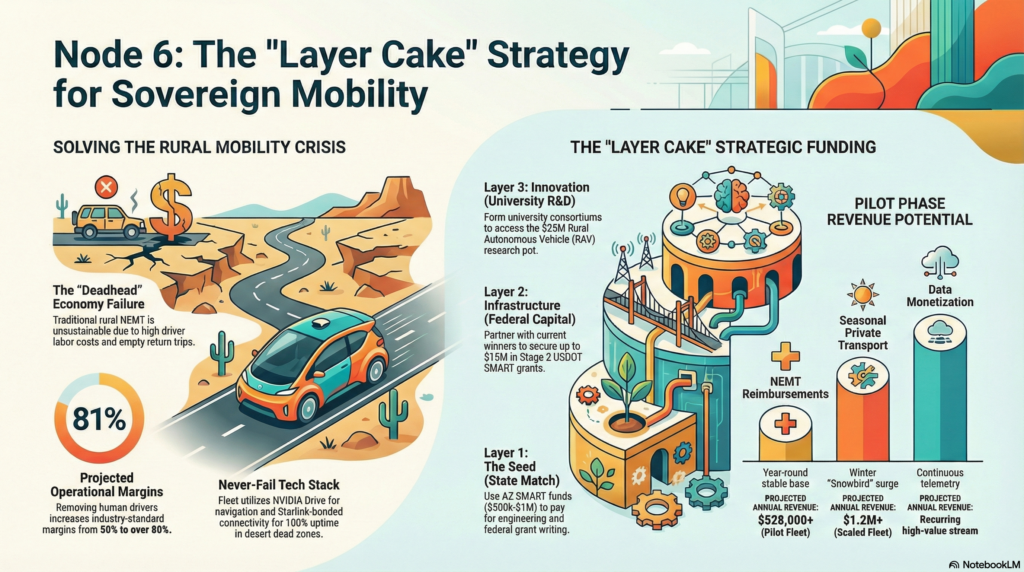
- How does the “Deadhead Economy” contribute to the failure of traditional Non-Emergency Medical Transportation (NEMT)?
- Describe the technological “Nervous System” that ensures 100% uptime for the Kurb Kar fleet.
- What is the “Vehicle-to-Grid” (V2G) capability of the Kurb Kar fleet?
- Who is Brion Crum, and what is his specific role as the “Champion of Node 6”?
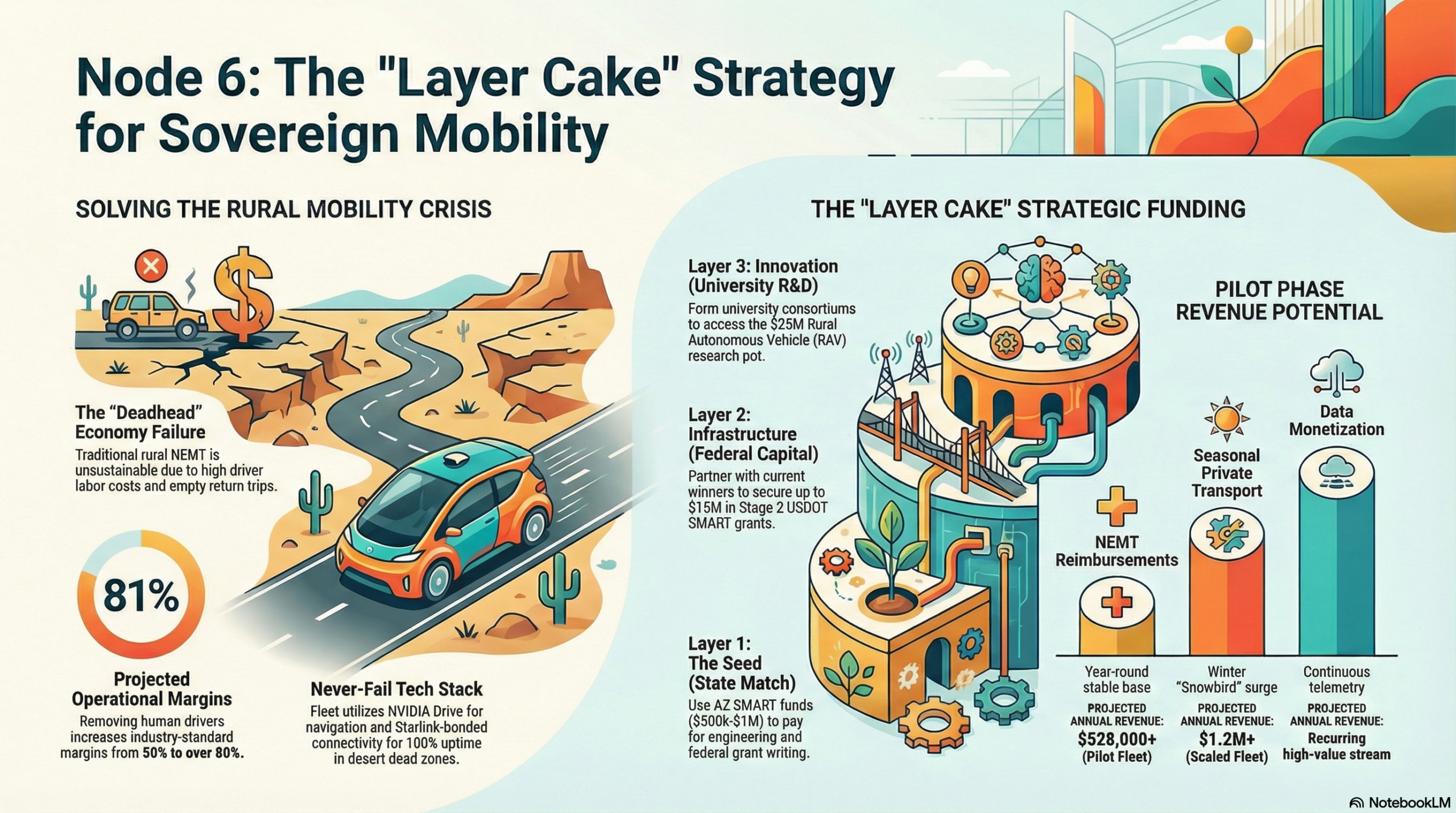
- Explain the “Layer Cake” funding strategy proposed for the 2026 fiscal year.
- How does Node 6 intend to utilize the 2026 Route 66 Centennial for strategic growth?
- What is “Federated Learning” in the context of the Project Octagon network?
Part 2: Answer Key
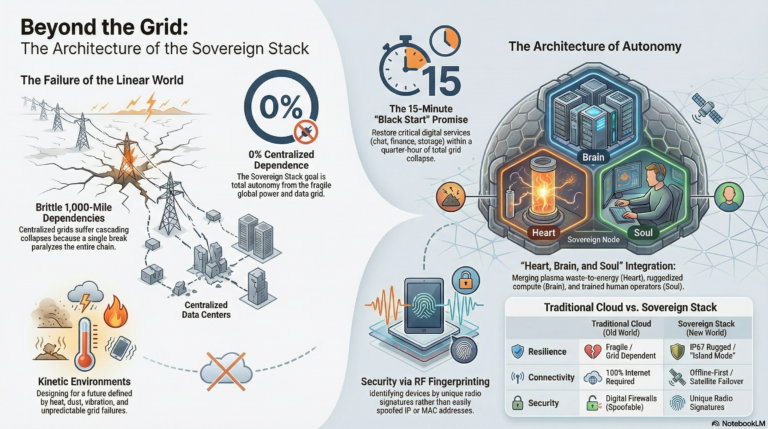
- The Sovereign Stack Thesis: It is a framework designed to enable communities to achieve self-sufficiency and operate in “Island Mode,” independent of national grids and fragile supply chains. It consists of a complete toolkit of tools for local resilience, including power generation, autonomous logistics, and network intelligence.
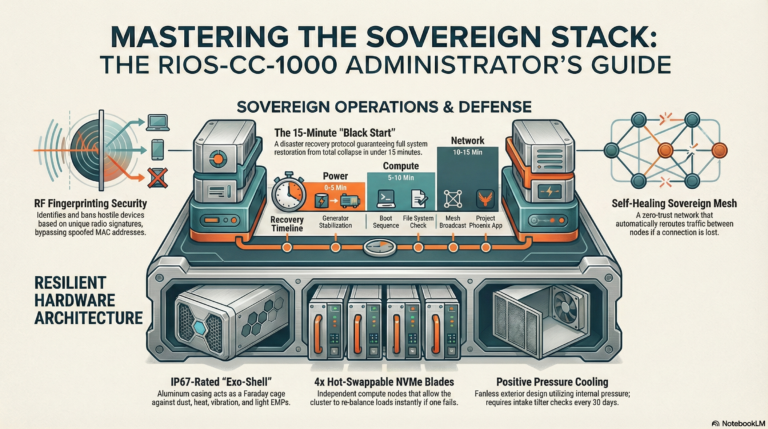
- The Three Pillars: The “Muscle” (Agra Dot Energy) provides power via plasma gasification; the “Motion” (Kurb Kars) handles autonomous logistics and physical movement; and the “Mind” (RIOS/Biz Builder Mike) provides the network intelligence and operating system directing the ecosystem.
- Node 6 Mission: Formerly focused on governance, Node 6 is now the “Autonomous Transportation Division” tasked with solving the rural NEMT crisis. It aims to deploy a fleet of autonomous “Kurb Kars” to provide reliable, 24/7 healthcare logistics for the elderly and vulnerable populations of La Paz County.
- The Deadhead Economy: This refers to the financial penalty traditional providers face when driving empty vehicles to remote pickup locations. These unsustainable costs lead to chronic provider shortages, frequently missed medical appointments, and a breakdown of the physical link to healthcare in rural areas.
- The Nervous System: The fleet utilizes “Signal Fusion” or “Starlink Bonding,” which merges high-performance Starlink satellite internet with CAT4 vSIM cellular data. This creates an unbreakable “Global Mesh Protocol” that maintains a constant connection even in remote cellular dead zones.
- Vehicle-to-Grid (V2G): This technology allows Kurb Kars to function as mobile batteries when they are not in service. By plugging into a microgrid, they stabilize the local power supply and trade energy, turning a depreciating transportation asset into a revenue-generating utility.
- Brion Crum: Known as “The Human Link,” Crum is a veteran private equity and real estate executive who serves as the strategic architect for Node 6. His role is to bridge technology, capital, and real estate to ensure the physical infrastructure is funded, compliant, and integrated into the community.
- The Layer Cake Funding Strategy: This is a three-tiered approach to securing non-dilutive capital: the “Seed Layer” uses state funds (AZ SMART Fund) for grant writing; the “Infrastructure Layer” targets federal DOT grants for physical assets; and the “Innovation Layer” seeks R&D grants for autonomous operations.
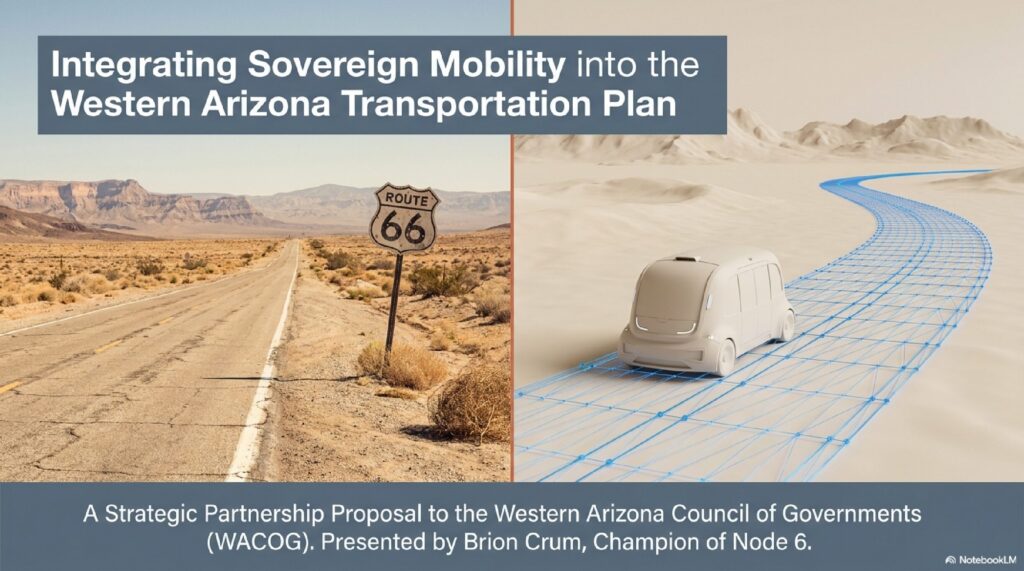
- Route 66 Centennial: Node 6 plans to secure “Official Centennial Project” status by positioning the Kurb Kar fleet as the high-tech evolution of the “Mother Road.” This includes creating a “Green Corridor” shuttle service and converting historic motels into “Autonomous Depots” to access preservation and tourism grants.
- Federated Learning: This is a concept where insights gained in one location improve the entire global network. For example, autonomous driving data perfected on difficult Arizona desert roads is pushed via network updates to improve the performance of agricultural tractors in other nodes, such as Uganda.
Part 3: Essay Questions
Instructions: Use the provided context to develop comprehensive responses to the following prompts.
- Systemic Failure and Innovation: Analyze how Node 6 addresses the “Social Determinant Barrier” of transportation. Discuss how the autonomous model overcomes the specific economic and demographic hurdles identified in the La Paz County regional analysis.
- The Economic Shift of Autonomous Transit: Compare the traditional NEMT business model with the Node 6 model. Focus on the transition from a 50% industry-standard margin to a projected 81% margin, citing specific cost reductions and new revenue streams like data monetization and energy arbitrage.
- Infrastructure Piggybacking and Regional Planning: Discuss the importance of integrating autonomous technology into existing regional projects, such as the Quartzsite Blvd widening and the Mohave Road Reconstruction. Why is “V2I” (Vehicle-to-Infrastructure) communication critical for long-term success?
- Resilience and “Island Mode”: Evaluate the role of RIOS (Rural Infrastructure Operating System) in creating a resilient network. How do features like “Signal Fusion” and “Agentic Workflows” ensure that the system remains functional independent of national infrastructure?
- The Human and Capital Nexus: Examine the role of the “Node Champion.” Using Brion Crum as a case study, explain why the deployment of high-tech autonomous systems requires expertise in private equity, real estate, and community networking rather than just technical engineering.
——————————————————————————–
Part 4: Glossary of Key Terms
| Term | Definition |
| AHCCCS | Arizona Health Care Cost Containment System; the state’s Medicaid agency used for NEMT reimbursements. |
| AZ SMART Fund | A state-level fund designed to help rural Arizona counties pay for engineering and grant-writing services to compete for federal grants. |
| CFI Grant | Charging and Fueling Infrastructure Grant; a federal program with a 50% set-aside for rural areas, targeted by Node 6 for charging hubs. |
| Deadhead Miles | Miles driven by a commercial vehicle without a passenger or cargo; a primary cause of financial loss in rural transit. |
| Federated Learning Mesh | A decentralized network architecture where data/intelligence from one node (e.g., Arizona) is used to train and update systems in other nodes (e.g., Uganda). |
| Island Mode | A state of operational self-sufficiency where a community functions independently of national energy, data, and supply grids. |
| Kurb Kar | A ruggedized, autonomous electric pod designed for patient transport, light logistics, and mobile energy storage. |
| NEMT | Non-Emergency Medical Transportation; a critical healthcare service for patients who need transport to medical appointments but do not require an ambulance. |
| Project Octagon | DeReticular’s strategic global deployment of eight interconnected “Sovereign Nodes,” each serving a unique function like R&D, energy, or logistics. |
| RIOS | Rural Infrastructure Operating System; the proprietary “Global Operating System” that connects and directs the DeReticular ecosystem. |
| Signal Fusion | The process of bonding different data streams (like Starlink satellite and cellular 5G/vSIMs) to create a reliable, “never-fail” internet connection. |
| Sovereign Mobility | The capacity to provide essential transportation services that are independent of traditional fuel, labor, and data supply chains. |
| V2G (Vehicle-to-Grid) | A system where electric vehicles can communicate with the power grid to either take power for charging or discharge power back into the grid to stabilize it. |
| V2I (Vehicle-to-Infrastructure) | Communication technology that allows vehicles to share data with “smart” road components like sensors, overpasses, and charging hubs. |
| zkVerify | A technology used to verify high-value “edge case” driving data before it is sold to global autonomous driving databases. |
| Term | Definition |
| AHCCCS | Arizona Health Care Cost Containment System; the state’s Medicaid agency used for NEMT reimbursements. |
| AZ SMART Fund | A state-level fund designed to help rural Arizona counties pay for engineering and grant-writing services to compete for federal grants. |
| CFI Grant | Charging and Fueling Infrastructure Grant; a federal program with a 50% set-aside for rural areas, targeted by Node 6 for charging hubs. |
| Deadhead Miles | Miles driven by a commercial vehicle without a passenger or cargo; a primary cause of financial loss in rural transit. |
| Federated Learning Mesh | A decentralized network architecture where data/intelligence from one node (e.g., Arizona) is used to train and update systems in other nodes (e.g., Uganda). |
| Island Mode | A state of operational self-sufficiency where a community functions independently of national energy, data, and supply grids. |
| Kurb Kar | A ruggedized, autonomous electric pod designed for patient transport, light logistics, and mobile energy storage. |
| NEMT | Non-Emergency Medical Transportation; a critical healthcare service for patients who need transport to medical appointments but do not require an ambulance. |
| Project Octagon | DeReticular’s strategic global deployment of eight interconnected “Sovereign Nodes,” each serving a unique function like R&D, energy, or logistics. |
| RIOS | Rural Infrastructure Operating System; the proprietary “Global Operating System” that connects and directs the DeReticular ecosystem. |
| Signal Fusion | The process of bonding different data streams (like Starlink satellite and cellular 5G/vSIMs) to create a reliable, “never-fail” internet connection. |
| Sovereign Mobility | The capacity to provide essential transportation services that are independent of traditional fuel, labor, and data supply chains. |
| V2G (Vehicle-to-Grid) | A system where electric vehicles can communicate with the power grid to either take power for charging or discharge power back into the grid to stabilize it. |
| V2I (Vehicle-to-Infrastructure) | Communication technology that allows vehicles to share data with “smart” road components like sensors, overpasses, and charging hubs. |
| zkVerify | A technology used to verify high-value “edge case” driving data before it is sold to global autonomous driving databases. https://youtu.be/xFO_LjW2CWk |