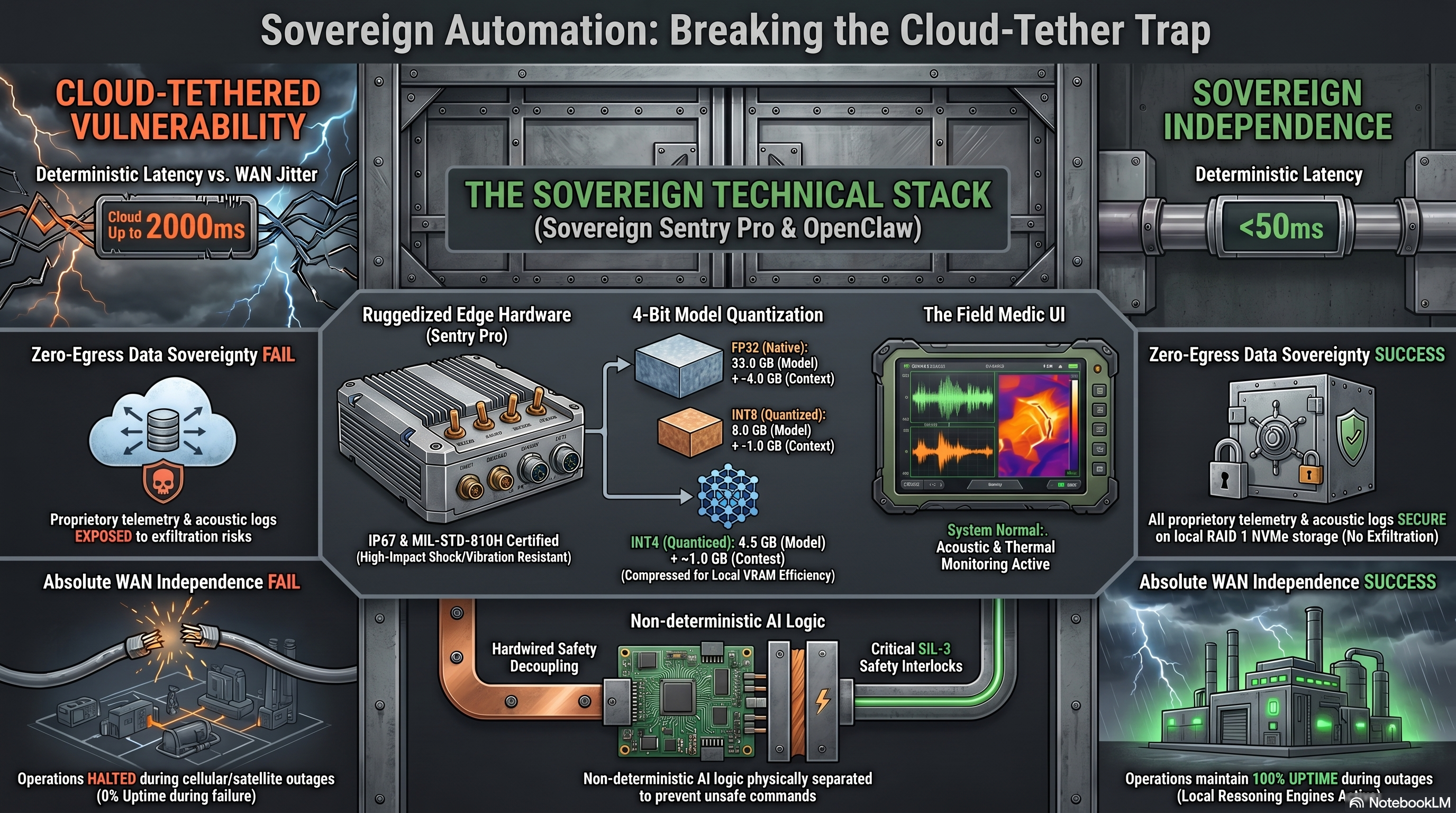
This study guide provides a comprehensive review of the “Sovereign Automation” paradigm, focusing on the deployment of air-gapped AI agents using localized edge hardware. It synthesizes technical specifications, operational strategies, and risk mitigation frameworks as outlined by the Systems Engineering Division at DeReticular.
——————————————————————————–
Part 1: Short-Answer Quiz
Instructions: Answer the following questions in 2–3 sentences based on the information provided in the technical white paper and gap analysis.
- Define “Sovereign Automation” as presented in the text.
- What are the primary operational risks associated with “cloud-tethered” industrial AI?
- Explain the mathematical benefit of transitioning an 8-billion (8B) parameter model from FP32 to INT4 precision.
- Distinguish between the “Prefill Phase” and the “Decoding Phase” in edge AI computation.
- What physical hardware features allow the Sovereign Sentry Pro to operate in harsh industrial environments?
- How does the OpenClaw framework handle legacy industrial protocols like Modbus or CAN bus?
- Describe the role of the “Physical Air-Gap” key-switch in the system’s security architecture.
- In the “Field Medic” case study, how does the agent use Retrieval-Augmented Generation (RAG)?
- What is the “deterministic parsing layer,” and why is it critical for safety?
- Explain the “Air-Gap Maintenance Tax” mentioned in the SWOT analysis.
——————————————————————————–
Part 2: Quiz Answer Key
- Sovereign Automation Definition: Sovereign Automation is a paradigm shift where AI intelligence resides locally where physical work is performed. It utilizes ruggedized edge-compute clusters and optimized local AI runtimes to execute reasoning and diagnostic logic entirely within a local area network (LAN) under air-gapped conditions.
- Cloud-Tethered Risks: Cloud dependency introduces deterministic network deficits like latency spikes and jitter, which prevent stable control loops. It also creates fragility through WAN backhaul reliance, risks intellectual property exfiltration, and leads to vendor lock-in through software locks and subscription models.
- Quantization Benefits: Moving from FP32 to INT4 reduces the memory footprint of an 8B parameter model from approximately 32.0 GB to 4.5 GB (including context overhead). This 71.8% reduction in memory allows advanced models to fit on cost-effective edge chips with minimal degradation in reasoning cohesion.
- Prefill vs. Decoding: The Prefill Phase (prompt processing) is compute-bound, benefiting from parallel processing units like Tensor Cores to process input tokens simultaneously. The Decoding Phase (token generation) is memory-bandwidth bound because the processor must load the entire model’s weights sequentially for each token generated.
- Ruggedized Hardware Features: The Sovereign Sentry Pro features a fanless, IP67-rated CNC-milled aluminum chassis with deep cooling fins for passive heat dissipation. It is MIL-STD-810H certified for high-impact shock and multi-axis vibration, utilizing no moving parts and locked-down internal connections.
- Protocol Integration: OpenClaw includes containerized protocol proxies that translate physical bus signals into clean, JSON-structured schema telemetry. This bridge allows AI agents to read machine states from legacy systems and suggest precise physical commands.
- Physical Air-Gap Security: The system utilizes a hardwired key-switch on the front panel that acts as a hardware-level network disconnect. When activated, it physically disables the RJ45 and wireless transceivers to guarantee a 100% air-gapped posture that cannot be overridden by software.
- RAG in the Field Medic Study: The Field Medic agent queries a localized SQLite-VSS or Qdrant database containing 800 pages of OEM repair manuals and parts catalogs. By retrieving this data locally, the agent can provide step-by-step repair instructions without an external internet connection.
- Deterministic Parsing Layer: This is a hardcoded schema validator in the OpenClaw software that inspects every action suggested by the AI agent. If a model suggests a command or value outside of predefined safe physical boundaries, the software halts execution to prevent “hallucinations” from causing physical damage.
- Air-Gap Maintenance Tax: This refers to the operational burden of manual lifecycle management. Because the system is air-gapped, standard cloud-pushed updates are impossible, requiring maintenance teams to schedule physical site visits to deliver cryptographically signed updates via USB-C.
——————————————————————————–
Part 3: Essay Format Questions
Instructions: Use the provided source context to develop detailed responses for the following prompts.
- The Physics of Edge AI: Discuss the relationship between model quantization, memory bandwidth, and token generation speed. How do these factors determine the feasibility of running an 8B parameter model on localized hardware?
- Architectural Transition: Based on the Gap Analysis, outline the four-phase roadmap required to transition a facility from a cloud-tethered IoT setup to Sovereign Edge Automation. What are the most critical “blocker” gaps that must be addressed?
- Safety and Human-AI Interaction: Evaluate the multi-layered safety strategy employed in Sovereign Automation. Focus on the decoupling of AI cognitive layers from SIL-3 rated safety PLCs and the role of hardwired overrides.
- Economic and Strategic Value: Analyze the SWOT matrix for Sovereign Automation. Compare the upfront Capital Expenditure (CapEx) against the potential reduction in Operating Expenditure (OpEx) and the strategic advantage of “Right to Repair” alignment.
- Multi-Modal Diagnostics in Practice: Compare and contrast “The Field Medic” and “The Industrial Foreman” case studies. How do these applications demonstrate the versatility of the OpenClaw framework in different industrial environments?
——————————————————————————–
Part 4: Comprehensive Glossary
| Term | Definition |
| AWQ (Activation-aware Weight Quantization) | A quantization technique that preserves the high-impact “salient” weights of LLMs, minimizing reasoning degradation while compressing the model footprint. |
| CAN bus (Controller Area Network) | A robust vehicle bus standard that allows microcontrollers and devices to communicate without a host computer; common in heavy machinery. |
| Deterministic Latency | A predictable, bounded time delay in network communication, essential for stable industrial control loops. |
| GGUF (GPT-Generated Unified Format) | A binary file format optimized for local CPU/GPU execution using llama.cpp, designed for fast loading and saving of models. |
| Modbus | A legacy serial communication protocol widely used for connecting industrial electronic devices. |
| OPC UA (Open Platform Communications Unified Architecture) | A machine-to-machine communication protocol for industrial automation. |
| Perplexity | A statistical metric used to measure how well a probability model predicts a sample; lower perplexity indicates a more coherent and accurate model. |
| PLP (Power Loss Protection) | Capacitors used in NVMe solid-state storage to prevent data corruption during sudden electrical blackouts. |
| Quantization | The process of mapping continuous floating-point weights (e.g., FP32) to lower-precision representations (e.g., INT4) to reduce memory requirements. |
| RAG (Retrieval-Augmented Generation) | An architecture that retrieves relevant data from a local index (like technical manuals) to ground AI responses and reduce hallucinations. |
| SIL-3 (Safety Integrity Level 3) | A high-level safety certification for industrial systems; SIL-3 interlocks are used for critical safety-critical functions like emergency stops. |
| Sparse TOPS | A measure of AI compute performance (Tera Operations Per Second) emphasizing the hardware’s ability to handle sparse neural network calculations. |
| TPM 2.0 (Trusted Platform Module) | A dedicated microcontroller designed to secure hardware through integrated cryptographic keys, used for secure boot and update verification. |
| VSS (Vector Search Structure) | A localized database indexing method (e.g., SQLite-VSS) used for high-speed retrieval of embedded data during RAG operations. |
| WAN (Wide Area Network) | External network connections (cellular, satellite, fiber) that Sovereign Automation seeks to bypass to ensure operational independence. |