DeReticular and the Sovereign Automation Landscape: A Briefing Document
Executive Summary
As of May 2026, the artificial intelligence industry is undergoing a fundamental “Agentic Shift,” moving from reactive Large Language Models (LLMs) to proactive “Agentic AI.” This landscape is currently divided between two warring philosophies: Centralized Cloud Agents (epitomized by Google’s Project Remy) and Decentralized Sovereign Agents (championed by DeReticular and the OpenClaw framework).
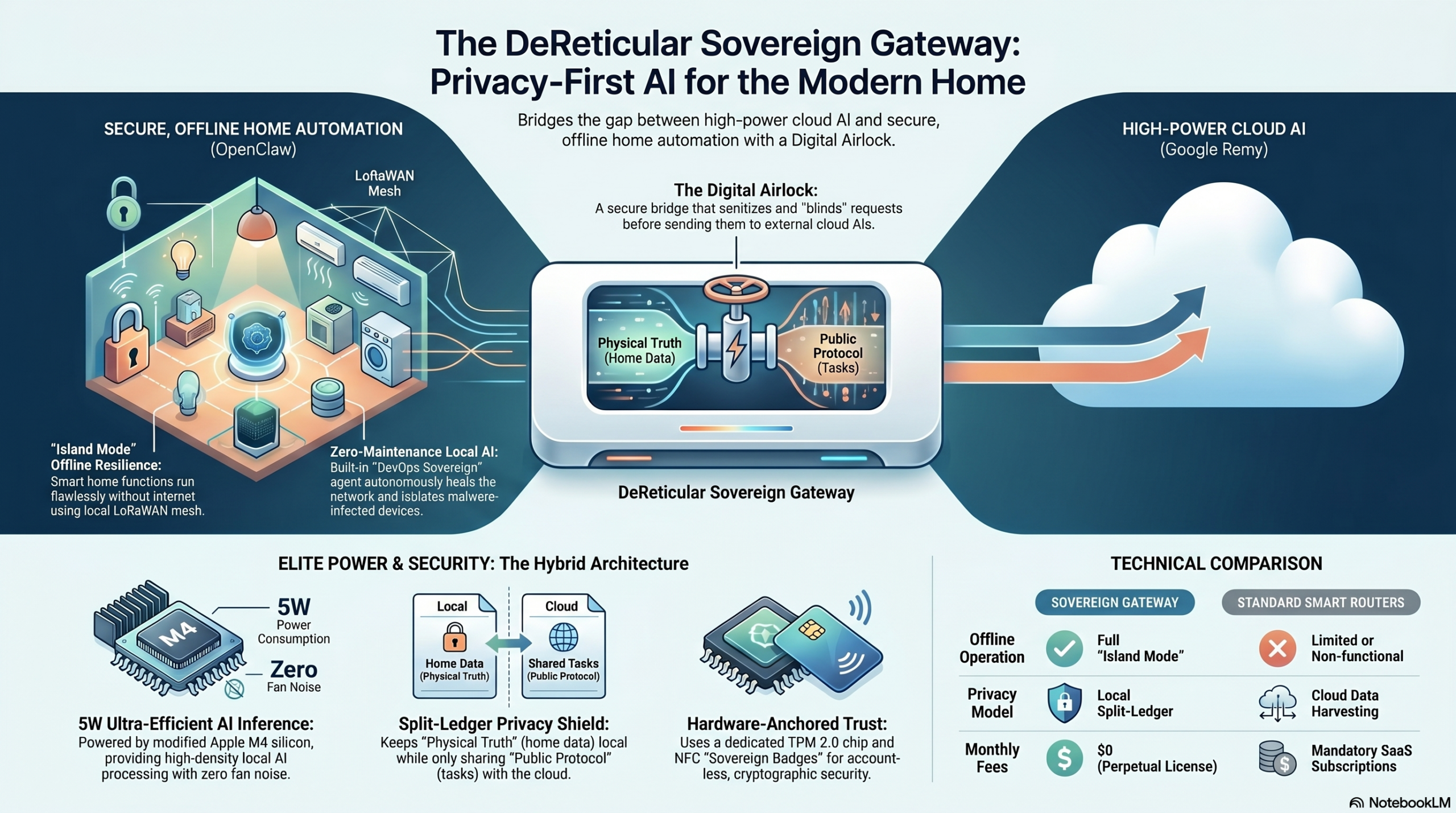
DeReticular, a venture studio specializing in Decentralized Physical Infrastructure Networks (DePIN), is positioning itself as the bridge between these two worlds. Its flagship consumer product, the Sovereign Gateway, integrates industrial-grade resilient infrastructure into a home mesh router. The Gateway utilizes the “Digital Airlock” and “Split-Ledger Privacy Shield” to allow users to access the logistical power of Google Remy while maintaining absolute local privacy through “Island Mode”—an air-gapped operating state that ensures smart homes remain functional without internet connectivity.
The core value proposition of this ecosystem is Sovereign Automation: the ability to own one’s hardware, data, and AI capabilities perpetually, without mandatory SaaS subscriptions or exposure to corporate data harvesting.
1. The Agentic Divide: Centralization vs. Decentralization
The tech industry in 2026 is defined by a fierce battle over the future of autonomous personal assistants.
Google Project Remy (The Centralized Model)
Leaked in early May 2026, Project Remy is an “always-on” proactive assistant integrated into the Google ecosystem.
- Architecture: Cloud-native, relying on Google’s server farms, TPU 8i silicon, and Gemini 3.2 Flash models.
- Operation: Monitors Gmail, Calendar, and Drive to execute multi-step tasks (e.g., booking flights or organizing schedules) autonomously.
- Weakness: Requires deep, privileged access to user data and persistent internet connectivity, leading to the “Trusted Environment Fallacy.”
OpenClaw (The Decentralized Model)
An open-source AI agent framework that allows for self-hosted, autonomous assistants.
- Architecture: Localized and framework-agnostic (“Bring Your Own Agent”).
- Operation: Executes tasks natively on local hardware without relying on centralized providers.
- Weakness: Historically more complex to set up; suffered a major supply chain attack (CVE-2026-25253) in early 2026.
DeReticular’s Strategic Positioning
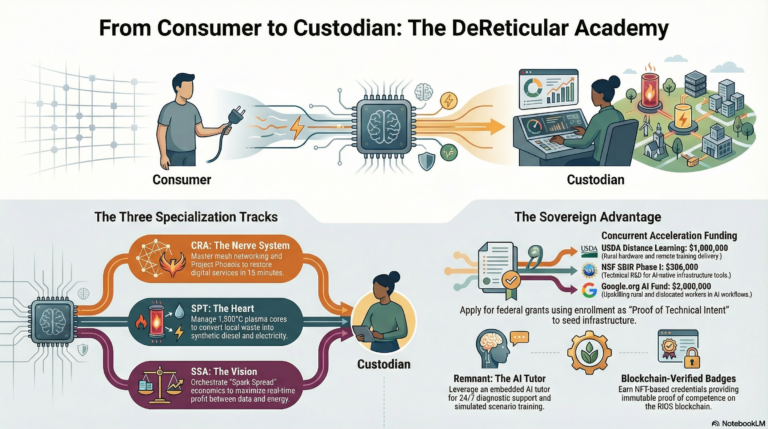
DeReticular utilizes OpenClaw to power its Rural Infrastructure Operating System (RIOS). While Google aims for mass-market convenience, DeReticular focuses on “Spherical Resilience,” replacing vulnerable centralized lines with autonomous, self-healing nodes.
——————————————————————————–
2. DeReticular Corporate Profile and Philosophy
DeReticular is an AI-focused venture and research platform dedicated to re-industrializing the world through decentralized infrastructure.
- Core Philosophy: “The Death of the Line.” The company seeks to replace fragile, centralized utility grids with autonomous nodes.
- Mission: Providing resilient infrastructure to rural and underserved areas, ensuring physical survival through offline autonomy.
- Key Personnel: Co-founded by Michael Noel, an expert in DePIN and blockchain infrastructure.
- Affiliated Ventures: Includes “Kurb Kars,” a self-governing autonomous logistics network for Non-Emergency Medical Transportation (NEMT) and last-mile delivery.
——————————————————————————–
3. The Sovereign Gateway (DER-SOV-GW-01)
The Sovereign Gateway is a consumer-grade edge-compute AI mesh router that packages enterprise-grade “Sovereign Automation” into a home appliance.
Technical Specifications
| Component | Specification |
| Processor | Premium Silicon Sentry (Modified Apple M4 Silicon) |
| Memory | 16GB LPDDR5X Unified Memory |
| Storage | 512GB NVMe NAND Flash |
| Networking | Trifi Wireless (Wi-Fi 6E, LoRaWAN Local Mesh) |
| Power Draw | 5W Idle (Passively Cooled / Fanless) |
| Security | Hardware TPM 2.0; RF Fingerprinting; Physical Reset Pin |
| Operating System | RIOS (Rural Infrastructure Operating System) |
Key Product Features
- Island Mode: Processes all IoT and smart home commands locally. If the ISP fails, lights, security, and climate control continue to run.
- The Remy Bridge (Digital Airlock): A secure API gateway that sanitizes cloud requests. It strips contextual home data via a “Split-Ledger Privacy Shield” before handing a “blinded” payload to Google Remy for external logistics.
- Zero-Maintenance Edge AI: Pre-installed agents manage the system autonomously, acting as an “invisible IT department.”
- Sovereign Badges: An account-less identity system using NFC-enabled setup cards to mint cryptographic keys into user phone wallets (Apple/Google Wallet).
——————————————————————————–
4. Specialized Sovereign AI Agents
DeReticular utilizes the OpenClaw framework to run proprietary agents natively on the Gateway hardware:
- SOV-AUTO-DEV (DevOps Sovereign): An air-gapped sysadmin that monitors network security, isolates malware-infected IoT devices, and self-heals digital services.
- SOV-AUTO-EXEC (Sovereign Executive): A private “Chief of Staff” using local Whisper AI for voice-to-text. It handles local commands and routes cloud-based requests through the Digital Airlock.
- Vault Warden (Consumer Edition): Processes local security camera feeds on the device’s GPU using volumetric and multispectral analysis. It stores footage on a local split-ledger, ensuring no cloud uploads or monthly fees.
——————————————————————————–
5. Manufacturing and Fulfillment Operations
The production and distribution of the Sovereign Gateway follow a rigorous cryptographic security protocol known as “The Forge.”
Fulfillment Workflow
- Compliance: All orders undergo ITAR/EAR and OFAC export compliance checks due to the inclusion of advanced silicon and military-grade encryption.
- Hardware Provisioning: Technicians flash RIOS and pre-load Sovereign Agents onto a raw “Premium Silicon Sentry” node.
- Cryptographic Anchoring: The system burns a unique RF Fingerprint for the radios and initializes the TPM 2.0 module, creating a unique Split-Ledger genesis block for the user.
- Tamper-Evident Kitting: The unit is packed with a paired NFC Sovereign Badge card and sealed with holographic security tape.
- Data Destruction Protocol: For returns (RMA), a hardware jig triggers the physical reset pins, shredding the TPM 2.0 keys and turning all stored data into unrecoverable noise.
——————————————————————————–
6. Strategic Analysis (SWOT)
| Strengths | Weaknesses |
| Unmatched privacy (TPM 2.0, Split-Ledger). | High price point ($799 base / $1,299 mesh). |
| “Island Mode” offline resilience. | High consumer education barrier. |
| Perpetual licensing (No SaaS fees). | “Bring Your Own Key” friction for cloud AI. |
| Opportunities | Threats |
| Growing “Tech-Lash” and privacy demands. | Big Tech API gatekeeping (blocking intermediaries). |
| Rural tech boom (Starlink/5G integration). | OpenClaw supply chain vulnerabilities. |
| “Prosumer” market for trustless hardware. | Competitor pivots by Apple or Ubiquiti. |
——————————————————————————–
7. Conclusion
DeReticular is transitioning from an industrial infrastructure provider to a premier consumer privacy brand. By “consumerizing” its existing industrial nodes into the Sovereign Gateway, the company has created a new hardware category: the Trustless AI Gateway.
While Google’s Project Remy seeks to become the ultimate cloud-connected digital butler, DeReticular’s ecosystem prioritizes sovereignty and offline survival. As noted in the strategic research, the Gateway allows users to enjoy the “logistical magic of Big Tech AI, without letting Big Tech see inside your home.” The success of this initiative depends on DeReticular’s ability to simplify its messaging and maintain the integrity of its “Digital Airlock” against potential gatekeeping by centralized AI providers.