DeReticular and the Sovereign Automation Landscape: A Comprehensive Study Guide
This study guide provides a detailed synthesis of the provided research reports, product specifications, and strategic analyses regarding DeReticular’s decentralized infrastructure and the 2026 AI agent competitive landscape.
1. Executive Overview of DeReticular
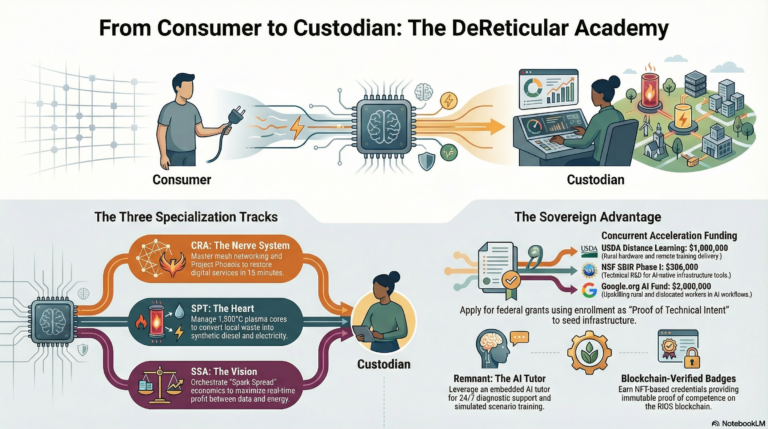
DeReticular is a venture studio and infrastructure company focused on Decentralized Physical Infrastructure Networks (DePIN). Its core mission is the “re-industrialization” of the world through resilient, self-healing infrastructure, particularly in rural and underserved areas.
Core Philosophy: “The Death of the Line”
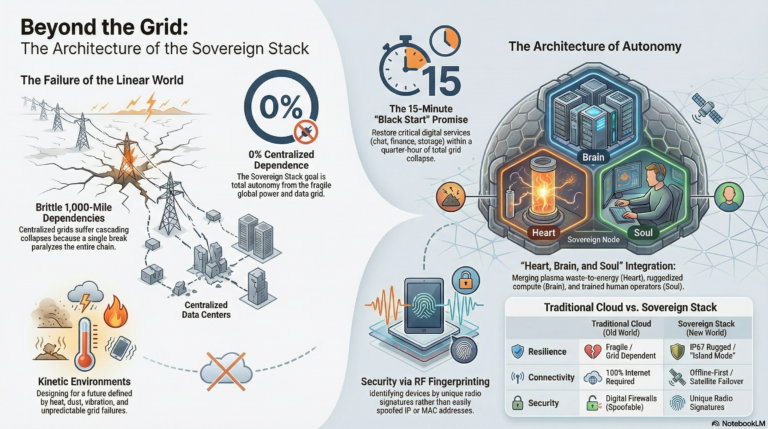
The company operates under the philosophy of “The Death of the Line,” which seeks to replace fragile, centralized utility grids (power and data lines) with “Spherical Resilience.” This is achieved through autonomous, air-gapped nodes that can operate independently of a central authority.
Key Infrastructure: RIOS and Island Mode
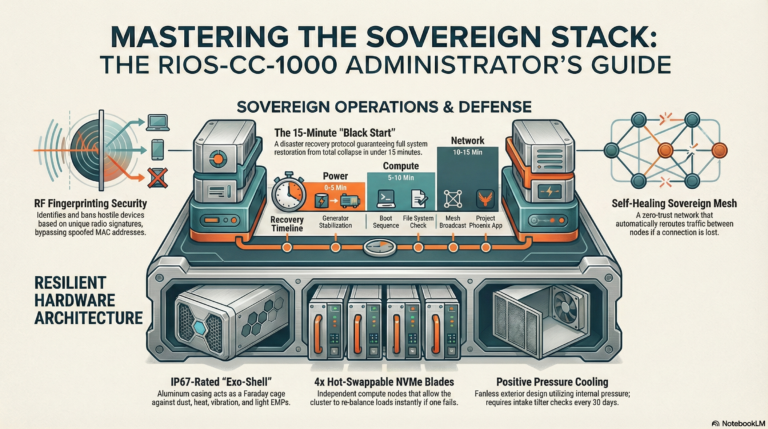
The Rural Infrastructure Operating System (RIOS) is the foundational “brain” of DeReticular’s architecture. It is an AI-native, container-optimized Linux kernel designed for “Island Mode”—a state where physical nodes operate completely offline to ensure security and survival during cyberattacks or centralized outages.
——————————————————————————–
2. Hardware Tiers and Specifications
DeReticular’s “Pilot Series” hardware scales based on compute requirements, ranging from individual home use to municipal management.
The Pilot Series Tiers
| Tier | Platform | Core Specifications | Intended Use |
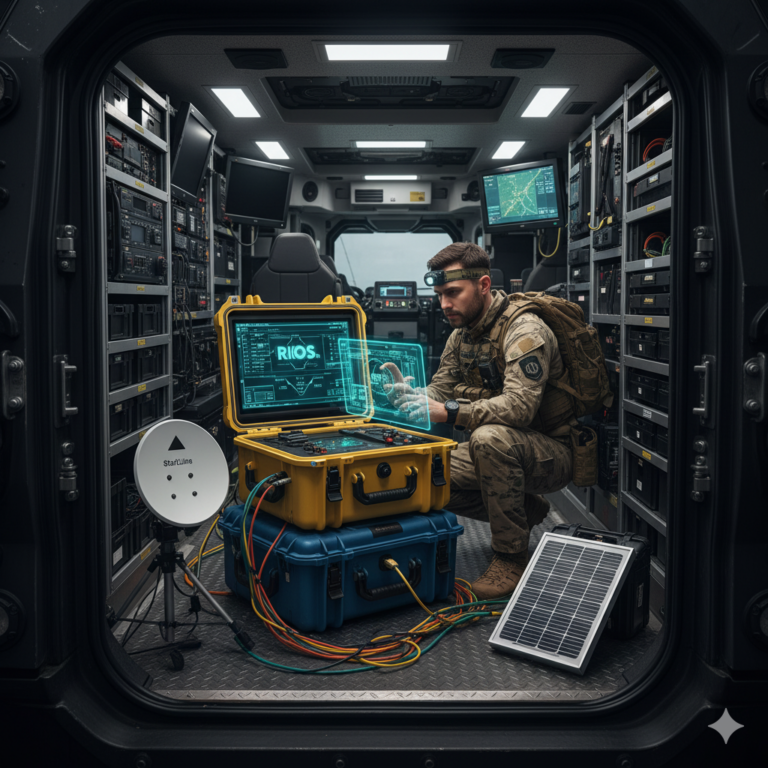
| Tier 1 | Pilot Expeditionary | Intel Xeon, NVIDIA A2 GPU, 400W Solar | Rugged/Mobile use in 3-case suitcase |
| Tier 2 | Pilot Standard | 10ft ISO Container, 4.4kW Solar, 20kWh Battery | Climate-controlled infrastructure |
| Tier 3 | Pilot AI Core | 20ft ISO Container, Dual Xeon Platinum, NVIDIA A100, 15kW Solar | Large-scale compute and power |
| Premium | Silicon Sentry | Modified Apple M4 Silicon (5W idle draw) | Efficient, silent AI inference |
The Sovereign Gateway (DER-SOV-GW-01)
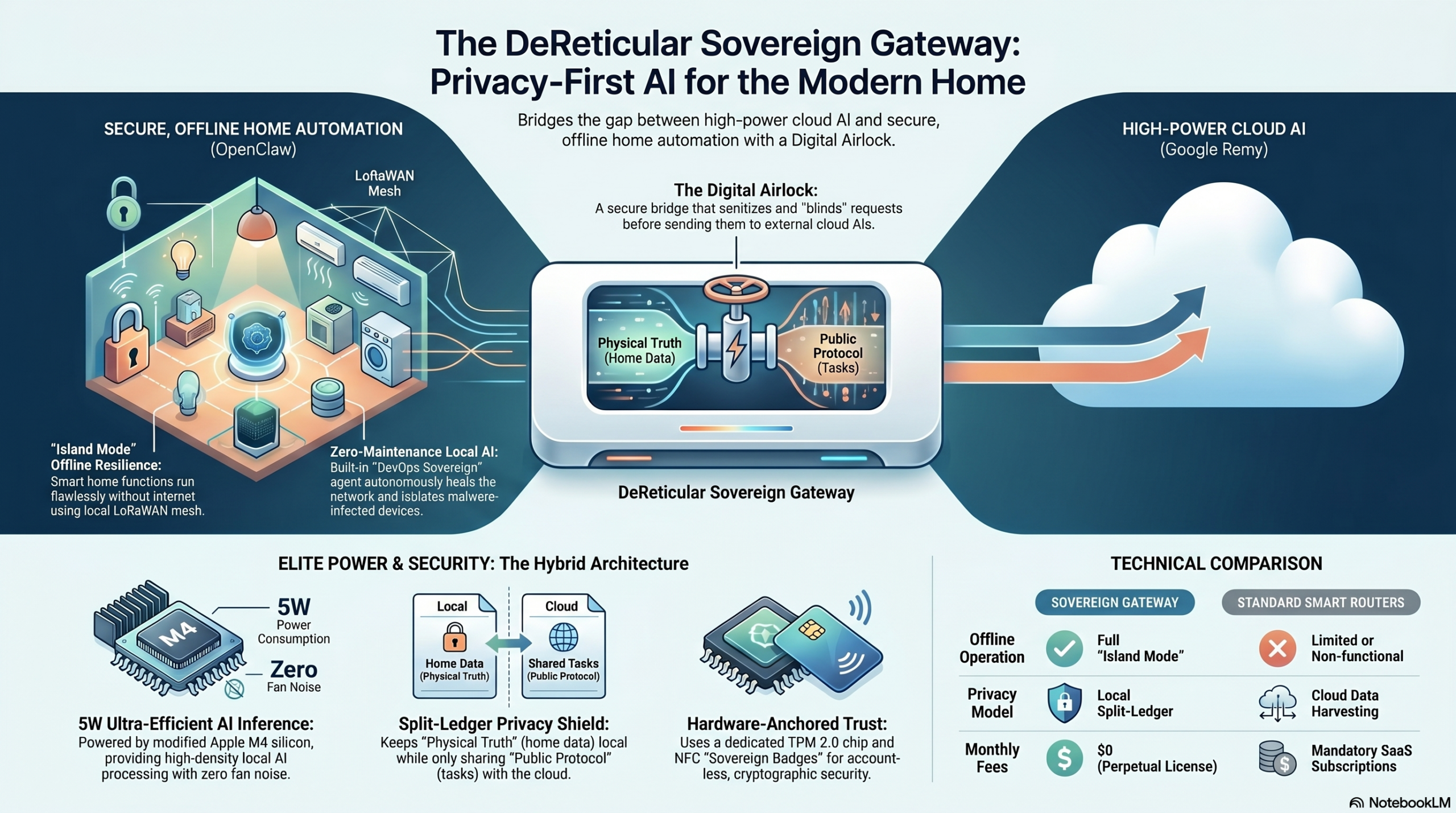
The Sovereign Gateway is the consumer-grade adaptation of this technology. It is an edge-compute AI mesh router designed for “Trustless” home automation.
- Networking: Trifi Wireless (Wi-Fi 6E and LoRaWAN mesh).
- Security: Hardware TPM 2.0 and RF Fingerprinting.
- Aesthetics: Anodized aluminum chassis designed for passive cooling (0dB noise).
——————————————————————————–
3. The AI Agent Landscape: OpenClaw vs. Google Remy
The year 2026 is defined by a “zero-sum war” between centralized and decentralized AI philosophies.
Google Project Remy (Centralized)
- Philosophy: A 24/7 proactive “digital butler” integrated into the Google Workspace (Gmail, Calendar, Drive).
- Architecture: Cloud-native, relying on TPU 8i silicon and Gemini models.
- Strength: Seamless logistics and convenience for the average consumer.
- Weakness: Requires constant internet connectivity and deep access to personal data (telemetry).
OpenClaw (Decentralized)
- Philosophy: An open-source, framework-agnostic platform for self-hosted, autonomous assistants.
- Architecture: Designed for local execution on hardware like the M4 Mac Mini or enterprise servers.
- Strength: Privacy-first, offline capable, and non-corporate dependent.
- Weakness: Requires more setup; suffered a supply chain attack (CVE-2026-25253) in early 2026.
——————————————————————————–
4. Proprietary Sovereign Agents
DeReticular utilizes the OpenClaw framework to power specialized agents across three domains:
- Industrial & Logistics:
- Industrial Foreman: Manages solar grids and logistics.
- Sovereign Agronomist: Manages irrigation and sensor fabrics.
- Administrative & IT:
- DevOps Sovereign (SOV-AUTO-DEV): An air-gapped sysadmin that self-heals crashed services and isolates malware.
- Sovereign Executive (SOV-AUTO-EXEC): A private Chief of Staff using local Whisper AI for voice-to-text.
- Civic & Security:
- Vault Warden: Uses LiDAR/multispectral analysis for volumetric security; stores footage locally.
- Sovereign Elector: An EAC-compliant, air-gapped voting system.
——————————————————————————–
5. Strategic Integration: The “Digital Airlock”
To provide consumers with cloud convenience without sacrificing privacy, DeReticular uses a “Hybrid Sovereign” model. This is centered on the Split-Ledger Architecture, which separates “Physical Truth” (private home data) from the “Public Protocol” (external logistics).
- The Remy Bridge: When a user asks for a cloud-based task (e.g., booking a flight), the Gateway sanitizes the request, strips personal telemetry, and sends a “blinded” payload to Google Remy. Google executes the task, but never gains visibility into the user’s home network.
——————————————————————————–
6. Short-Answer Quiz
Instructions: Answer the following questions in 2-3 sentences based on the source context.
- What is the primary objective of DeReticular’s “The Death of the Line” philosophy?
- How does “Island Mode” enhance the resilience of smart home infrastructure?
- Describe the function of the “Split-Ledger Privacy Shield” in the context of cloud integration.
- What hardware component allows the Sovereign Gateway to operate silently with a 5W idle power draw?
- What is the difference between Trifi Wireless and standard home Wi-Fi?
- How does a user establish administrative access to a Sovereign Gateway without a cloud account?
- What role does the “DevOps Sovereign” agent play within a DeReticular network?
- Why is Project Remy categorized as a “proactive” AI rather than a “reactive” one?
- What are the mandatory compliance checks required before a Sovereign Gateway can be shipped?
- What event in early 2026 threatened the reputation of the OpenClaw framework?
——————————————————————————–
7. Answer Key
- The Death of the Line aims to replace vulnerable, centralized power and data lines with “Spherical Resilience.” This involves creating decentralized, self-healing nodes that provide rural and underserved areas with municipal and industrial independence.
- Island Mode allows nodes to operate completely offline and air-gapped from the traditional internet. This ensures that smart home functions, such as security and climate control, continue to run flawlessly even during total ISP outages or cyberattacks.
- The Split-Ledger Privacy Shield separates private internal data from public logistical data. It sanitizes user requests and strips contextual home telemetry before passing a “blinded” payload to cloud AIs like Google Remy, preventing corporate data harvesting.
- The Gateway utilizes the Premium Silicon Sentry architecture, which is powered by a modified Apple M4 Silicon chip. This high-density AI inference chip is 100% passively cooled, requiring no fans for its 5W idle power operation.
- Trifi Wireless combines standard high-speed Wi-Fi 6E for consumer devices with a localized LoRaWAN mesh canopy. LoRaWAN is specifically used for ultra-low-power communication with smart home IoT devices like locks and sensors over long ranges.
- Users utilize an NFC-Enabled Sovereign Badge Setup Card included in the box. Tapping a smartphone to this card mints a “Sovereign Badge” (a cryptographic key) into the user’s digital wallet, granting root admin access without needing a username or password.
- The DevOps Sovereign (SOV-AUTO-DEV) acts as an invisible, air-gapped system administrator. It autonomously monitors network traffic, restarts crashed services, and isolates malware-infected devices without user intervention.
- Project Remy is proactive because it continuously monitors incoming data, such as emails and schedule changes, to execute multi-step tasks autonomously. Unlike reactive chatbots, it can run digital errands and handle logistics before a user issues a specific prompt.
- Because the Gateway contains military-grade encryption (TPM 2.0) and advanced AI silicon, it must pass ITAR/EAR (Export Administration Regulations) and OFAC (Office of Foreign Assets Control) compliance checks. This ensures the hardware is not shipped to sanctioned entities or restricted global regions.
- OpenClaw’s reputation was challenged by a highly publicized supply chain attack known as CVE-2026-25253. This security vulnerability highlighted the risks of using open-source frameworks for critical privacy infrastructure.
——————————————————————————–
8. Essay Format Questions
- The Centralization Conflict: Analyze the ideological and technological divide between Google’s Project Remy and the OpenClaw framework. How do these competing paradigms reflect broader societal concerns regarding privacy versus convenience in 2026?
- Infrastructure as a Product: Discuss the strategic challenges DeReticular faces in “consumerizing” industrial-grade decentralized infrastructure. What technical and marketing abstractions are necessary to sell the Sovereign Gateway to a non-technical audience?
- Security in a Trustless Environment: Evaluate the multi-layered security architecture of the Sovereign Gateway, specifically the roles of RF Fingerprinting, TPM 2.0, and “Sovereign Badges.” How do these elements collectively support a “Zero-Account” setup?
- The Future of Rural Independence: Using DeReticular’s “WISP-in-a-Box” and “City Infrastructure Nexus” as examples, explain how decentralized physical infrastructure networks (DePIN) could potentially transform the economy of rural or off-grid communities.
- Risk Assessment of the Hybrid Model: While the “Digital Airlock” provides a bridge to cloud AI, it introduces specific strategic risks. Examine the potential for “Big Tech API Gatekeeping” and how it might impact the long-term viability of the Sovereign Gateway.
——————————————————————————–
9. Glossary of Key Terms
- Agentic AI: AI capable of executing multi-step, autonomous tasks and reasoning, moving beyond simple text generation or reactive responses.
- DePIN (Decentralized Physical Infrastructure Networks): A framework for building and maintaining physical hardware networks (power, data, logistics) through decentralized, often blockchain-anchored, systems.
- Digital Airlock: A marketing and technical term for the secure API bridge that sanitizes and “blinds” requests sent from a local Sovereign Gateway to a cloud-based AI.
- Island Mode: A hardware/software state in which a node operates entirely air-gapped from the internet, maintaining all local functionality through local compute and mesh networking.
- LoRaWAN: A sub-GHz radio protocol used in DeReticular’s Trifi Wireless for long-range, low-power communication with IoT sensors and smart home devices.
- Nomad Link: A ruggedized connectivity bridge used by DeReticular to bond systems to LTE or Starlink networks for backhaul.
- OpenClaw: A popular open-source AI agent framework (originally “Clawdbot”) used for building self-hosted, autonomous assistants.
- RIOS (Rural Infrastructure Operating System): DeReticular’s proprietary, AI-native Linux kernel designed for decentralized, containerized applications.
- Sovereign Badge: A “soulbound” NFT or cryptographic token, often stored in a mobile wallet via NFC, that serves as a permanent, account-less identity and access key for DeReticular hardware.
- Split-Ledger Architecture: A data management design that keeps private, local truths separate from public, logistical data transmitted to external networks.
- TPM 2.0 (Trusted Platform Module): A dedicated hardware microchip designed to secure hardware through integrated cryptographic keys.
- Trifi Wireless: DeReticular’s proprietary networking array that integrates Wi-Fi 6E and LoRaWAN into a single mesh system.