This study guide provides an in-depth review of the emerging landscape of sovereign automation, the Agent Payments Protocol (AP2), and the shift toward Sovereign Autonomous Economies (SAEs). It synthesizes research regarding DeReticular’s infrastructure stack, the development of machine-to-machine (M2M) commerce rails, and the strategic implications of autonomous coordination layers.
——————————————————————————–
Part 1: Short-Answer Quiz
Instructions: Answer the following ten questions in two to three sentences based on the provided research context.
- What is the core concept of DeReticular’s “Island Mode” operation?
- Describe the primary function of the OpenClaw framework within the Sovereign Automation product line.
- What three mandates constitute the AP2 (Agent Payments Protocol) architecture?
- How does the x402 protocol enable machine-to-machine settlement?
- Identify the three primary software components that form the foundation of the DeReticular infrastructure stack.
- What is a Decentralized Physical Infrastructure Network (DePIN), and why is it significant to autonomous economies?
- Describe the specific focus and potential vertical applications of the “Industrial Foreman” agent.
- What is the “Autonomous Economic Coordination Layer” (AECL), and how does it differ from previous iterations of the internet?
- Why is “Sovereign AI” considered a matter of strategic and national importance for many countries?
- What are two major regulatory or compliance gaps currently facing autonomous agent commerce?
——————————————————————————–
Part 2: Quiz Answer Key
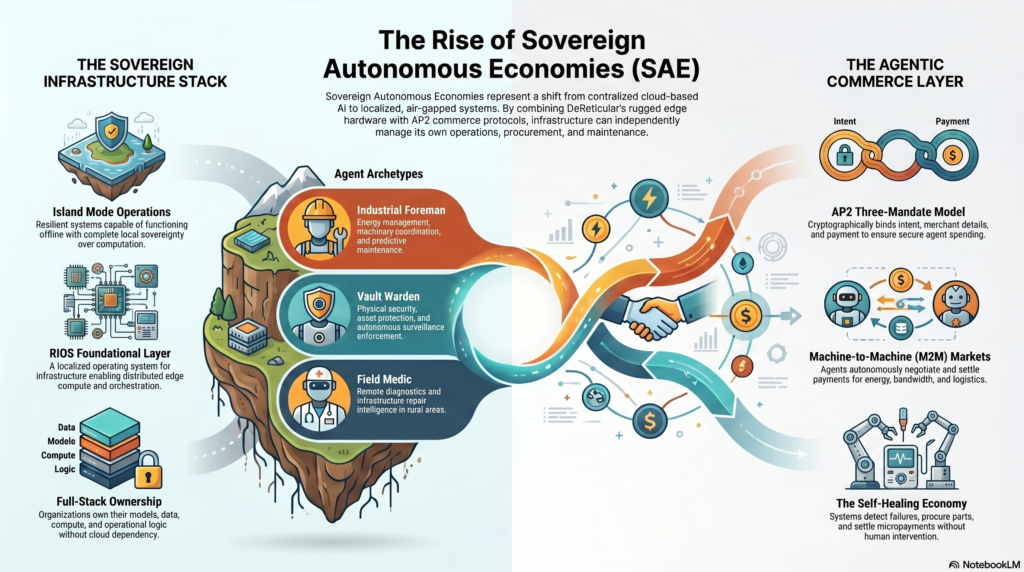
- Island Mode refers to the ability of physical infrastructure to operate as resilient, autonomous cyber-physical systems that function independently of cloud connectivity. This architecture allows for complete local sovereignty over data and computation, ensuring operations remain viable in air-gapped, rural, or disconnected environments.
- OpenClaw serves as the intelligence layer and orchestration middleware for the DeReticular ecosystem. It is responsible for autonomous agent execution, local reasoning, and the coordination of robotics and cyber-physical control systems.
- The AP2 architecture is built on the Intent Mandate (defining authorized spending goals), the Cart Mandate (merchant-signed confirmation of exact products and pricing), and the Payment Mandate (binding the payment method to the transaction context). Together, these ensure that autonomous agents stay within verifiable bounds of authorization.
- x402 enables machine-to-machine settlement by utilizing the HTTP status code “402 Payment Required” to create a programmable payment fabric. It facilitates stablecoin micropayments and native API monetization, allowing agents to negotiate and settle transactions in real-time without human intervention.
- The stack is built on Kubuntu (providing Linux stability and edge deployment flexibility), Freenet (offering decentralized, censorship-resistant networking), and pfSense (serving as the sovereign firewall and network security layer).
- DePIN refers to networks that decentralize the ownership and operation of physical assets like compute, telecom, and energy grids. These networks are significant because they shift infrastructure from centralized, capital-intensive models to distributed, community-owned systems that can be managed autonomously by AI agents.
- The Industrial Foreman agent focuses on industrial orchestration, energy management, and predictive maintenance. Its potential verticals include manufacturing, utilities, mining, agriculture, and the management of smart city infrastructure.
- The AECL is an emerging operational substrate that transforms the internet from an information network into an autonomous coordination and transaction network. It enables agents, infrastructure, and financial protocols to coordinate economic activity programmatically without continuous human supervision.
- Sovereign AI is seen as critical because it allows for local ownership of models, training, and data, reducing dependency on foreign hyperscale cloud providers. This independence is increasingly viewed as a prerequisite for national security, economic sovereignty, and protection against foreign surveillance or sanctions.
- Current autonomous systems struggle with jurisdictional compliance (managing varying laws across regions) and KYC/AML (Know Your Customer/Anti-Money Laundering) requirements. Additionally, there is a lack of established frameworks for sanctions screening and dispute resolution in machine-to-machine transactions.
——————————————————————————–
Part 3: Essay Questions
Instructions: Use the provided source material to develop comprehensive responses to the following prompts.
- The Evolution of Infrastructure: Analyze how the transition from “static assets” to “intelligent economic systems” changes the way municipal utilities and industrial facilities are managed. Use the example of a self-healing infrastructure workflow to illustrate your points.
- Strategic Synergies in Frontier Markets: Discuss the potential for DeReticular and AP2 to “leapfrog” traditional banking and utility infrastructure in rural or developing regions such as East Africa.
- The Identity Crisis in Machine Economies: Explore the unique challenges of establishing machine identity compared to human identity. Why do traditional systems “break” when applied to autonomous agents that can fork, migrate, or replicate?
- Sovereign vs. Centralized AI: Compare the risks and benefits of DeReticular’s sovereign, air-gapped approach against the current dominance of centralized, cloud-based AI “hyperscalers.”
- The Governance of Autonomous Systems: Evaluate the emerging models for governing decentralized autonomous economies, including the roles of “Machine Constitutions,” DAOs, and policy engines.
——————————————————————————–
Part 4: Glossary of Key Terms
| Term | Definition |
| AECL | Autonomous Economic Coordination Layer; a distributed framework enabling machines and agents to coordinate economic activity programmatically. |
| Agentic Commerce | A system where autonomous AI agents act as economic participants, capable of negotiating, procuring services, and settling transactions. |
| AP2 | Agent Payments Protocol; an open protocol designed to enable secure, verifiable, and bounded spending authority for AI agents. |
| DePIN | Decentralized Physical Infrastructure Networks; distributed networks of physical hardware (compute, energy, sensors) managed via cryptographic incentives. |
| Freenet | A decentralized communication and data distribution network used for resilient, censorship-resistant peer-to-peer networking. |
| Island Mode | A state of operation where a system functions with complete local sovereignty, disconnected from external cloud or internet dependencies. |
| MCP | Model Context Protocol; a standardized protocol for tool access and context exchange between AI systems. |
| OpenClaw | An orchestration framework used for agent runtime, local reasoning, and cyber-physical coordination. |
| pfSense | An open-source firewall and routing platform used to provide sovereign network security and deterministic traffic orchestration. |
| RIOS | Rural Infrastructure Operating System; the foundational hardware and software layer for distributed edge compute and infrastructure orchestration. |
| Sovereign AI | AI characterized by local ownership of models, data, and compute, ensuring operational independence from external providers. |
| Stablecoins | Digital currencies pegged to a stable asset; used in SAEs as “machine-native money” due to their programmability and instant settlement. |
| Vault Warden | A specialized sovereign agent archetype focused on physical security, volumetric monitoring, and autonomous asset protection. |
| x402 | A protocol for HTTP-native payments and stablecoin micropayments, built around the 402 “Payment Required” status code. |