Study Guide: Agricultural Autonomy-as-a-Service and Sovereign Infrastructure
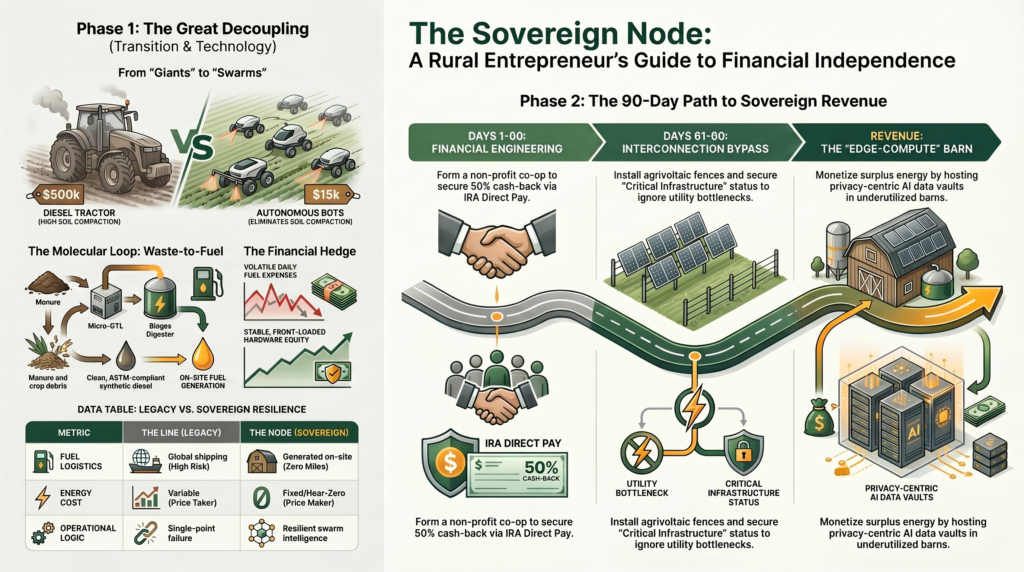
This study guide synthesizes strategic reports regarding the shift from legacy industrial agriculture to a decentralized, autonomous, and energy-sovereign model. It explores the technological, economic, and infrastructural components required for rural entrepreneurs to transition from “Price Takers” to “Market Makers.”
——————————————————————————–
Part I: Short-Answer Quiz
Instructions: Answer the following questions in 2-3 sentences based on the provided source context.
- Define the “Capital Gap” in modern agriculture and explain how Agricultural Autonomy-as-a-Service (AaaS) addresses it. The “Capital Gap” refers to the prohibitive cost of high-end legacy machinery, which can exceed $800,000, pricing out small-to-medium landowners. AaaS bridges this gap by allowing entrepreneurs to operate fleets of small, affordable robots that provide precision farming to local farms under a “pay-per-acre” model, shifting the financial burden from capital expenditure (CAPEX) to operating expense (OPEX).
- What are the primary differences between legacy “Giant” machines and AaaS “Swarm” bots regarding soil impact and energy? Legacy machines are heavy (20+ tons), causing deep-soil compaction that reduces yields and relies on global diesel logistics. In contrast, “Swarm” bots are lightweight (150–800 lbs), preserving soil health, and are powered by localized electric sources or synthetic fuels generated on-site.
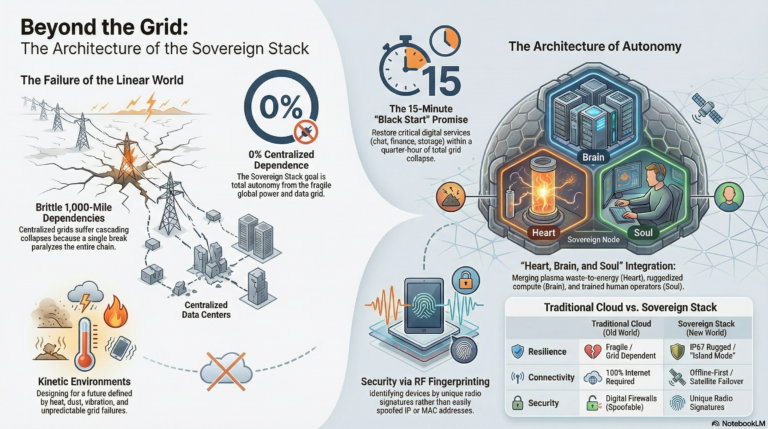
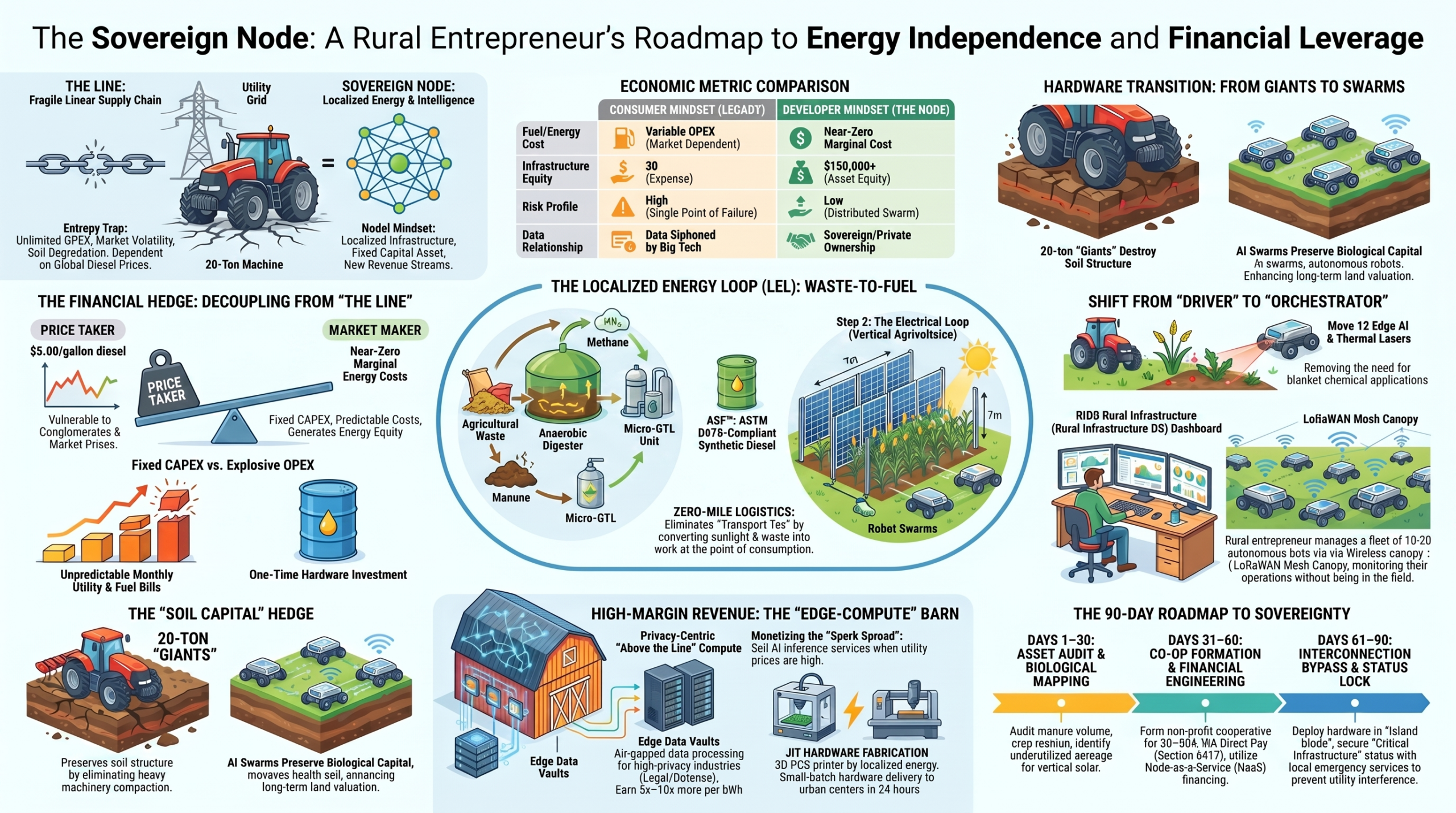
- Explain the concept of “The Line” versus “The Node.” “The Line” represents the fragile, centralized, and global supply chain of petroleum-based diesel and utilities that legacy operations depend upon. “The Node” is a localized, circular energy loop where power is generated, stored, and consumed within a square mile, allowing for near-zero marginal energy costs and resilience against global market volatility.
- Describe the three pillars of the Localized Energy Loop (LEL). The LEL is built on a Biological Pillar (Micro-GTL units converting waste into synthetic diesel), a Photovoltaic Pillar (vertical agrivoltaic fences providing direct DC power), and a Storage/Logic Pillar (LFP battery vaults managed by RIOS). Together, these hardware subsystems allow a property to achieve total energy independence and “Island Mode” capability.
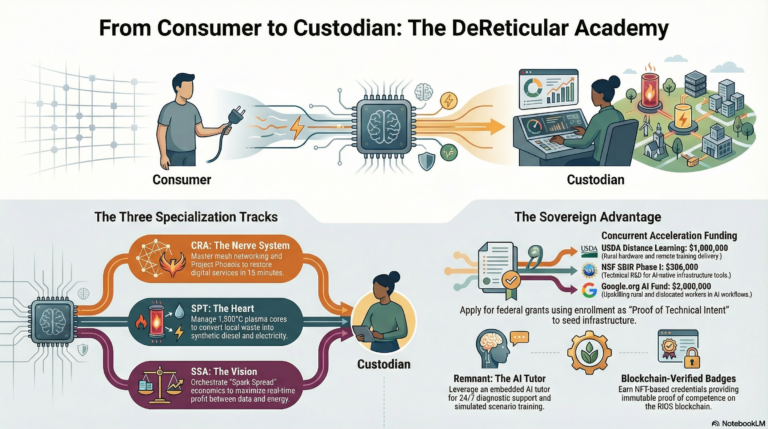
- What is the role of the Rural Infrastructure Operating System (RIOS)? RIOS serves as the air-gapped, high-inference “brain” of the Sovereign Node, managing agentic workflows and telemetry from a home office. It automates complex decisions, such as scheduling bot tasks based on weather data or deciding whether to convert energy into synthetic fuel, local electricity, or high-margin compute services.
- How does the “Outcome-Based” revenue model differ from traditional equipment sales? Instead of selling high-debt machinery, entrepreneurs charge based on specific results, such as “Chemical Displacement,” where the service provider takes a percentage of the savings generated by reducing herbicide costs. This model aligns the incentives of the farmer and the service provider, focusing on efficiency and cost reduction rather than equipment ownership.
- What is “Section 6417” (IRA Direct Pay), and why is it significant for rural cooperatives? Section 6417 allows non-profit cooperatives and municipal entities to receive 30–50% of their hardware CAPEX as direct cash reimbursements from the federal government. This financial mechanism significantly lowers the barrier to entry for establishing sovereign power nodes and autonomous fleets.
- Explain the “Medic & Rescue Lifeboat” use case for a Sovereign Power Node. In this scenario, a node provides 24/7 “Lifeboat Power” to local medical clinics and mesh satellite internet during grid blackouts. By linking to essential services, the entrepreneur can secure “Critical Infrastructure” status, which provides legal protection and priority permitting against utility grid interference.
- What is the “Entropy Trap” mentioned in the strategic reports? The Entropy Trap describes a state where the costs of maintaining centralized industrial systems—such as diesel logistics, heavy machinery maintenance, and soil structural loss—begin to exceed the actual profits generated. It signals the point where mass-centralization becomes less efficient than specialized, nodal decentralization.
- How do swarm bots achieve “Anti-fragility” compared to legacy tractors? A legacy tractor represents a single point of catastrophic failure; if a sensor fails, the entire operation stops. A swarm fleet is anti-fragile because the failure of one bot only reduces capacity by a small fraction (e.g., 5%), allowing the “Fleet Commander” to swap the node and continue operations without systemic downtime.
——————————————————————————–
podcast
Part II: Answer Key
- The Capital Gap: High cost (500k-800k) of machinery vs. AaaS model using affordable robots on a pay-per-acre basis.
- Giants vs. Swarms: Giants cause high compaction and use diesel; Swarms are ultra-low weight, improve soil health, and use local electricity.
- The Line vs. The Node: The Line is centralized/fragile/global; The Node is circular/resilient/localized.
- Three Pillars of LEL: Biological (Micro-GTL), Photovoltaic (Vertical Solar), and Storage/Logic (LFP Batteries + RIOS).
- RIOS Role: Orchestrates autonomous swarms, manages energy arbitrage (Spark Spread), and handles 70% of operational labor via agentic workflows.
- Outcome-Based Revenue: Fees based on results like chemical reduction or flat per-acre tasks rather than machinery debt/sales.
- Section 6417: Federal cash reimbursement for 30-50% of hardware costs for non-profits/co-ops.
- Medic & Rescue Lifeboat: Provides resilient power/comms for emergency services, securing Critical Infrastructure legal status.
- Entropy Trap: The point where the cost of maintaining centralization (logistics, soil repair) exceeds profit.
- Anti-fragility: Distributed risk in swarms means one failure does not stop the system, unlike monolithic legacy machinery.
——————————————————————————–
video
Part III: Essay Questions
- The Shift in Mindset: Discuss the transition from a “Consumer Mindset” to a “Developer Mindset” as outlined in the reports. How does this shift affect a rural entrepreneur’s approach to utility bills and infrastructure?
- Energy Sovereignty as a Financial Hedge: Analyze how “The Node” serves as a financial hedge against linear supply chain volatility. Contrast fixed-CAPEX models with explosive-OPEX models in the context of global diesel price spikes.
- Agronomic Impact of Swarm Logic: Examine the relationship between machine weight, soil health, and “Biological Capital.” How do autonomous swarms preserve or even compound the value of land compared to legacy “Giants”?
- The Role of Data Sovereignty: Using the “Edge-Compute Barn” use case, explain the value of localized AI inference. Why is “Data Sovereignty” a higher-margin product than raw processing power in the modern AI economy?
- Bypassing the Centralized Grid: Evaluate the strategic 90-day plan for achieving “Island Mode.” What are the legal, financial, and technical steps required to circumvent the 4–7 year interconnection queues faced by traditional energy projects?
——————————————————————————–
Part IV: Glossary of Key Terms
| Term | Definition |
| AaaS | Agricultural Autonomy-as-a-Service: A business model where precision farming (weeding, seeding) is provided as a service using autonomous robots. |
| Agra-Dot Energy | A provider of modular energy infrastructure, specifically Micro-GTL units and vertical agrivoltaic systems. |
| ASF™ | Agra Synthetic Fuel: High-grade synthetic diesel produced on-site from biogas and organic waste via Fischer-Tropsch technology. |
| Behind-the-Meter | Energy generation and consumption that occurs on-site, bypassing the need for a utility grid interconnection. |
| Critical Infrastructure (CI) | A legal designation for assets (like power hubs) linked to essential services (medical, fire, rescue) that provides protection against utility interference. |
| Fischer-Tropsch | A chemical process (used in GTL units) that converts syngas into liquid hydrocarbons like synthetic diesel. |
| GTL | Gas-to-Liquid: The technology used to convert biological methane or waste gas into stable liquid fuel (ASF™). |
| Island Mode | The ability of a power system to operate independently and disconnect from the main utility grid during surges or outages. |
| LEL | Localized Energy Loop: A circular model where energy is generated (solar/biogas), stored (batteries), and consumed (swarm bots) in the same location. |
| LFP Battery | Lithium Iron Phosphate: A type of high-safety, long-life battery vault used for stationary energy storage in a Node. |
| Move 12 | A strategic AI play involving on-device, vertical-specific workflows and localized inference. |
| NaaS | Node-as-a-Service: A financing model where equipment is provided in exchange for a portion of the energy or revenue generated. |
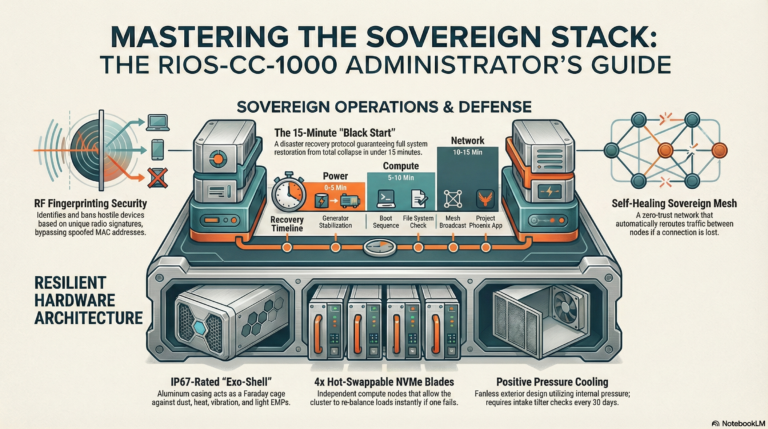
| RIOS | Rural Infrastructure Operating System: The central AI software used to manage energy, swarms, and data within a Sovereign Node. |
| Sovereign Node | A decentralized hub of energy, intelligence, and hardware that operates autonomously from global supply lines. |
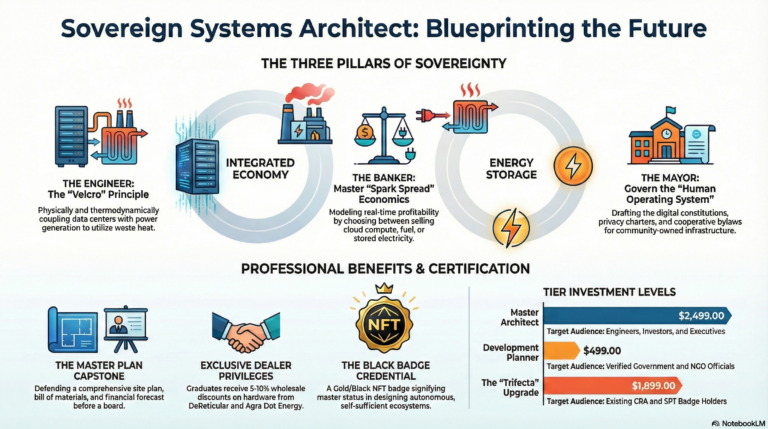
| Spark Spread | The price/value difference between the cost of fuel and the value of the electricity or data services generated from it. |
| The Line | The centralized, linear logistics of the global economy (diesel shipping, utility grids, cloud internet). |
| The Node | The decentralized, circular alternative to “The Line,” focused on local resource regeneration. |
| Vertical Agrivoltaics | Bifacial solar fences that harvest electricity while allowing crops to grow and bots to move in the spaces between them. |