Study Guide: Digital Asset Collateral and the 2026 Regulatory Framework
This study guide provides a comprehensive review of the regulatory developments, physical applications, and legal frameworks surrounding the use of digital assets as collateral in U.S. derivatives markets, as established by the CFTC and the GENIUS Act.

Part I: Short-Answer Quiz
Instructions: Answer the following questions in 2–3 sentences based on the provided source context.
- What is the primary purpose of the CFTC’s Digital Assets Pilot Program launched in December 2025?
- Explain the “Digital Twin” concept within the RIOS framework as it relates to Real-World Assets (RWAs).
- Under the GENIUS Act, what are the primary requirements for assets held in reserve by a permitted payment stablecoin issuer?
- What is “atomic settlement,” and how does it benefit market participants compared to traditional collateral methods?
- Describe the “Article 8 Solution” regarding the Uniform Commercial Code (UCC) and digital assets.
- What specific digital assets are permitted for use as collateral during the initial onboarding period of the CFTC’s Digital Assets Pilot Program?
- According to the CFTC’s December 8 Guidance, how does tokenization affect the fundamental characteristics of an underlying asset?
- What is the significance of the 2022 Amendments to the UCC, specifically Article 12, in the context of digital collateral?
- Why does the new regulatory framework favor the emergence of “digital plumbers” in the utility token space?
- What are the consequences for a digital asset service provider that offers non-permitted payment stablecoins after the three-year grace period specified in the GENIUS Act?
——————————————————————————–
Part II: Answer Key
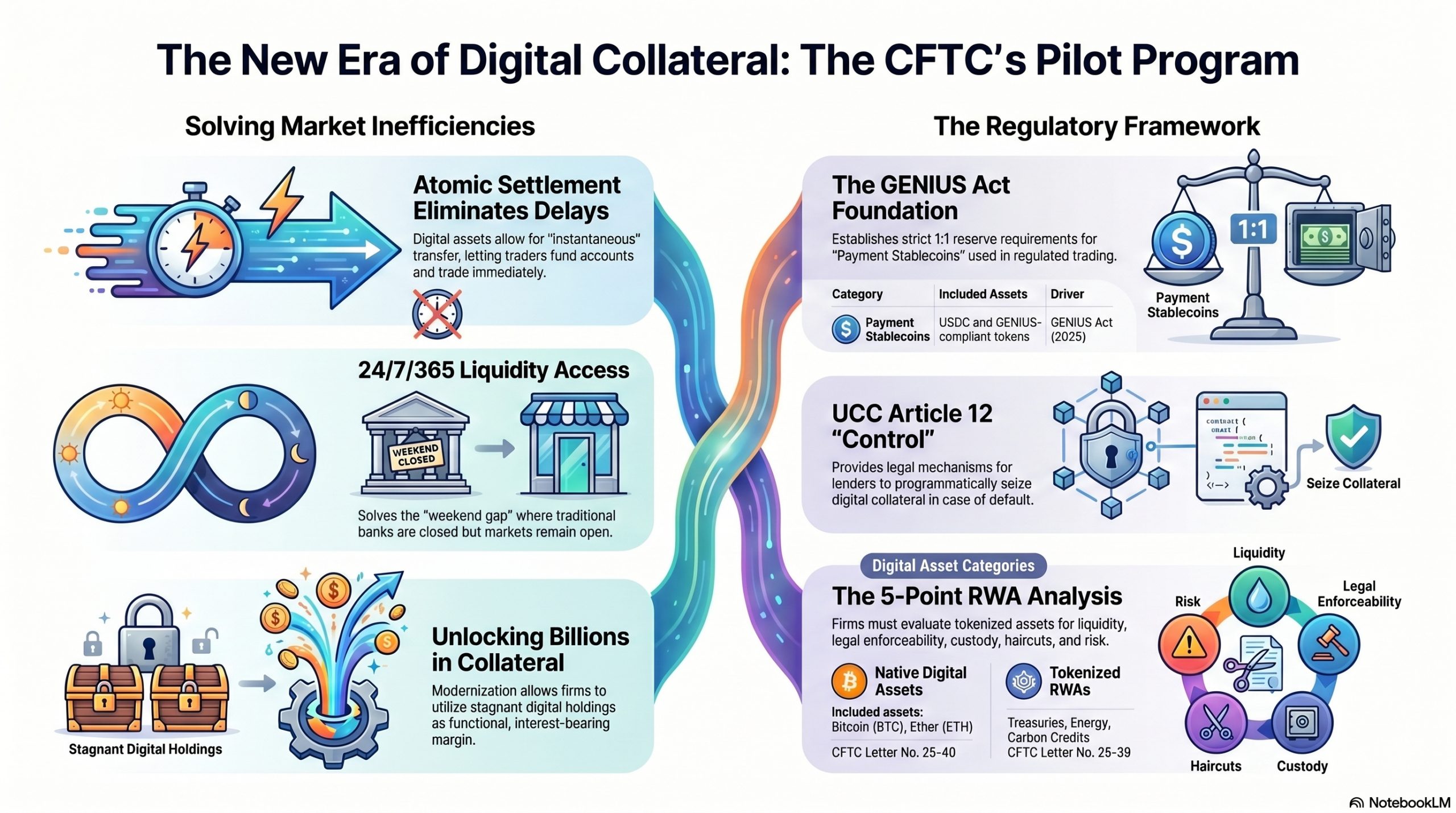
- The program aims to provide regulatory certainty for commodity derivatives market participants to accept digital assets like Bitcoin, Ether, and stablecoins as collateral. It is designed to unlock billions of dollars in digital collateral by legitimizing these assets within the regulated U.S. derivatives ecosystem.
- In the RIOS framework, a “Digital Twin” is a dynamic NFT that represents a physical asset, such as biomass or energy production, verified via cryptographic proofs. This NFT acts as a Controllable Electronic Record (CER) that carries the legal title and verified feasibility data, allowing physical production to be used as financial collateral.
- Issuers must maintain identifiable reserves on at least a 1:1 basis consisting of highly liquid assets like U.S. currency, Treasury bills with maturities of 93 days or less, or certain repurchase agreements. The Act also strictly prohibits the rehypothecation or pledging of these reserves, except for specific liquidity-creation purposes.
- Atomic settlement refers to the instantaneous posting of digital assets as collateral, which occurs 24/7/365. This eliminates the time delays associated with traditional wire transfers or checks, allowing traders to establish positions immediately and manage risk even when traditional banking systems are closed.
- The “Article 8 Solution” involves an FCM and a customer agreeing to treat non-security digital assets as “financial assets” to be credited to a securities account. This allows the FCM to perfect its security interest using traditional methods, such as a securities account control agreement, providing a familiar legal pathway for intermediaries.
- During the initial onboarding phase, permitted digital assets are strictly limited to Bitcoin (BTC), Ether (ETH), and qualified existing payment stablecoins. Additionally, these assets must be of the types specifically accepted by Derivatives Clearing Organizations (DCOs).
- The guidance clarifies that the use of digital ledger technology to tokenize an asset does not change its fundamental characteristics or risk profile. Firms must still analyze whether the underlying real-world asset is eligible to serve as regulatory margin regardless of its digital representation.
- Article 12 introduces “Controllable Electronic Records” (CERs) and establishes a new “control” test for perfecting security interests in digital assets. This provides a clear legal framework for lenders to establish priority and realize on collateral held in non-custodial digital wallets.
- “Digital plumbers” provide the essential infrastructure—the “rails”—for 24/7 settlement, programmatic custody, and the “wrapping” of RWAs. Their value shifts from speculation to providing the critical utility required to facilitate the movement and control of newly regulated institutional-grade assets.
- Beginning three years after the Act’s enactment, it becomes unlawful to offer or sell payment stablecoins not issued by a “permitted” issuer. Violators can face significant civil money penalties, reaching up to $100,000 per violation per day.
——————————————————————————–
Part III: Essay Questions
Instructions: Use the provided sources to develop detailed responses to the following prompts. (Answers not provided).
- The “Sovereign Banking” Model: Analyze how the combination of real-time sensor data (RIOS), Zero-Knowledge Proofs (zkVerify), and the CFTC regulatory framework allows a rural industrial project like “Node 4” to achieve capital velocity.
- Risk Management in Tokenization: Discuss the CFTC’s perspective on why tokenized assets might require “deeper haircuts” than their traditional counterparts. Consider factors such as smart contract risk, cybersecurity, and operational dependencies.
- The Impact of the GENIUS Act: Evaluate the legal and economic implications of the GENIUS Act’s prohibition on paying interest to stablecoin holders. How does this create opportunities for other market participants or utility protocols?
- Jurisdictional Evolution: Compare the regulatory approaches of the CFTC and the SEC as described in the sources. How does the CFTC’s “Digital Assets Pilot Program” put pressure on the SEC to harmonize its own rules for tokenized securities?
- Legal Enforceability and the UCC: Explain the challenges FCMs face when perfecting security interests in digital assets. Contrast the “Article 8 Solution” with the requirements for perfection under Article 12 for assets held outside traditional custodial accounts.
——————————————————————————–
Part IV: Glossary of Key Terms
| Term | Definition |
| Atomic Settlement | The instantaneous and 24/7/365 transfer of digital assets, allowing for immediate clearing and trading without traditional banking delays. |
| Capital Velocity | The speed at which capital can be deployed, borrowed against, and reinvested; in this context, enhanced by the immediate tokenization of production. |
| CFTC Letter No. 25-39 | Regulatory guidance providing the framework for using tokenized Real-World Assets (RWAs) as collateral in futures and swaps markets. |
| CFTC Letter No. 25-40 | No-action relief permitting FCMs to accept BTC, ETH, and stablecoins as margin collateral under specific reporting and risk conditions. |
| Controllable Electronic Record (CER) | A new asset class established under UCC Article 12 that allows for legal “control” and perfection of security interests in digital records. |
| Derivatives Clearing Organization (DCO) | A clearinghouse that acts as an intermediary for derivatives trades and is authorized to accept specific digital assets under the pilot program. |
| Digital Twin | A digital representation (often an NFT) of a physical asset that carries legal title and verified data about that asset into the financial system. |
| Futures Commission Merchant (FCM) | An individual or organization that solicits or accepts orders to buy or sell futures or swaps and accepts money or assets as collateral. |
| GENIUS Act | The “Guiding and Establishing National Innovation for U.S. Stablecoins Act,” which provides the federal regulatory framework for payment stablecoins. |
| Haircut | A percentage reduction in the recognized value of an asset used as collateral to provide a safety buffer against market volatility or technological risk. |
| Payment Stablecoin | A digital asset used for payment or settlement that the issuer is obligated to redeem for a fixed amount of monetary value (e.g., 1:1 with USD). |
| Permitted Payment Stablecoin Issuer | A U.S.-formed entity (subsidiary of a bank, Federal, or State qualified issuer) authorized under the GENIUS Act to issue stablecoins. |
| Real-World Assets (RWAs) | Physical or traditional financial assets (e.g., hemp, energy, Treasury bonds) that are represented as digital tokens on a blockchain. |
| Rehypothecation | The practice by which a lender uses assets posted as collateral by a borrower for its own purposes; strictly limited under the GENIUS Act. |
| RIOS (Rural Infrastructure Operating System) | A “digital nervous system” using sensors and cryptographic verification to transform physical industrial output into tokenized financial assets. |
| zkVerify (Zero-Knowledge Proofs) | A cryptographic method that proves the validity of data (e.g., production levels) without revealing the underlying proprietary information. |