Study Guide: Karamoja Eco-Industrial Park and Advanced Solar Technologies
This study guide provides a comprehensive review of the strategic, technical, and socioeconomic frameworks involved in developing a 50 MW Eco-Industrial Park (EIP) in Karamoja, Uganda, and the comparative technological benchmarks set by the CGN Wumatang project in Tibet.
——————————————————————————–
Part I: Short-Answer Quiz
Instructions: Answer the following questions using 2–3 sentences. Focus on specific data and concepts provided in the source context.
- What is the strategic advantage of “Behind-the-Meter” (BTM) generation for the Karamoja Eco-Industrial Park?
- Describe the concept of “Industrial Symbiosis” as it applies to the park’s thermal loops.
- What are the primary technical specifications of the CGN Wumatang Integrated Energy Project in Tibet?
- Why is “Dry Cooling” (Air-Cooled Condensers) prioritized over evaporative cooling in the Karamoja EIP?
- How does the “Agrivoltaic” model benefit the local Karamojong pastoralists?
- Explain the role of the “Thermal Backbone” in the park’s infrastructure.
- What are the “Triple-Lock” legal requirements for Karamoja marble to achieve “Green Marble” status in global markets?
- How does the park’s logistics strategy address the difficulty of transporting marble from Moroto to the Port of Mombasa?
- What technological advancements in 2026 have improved the efficiency of Parabolic Trough Collectors (PTC)?
- In the event of a sudden drop in solar generation, how does the Microgrid Controller manage the industrial load?
——————————————————————————–
Part II: Quiz Answer Key
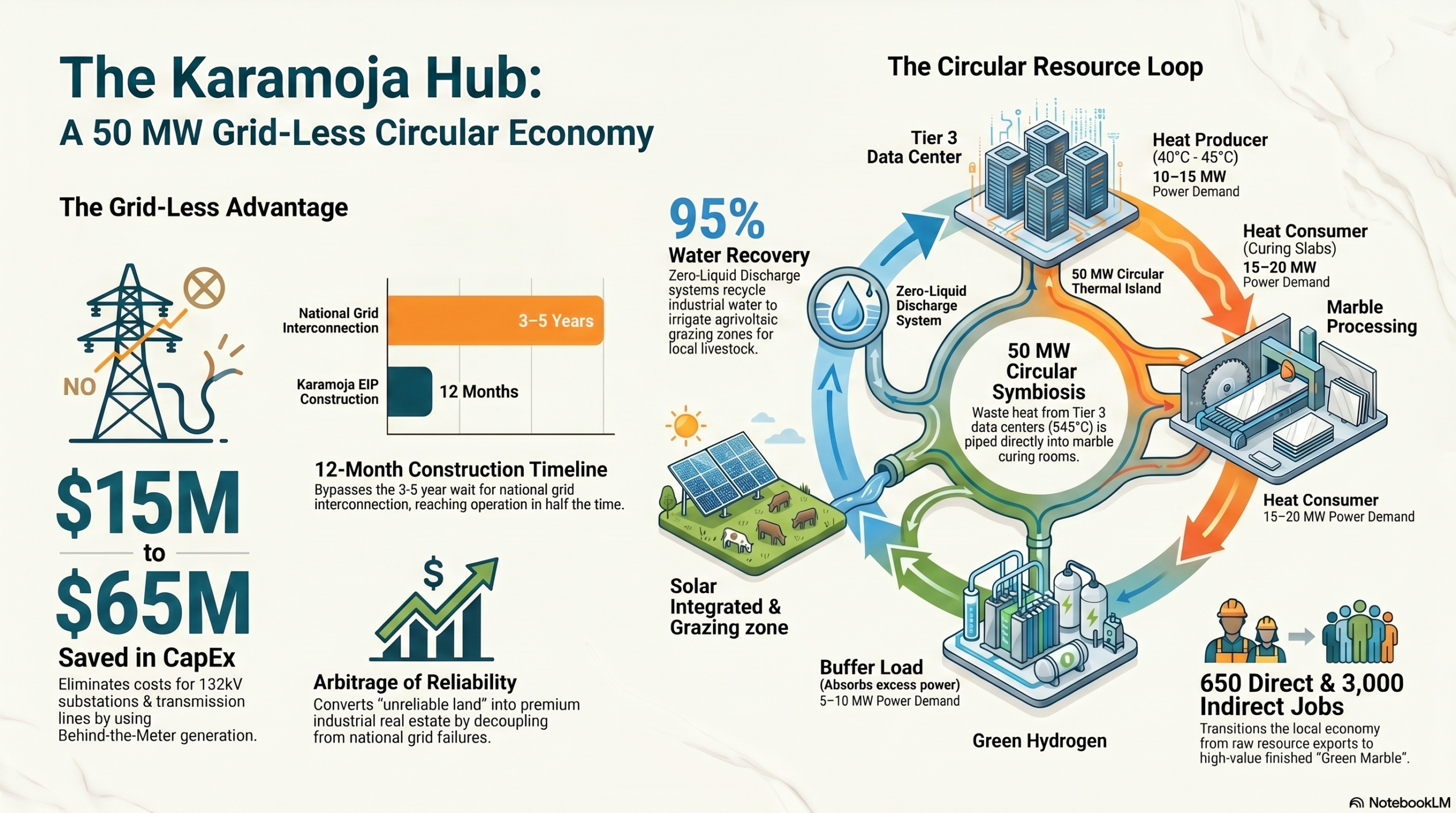
- BTM Advantage: BTM generation eliminates national grid dependency, saving between $15 million and $65 million by avoiding the need for 132kV substations and transmission lines. It also allows the park to be operational within 18–24 months, bypassing the 3–5 year wait times typical for grid interconnection in remote regions.
- Thermal Symbiosis: This involves channeling “waste” heat from one facility to power another, such as using the 35-45^\circ\text{C} exhaust from the Data Center to cure marble slabs. This reduces overall energy consumption and eliminates the need for separate electric heating systems in industrial processes.
- Wumatang Specifications: The project is a 450 MW hybrid facility located at 4,550 meters, consisting of 400 MW of Photovoltaics (PV) and 50 MW of Concentrated Solar Power (CSP). It features 6 hours of molten salt thermal storage and utilizes large-aperture 8.6-meter parabolic trough collectors.
- Dry Cooling Priority: In the semi-arid Karamoja region, water is a scarce and critical resource for livestock; Dry Cooling preserves approximately 2,000 m^3/day of groundwater. Although it reduces electrical efficiency by about 4% during peak heat, it prevents local conflict and supports the park’s “Net-Zero Water” strategy.
- Agrivoltaic Benefits: By elevating solar panels to 2.5 meters, the model allows cattle and goats to graze in the shade, which reduces soil evaporation by 25–30%. This increases the land’s carrying capacity and extends the grazing season by 3–5 weeks during the dry season.
- Thermal Backbone: The Thermal Backbone is a 2-kilometer loop of insulated high-density polyethylene (HDPE) piping that replaces a traditional grid substation. It moves heated fluids between sectors—such as the data center, hydrogen electrolyzer, and marble facility—to maximize energy efficiency.
- Green Marble Legalities: To qualify, the project must adhere to international sustainability standards (ANSI/NSI 373), comply with EU directives like the Carbon Border Adjustment Mechanism (CBAM), and fulfill Uganda’s Mining and Minerals Act of 2022 regarding local value addition.
- Logistics Strategy: The park uses a multi-modal approach, transporting slabs via hydrogen-fueled trucks to the railhead, followed by Standard Gauge Railway (SGR) transport to Mombasa. This reduces costs by 35% and utilizes shock-monitoring sensors to prevent damage to the fragile marble during transit.
- PTC Advancements: Key innovations include the use of hybrid nanofluids, which increase thermal conductivity by 24.8%, and advanced 10-blade fin-spiral turbulators that improve heat transfer by 12.25%. Additionally, AI-driven control systems now optimize temperature equilibrium across collector fields.
- Load Management: The Microgrid Controller uses “Load Shedding Logic” to protect mission-critical operations. For example, if power drops, the Green Hydrogen electrolyzer is disconnected first to ensure the industrial cold storage for meat exports remains powered.
Part III: Essay Questions
Instructions: Use the provided sources to develop comprehensive responses to the following prompts.
- Comparative Analysis of Energy Storage: Compare the use of Battery Energy Storage Systems (BESS) in the Karamoja EIP model with the Molten Salt Thermal Energy Storage (TES) used in the Wumatang project. Discuss the environmental, economic, and technical factors that make one more suitable than the other for their respective locations.
- Socioeconomic Transformation in Karamoja: Analyze how the transition from raw resource export to “Behind-the-Meter” value-added manufacturing impacts the Karamojong people. Address job creation, skill transfer, and the integration of traditional pastoralism with high-tech industry.
- The “Circular Resource” Strategy: Evaluate the effectiveness of the EIP’s closed-loop systems for water and heat. How do these loops contribute to the park’s “Impact Alpha” and its ability to secure financing from Tier-1 financial sponsors?
- Overcoming Geographic and Climatic Extremes: Compare the physical and mechanical hurdles of building the Wumatang project at 4,550 meters with the challenges of establishing an EIP in the semi-arid, remote Karamoja plateau. How do these environments dictate specific engineering choices?
- The Role of Eco-Industrial Parks in the Global South: Using case studies from Ethiopia, Vietnam, and Colombia mentioned in the text, discuss how EIPs are being used as a strategy for national industrial competitiveness and Net-Zero compliance by 2030.
Part IV: Glossary of Key Terms
| Term | Definition |
| Agrivoltaics | The simultaneous use of land for both solar power generation and agriculture, often involving elevated panels to allow for livestock grazing. |
| BESS | Battery Energy Storage System; used to store electrical energy to manage “inrush” currents and provide power when solar generation is low. |
| BTM (Behind-the-Meter) | A renewable energy system providing power directly to an on-site user, bypassing the national utility grid and its associated costs. |
| CBAM | Carbon Border Adjustment Mechanism; an EU policy requiring importers to pay for the carbon emissions embedded in products like marble. |
| CSP | Concentrated Solar Power; a technology that uses mirrors to focus sunlight to generate heat, which then produces steam for electricity. |
| DNI | Direct Normal Irradiance; the amount of solar radiation received per unit area by a surface that is held perpendicular to the rays of the sun. |
| EIP | Eco-Industrial Park; a community of manufacturing and service businesses located on a common property that seek enhanced environmental and economic performance through collaboration. |
| Industrial Symbiosis | A partnership where the waste or by-products of one industrial process become the raw materials or energy source for another. |
| Manyatta | A traditional Karamojong communal homestead; the primary social unit for the region’s pastoralist communities. |
| PTC | Parabolic Trough Collector; a type of solar thermal collector that is straight in one dimension and curved as a parabola in the other two to focus sunlight. |
| TES | Thermal Energy Storage; the technology that allows for the storage of heat (often in molten salts) to generate electricity after sunset. |
| TLU | Tropical Livestock Unit; a standardized unit representing a 250kg animal, used to calculate the carrying capacity of grazing land. |
| ZLD | Zero Liquid Discharge; a water treatment process in which all wastewater is purified and recycled, leaving no liquid waste. |