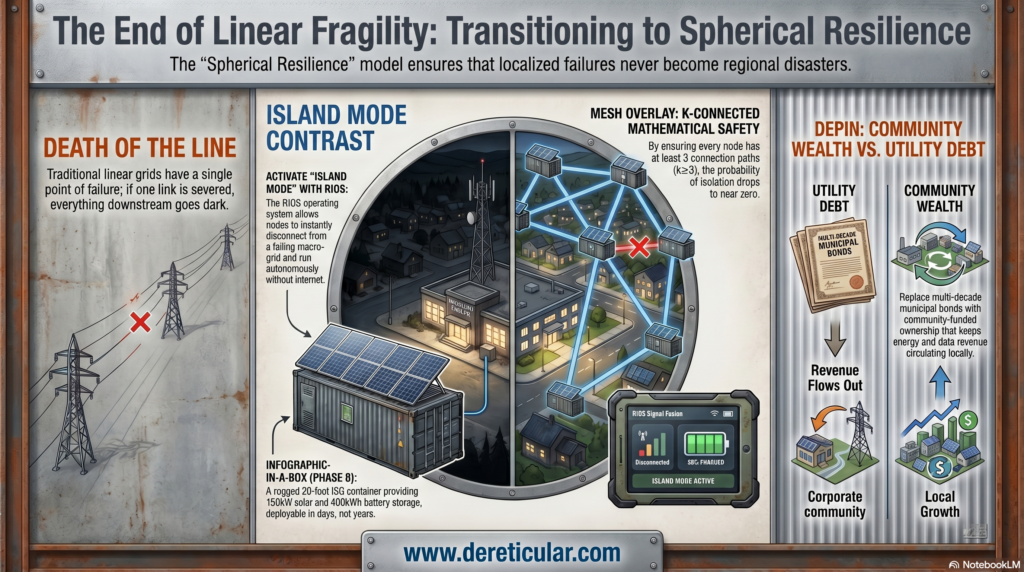
This study guide provides a comprehensive overview of the technical, economic, and strategic frameworks required to migrate from legacy centralized infrastructure to decentralized, resilient mesh networks. It focuses on the “Spherical Resilience” model, the deployment of “Island Mode” nodes, and the economic catalyst of Decentralized Physical Infrastructure Networks (DePIN).
——————————————————————————–
Part 1: Review Quiz
Instructions: Answer the following questions based on the provided research documents. Each answer should be between two and three sentences.
- What is the fundamental flaw of “Linear Fragility” in modern infrastructure?
- How does the concept of “Spherical Resilience” utilize graph theory to improve reliability?
- What is “Island Mode,” and how does it prevent cascade failures?
- Define the role of the Rural Infrastructure Operating System (RIOS).
- What are the primary hardware components included in a “Phase 0 Infrastructure-in-a-Box”?
- How does the DePIN model address the “Financial Risk & Asset Ownership Gap” for municipalities?
- Why is the “Behind-The-Meter” (BTM) configuration utilized in Phase 0 deployments?
- Explain the “Leapfrog Dynamic” as it applies to infrastructure in developing or rural regions.
- How does the “Infrastructure-in-a-Box” design address the technical skills and maintenance gap in rural areas?
- What are the primary regulatory hurdles facing multi-customer microgrids according to the research?
——————————————————————————–
Part 2: Answer Key
- Linear Fragility refers to the vulnerability of systems designed with single-source corridors where a failure at one point (edge connectivity \lambda(G) = 1) cascades downstream. This model ensures that any physical or digital severance results in a total system collapse for all connected endpoints.
- Spherical Resilience models infrastructure as a k-vertex-connected graph where k \ge 3, meaning every node has at least three independent pathways. Mathematically, this reduces the probability of isolation to the product of the failure probabilities of all independent ingress and egress paths.
- Island Mode is an autonomous operational state where a node isolates its local electrical and data systems from the macro-grid using solid-state transfer switches. By generating its own reference voltage and data synchronization, the node sets its autonomy factor to 1, which physically and digitally bounds failures to their point of origin.
- RIOS is an edge-native microkernel operating system that manages local resources, such as energy generation and data routing, under air-gapped conditions. It features a Signal Fusion Engine to aggregate disparate communication links and an Autonomous Machine Coordination (AMC) engine to balance generation against critical loads.
- Phase 0 Infrastructure-in-a-Box is housed in a 20-foot ISO shipping container and includes a 150 kW bifacial solar array and a 400 kWh Lithium Iron Phosphate (LiFePO4) battery system. It also features a 30 kW hydrogen-ready auxiliary generator and a telescoping mast for satellite (LEO), LTE, and RF mesh communications.
- The DePIN model democratizes funding by fractionalizing asset ownership on transparent ledgers, allowing local cooperatives and public-private partnerships to co-invest. This shifts the economic burden from massive upfront municipal capital expenditures (CapEx) to modular, community-funded assets that keep utility revenue within the region.
- BTM configurations are used to bypass lengthy utility interconnection queues and regulatory hurdles by installing nodes directly at municipal service points to offset local loads. During normal operations, they do not export power to the grid, but they provide immediate resiliency by triggering Island Mode during grid anomalies.
- The Leapfrog Dynamic suggests that regions lacking entrenched legacy infrastructure can skip expensive centralized systems and move directly to sovereign autonomous models. This is similar to how many regions skipped landline telephony for mobile networks, allowing for faster adoption of resilient, modular technologies.
- The design utilizes modular, “hot-swappable” Field-Replaceable Units (FRUs) that allow local technicians to replace components without specialized engineering expertise. Additionally, the RIOS internal diagnostic engine can issue encrypted alerts for remote troubleshooting, further reducing the need for onsite experts.
- Regulatory hurdles include archaic public utility commission (PUC) rules that classify microgrids distributing power across public rights-of-way as “electrical corporations.” This classification subjects small, local systems to heavy oversight, high administrative costs, and multi-year utility connection studies.
——————————————————————————–
Part 3: Essay Questions
Instructions: Use the provided source context to develop comprehensive responses to the following prompts.
- Analyze the Technical Stack of Spherical Resilience: Discuss the integration between Layer 1 (Physical), Layer 2 (Operating System), and Layer 3 (Network). Explain how these layers work in tandem to maintain service continuity when the national backhaul is severed.
- Economic Transition Strategies: Compare the traditional centralized utility financing model with the Microgrid-as-a-Service (MaaS) and DePIN frameworks. How do these new models facilitate “CapEx-to-OpEx substitution” for under-resourced municipalities?
- Regulatory and Political Navigation: The research identifies investor-owned utility (IOU) litigation as a significant threat. Discuss the strategic “bridges” proposed to overcome these obstacles, including the use of emerging state policies like California’s AB2175.
- The Role of Edge AI and Autonomous Coordination: Explain how localized AI workloads and “quantized models” enable infrastructure to function without cloud connectivity. What are the long-term implications of “Machine Identity” and “Agentic Coordination” for the future of these systems?
- SWOT Synthesis for Regional Planners: Using the provided SWOT analysis, develop a risk mitigation plan for a municipal leader concerned about high localized unit costs and battery supply chain volatility.
——————————————————————————–
Part 4: Glossary of Key Terms
| Term | Definition |
| BESS | Battery Energy Storage System; the nodes utilize 400 kWh Lithium Iron Phosphate (LiFePO4) arrays for energy density and thermal stability. |
| BTM (Behind-The-Meter) | A deployment strategy where energy assets are connected on the customer side of the utility meter, primarily to offset local loads. |
| DePIN | Decentralized Physical Infrastructure Network; an economic model that uses decentralized protocols to fund, build, and operate physical hardware. |
| FRU (Field-Replaceable Unit) | Modular hardware components (like server racks or battery drawers) designed to be easily swapped in the field to minimize maintenance complexity. |
| Island Mode | The capability of a microgrid to disconnect from the main grid and operate autonomously using its own generation and control systems. |
| K-Connectedness | A measure of network redundancy where a node has k independent pathways to other nodes; the target architecture requires k \ge 3. |
| LEO | Low Earth Orbit; refers to satellite constellations used by the nodes for resilient backhaul communications. |
| Linear Fragility | A structural vulnerability in traditional infrastructure where single points of failure can lead to cascading downstream collapses. |
| MaaS | Microgrid-as-a-Service; a financial framework where local assets are leased to users, avoiding large upfront capital layouts. |
| RIOS | Rural Infrastructure Operating System; the edge-native operating system designed to orchestrate power, data, and communications for the nodes. |
| SCADA | Supervisory Control and Data Acquisition; legacy systems used for monitoring and controlling industrial and utility processes. |
| Signal Fusion Engine | A software component in RIOS that dynamically aggregates and routes data packets over multiple physical layers (LEO, LTE, RF). |
| Spherical Resilience | A design framework that replaces linear corridors with dense, multi-directional meshes to ensure localized self-sufficiency and redundancy. |
| Solid-State Transfer Switch | Fast-acting electronic switches used to isolate a microgrid from the macro-grid within milliseconds during a failure. |