Study Guide: Sovereign Automation and Rural Infrastructure Revitalization
This study guide provides a comprehensive overview of the technologies and strategies developed by DeReticular to address the infrastructure and economic challenges facing small-to-medium rural municipalities. It focuses on the transition from centralized cloud dependencies to decentralized, autonomous “Island Mode” operations.
Part 1: Short-Answer Quiz
Instructions: Answer the following questions using 2–3 sentences based on the provided source context.
- What is “Island Mode” or “Spherical Resilience” as defined by DeReticular?
- Explain the function of the “Trinity Stack” within the Rural Infrastructure Operating System (RIOS).
- How does the OpenClaw AI Framework allow municipalities to operate without cloud-based APIs?
- Describe the “Split-Ledger Architecture” and its role in network security.
- What are the target market specifications and price point for the “City Infrastructure” Nexus Package (SKU: SOV-BNDL-CITY)?
- How does the “Professional Pillar” of the Nexus Package support local healthcare and legal offices?
- What is “Radio Frequency Fingerprinting,” and how does it address the “Oracle Problem”?
- Explain the purpose of the DeReticular Academy in the context of rural community development.
- Define the “Rural Rebound” and identify its primary driver.
- How do “place-based” economic development strategies differ from traditional factory-recruitment models?
——————————————————————————–
Part 2: Answer Key
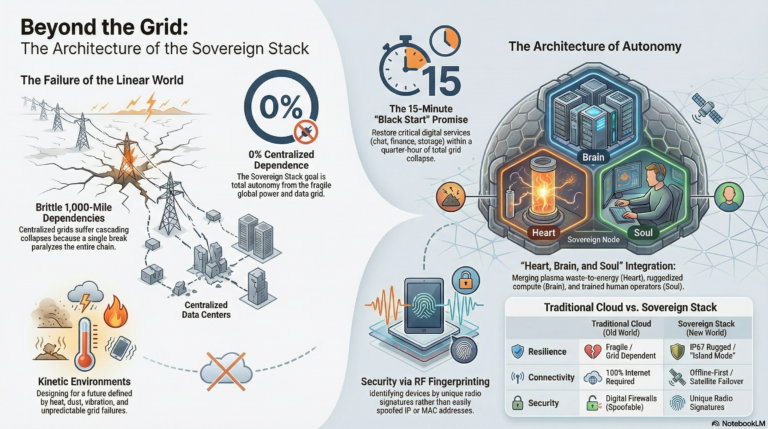
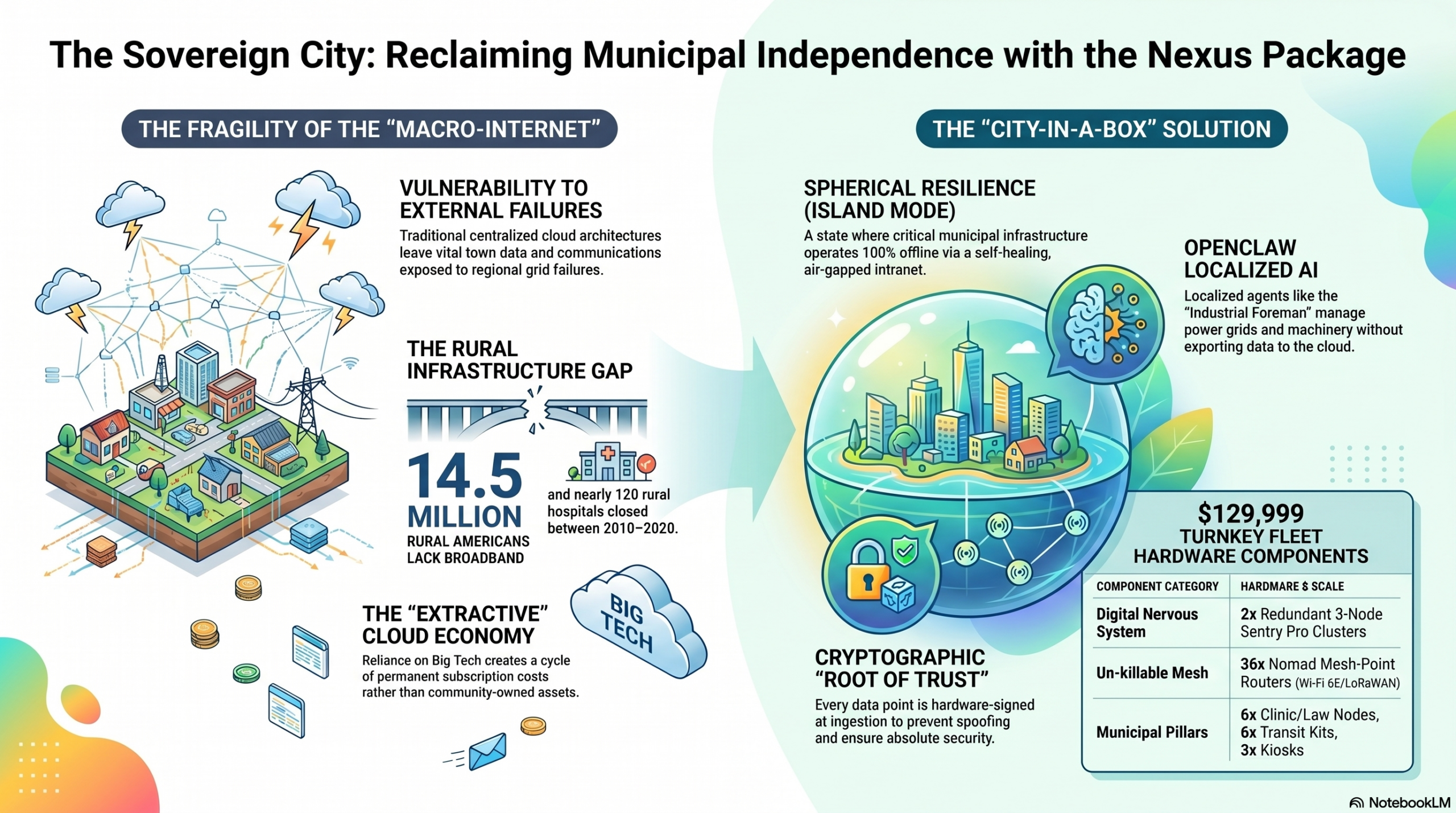
- Island Mode/Spherical Resilience: This refers to an engineering objective where municipal and industrial networks can operate autonomously and securely even during complete grid or telecommunications failures. It allows localized communities to end their reliance on vulnerable “macro-internet” cloud providers by using high-survivability, air-gapped hardware.
- Trinity Stack: This is a hyperconverged architecture built on a Type-1 hypervisor (Proxmox VE) that runs three isolated virtual environments. These layers include a “Gatekeeper” (pfSense) for connectivity, a “Ledger” (Ubuntu) for core logic and decentralized data storage, and an “Auditor” (Kali Linux) for continuous vulnerability scanning.
- OpenClaw AI Framework: This framework utilizes localized AI agents that process tasks entirely on edge hardware using onboard NVIDIA GPUs and quantized 4-bit Llama 3 models. By running these models locally, the system maintains intelligence capabilities like vision language algorithms and operational logistics without exporting sensitive data to external cloud APIs.
- Split-Ledger Architecture: This security framework ensures data integrity by cryptographically signing information at the moment of ingestion using non-exportable private keys burned into TPM 2.0 chips. This architecture, combined with hardware verification, insulates the mesh network from cloud vulnerabilities and ensures that every action is anchored to a verified physical reality.
- Nexus Package Specifications: The “City Infrastructure” Nexus Package is a turnkey “City-in-a-Box” priced at $129,999.00. It is specifically designed for small-to-medium municipalities with populations ranging from 1,000 to 3,000 residents.
- Professional Pillar: This component provides six dedicated Sovereign Sentry nodes (four for medical and two for law offices) that run the Sovereign Executive AI. These nodes enable high-security patient dictation, medical record OCR, and automated contract generation within isolated, HIPAA/Attorney-Client compliant sub-nets.
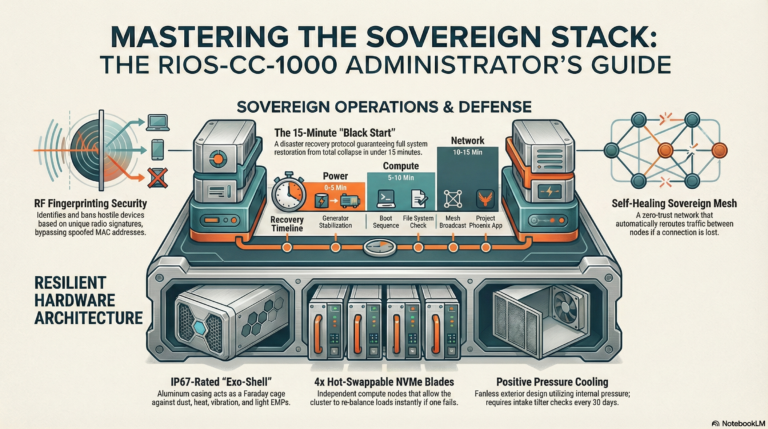
- Radio Frequency Fingerprinting: This technique uses software-defined radios to scan physical sensors for microscopic manufacturing imperfections to create a unique “radio signature” for each device. This solves the “Oracle Problem” by allowing the system to verify that data is coming from a real physical source rather than a spoofed or simulated machine.
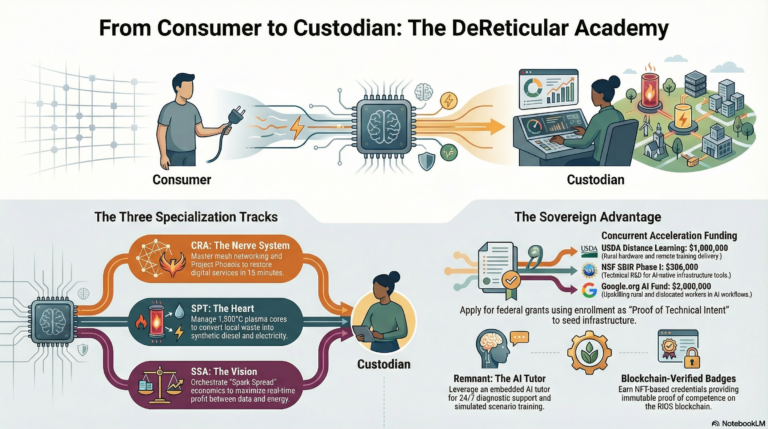
- DeReticular Academy: The Academy acts as a “Human Capital Engine” that provides community-focused courses to empower local talent to maintain and innovate on the RIOS platform. This initiative ensures the system’s longevity by reducing the municipality’s dependency on outside technicians and Big Tech support.
- Rural Rebound: This refers to the demographic resurgence of rural America following a decade of population loss, with the rural population reaching 46.2 million by 2024. This growth is driven almost entirely by positive net migration, as domestic migrants move away from large metropolitan areas.
- Place-Based Development: These strategies focus on investing in locally-owned businesses, civic infrastructure (like historic main streets), and unique local assets rather than recruiting large-scale, top-down industrial employers. This approach builds “entrepreneurial social infrastructure” that is more resilient to the fluctuations of the global economy.
Part 3: Essay Questions
Instructions: Use the provided sources to develop comprehensive responses to the following prompts. (Answers not provided).
- Sovereignty and the “Digital Border”: Analyze how DeReticular’s technology attempts to shift the relationship between a municipality and “Big Tech.” Discuss the economic and security implications of moving from “extractive” cloud dependencies to a community-owned Decentralized Physical Infrastructure Network (DePIN).
- The Nexus of Infrastructure and Healthcare: Evaluate the challenges of “Healthcare Deserts” in rural America. How does the “City Infrastructure” Nexus Package, specifically through the Field Medic agent and encrypted mesh referrals, provide a potential solution to these challenges?
- Architectural Resilience: Compare the “Trinity Stack” architecture of RIOS with traditional centralized server models. How do the roles of the “Gatekeeper,” “Ledger,” and “Auditor” contribute to what DeReticular calls “high-survivability” infrastructure?
- Economic Transition in Rural Cities: Using the data on the “Rural Rebound” and “Persistent Poverty,” argue for or against the adoption of a $129,999 “City-in-a-Box” system. Consider the return on investment through the lens of upcycling a digital footprint into a permanent asset.
- Security and the Physical Reality: Examine the methods DeReticular uses to establish a “root of trust” (e.g., TPM 2.0, RF Fingerprinting, Split-Ledger). Why is hardware-level verification considered critical for the operation of autonomous municipal transit and voting infrastructure?
——————————————————————————–
Part 4: Glossary of Key Terms
| Term | Definition |
| Air-Gapped | A network security measure that ensures a computer or network is physically and logically isolated from unsecured networks, such as the public internet. |
| DePIN | Decentralized Physical Infrastructure Network; a model where infrastructure is owned and operated by a decentralized community rather than a central authority. |
| Industrial Foreman | An OpenClaw AI agent that translates human intent into operational logistics for heavy machinery and localized power grid management. |
| Island Mode | A state in which a municipal or industrial network functions entirely autonomously and securely during a complete failure of the macro-internet or power grid. |
| Nomad Mesh-Point | Ruggedized Wi-Fi 6E/LoRaWAN routers used to create a decentralized, “un-killable” intranet canopy over a city. |
| OpenClaw Framework | A suite of localized AI agents designed to process sensitive tasks entirely on edge hardware without reaching out to cloud-based APIs. |
| Oracle Problem | The challenge of ensuring that data provided to a decentralized network from the physical world is accurate and has not been spoofed or tampered with. |
| Proxmox VE | A Type-1 hypervisor used in the RIOS architecture to run multiple isolated virtual environments (the Trinity Stack) on a single node. |
| RIOS | Rural Infrastructure Operating System; an AI-native, community-owned platform designed to transform municipal services into resilient assets. |
| Sovereign Executive | A localized AI agent that serves as a public-facing LLM concierge for visitor kiosks or an administrative assistant for medical and legal dictation. |
| Sovereign Sentry | Ruggedized hardware nodes (Standard and Pro editions) that serve as the compute foundation for DeReticular’s decentralized networks. |
| TPM 2.0 | Trusted Platform Module; a factory-sealed chip used to store non-exportable private keys for hardware-level cryptographic signing of data. |
| Vault Warden | A software component used for secure, LiDAR-based volumetric monitoring of public squares and transit hubs. |