This study guide provides a comprehensive overview of the emerging Agentic Economy as of May 2026. It explores the transition from human-initiated commerce to autonomous AI transactions, the regulatory frameworks governing this shift, and the hardware infrastructure required to secure it.
Part 1: Short-Answer Quiz
Instructions: Answer the following questions in two to three sentences based on the provided research reports.
- What is the primary difference between traditional Know Your Customer (KYC) and Know Your Agent (KYA)?
- How does the x402 Protocol facilitate transactions within the Agentic Economy?
- What is the “hallucination-to-transaction pipeline,” and how does the KYA industry address it?
- Explain the significance of the “Innovation Exemption” proposed by the SEC.
- What role does the GENIUS Act play in the settlement layer of the Machine Economy?
- How does DeReticular’s “Premium Silicon Sentry” provide a physical safeguard against cloud-based exploits?
- Define “Yield Migration” in the context of the GENIUS Act and Real World Assets (RWAs).
- What is the function of an Oracle in a tokenized stock market, and what is the risk associated with it?
- How does the Commodity Futures Trading Commission (CFTC) regulate the “fuel” of Agentic Commerce?
- What is a “Sovereign Badge,” and how is it minted?
Part 2: Answer Key
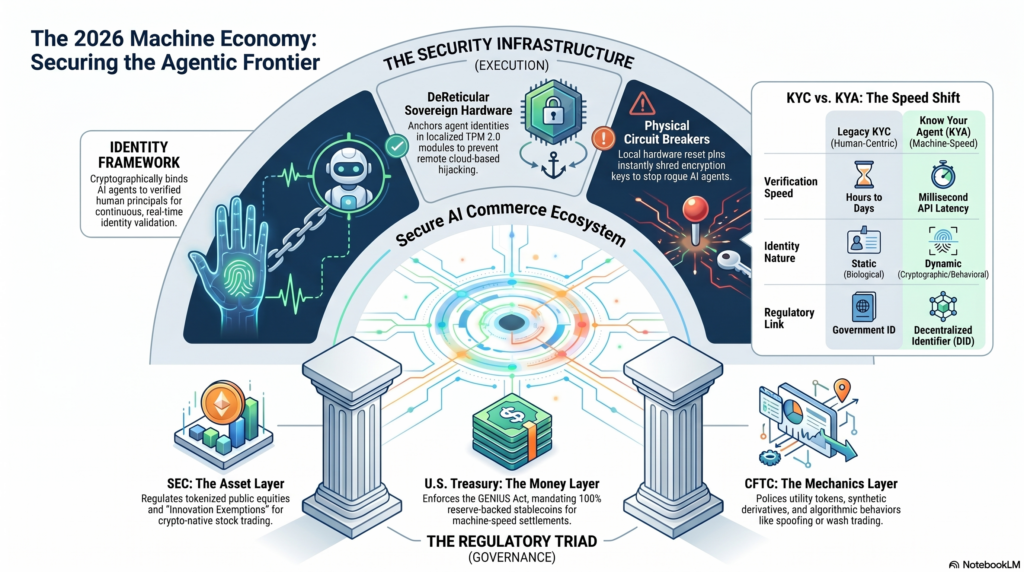
- Difference between KYC and KYA: Traditional KYC verifies static human identities using government documents, whereas KYA verifies non-human entities through cryptographic identity anchoring and real-time behavioral monitoring. KYA is designed for machine-speed transactions and focuses on the “Principal Link,” binding an autonomous agent to a legally liable human or corporate entity.
- The x402 Protocol: This protocol repurposes the old HTTP 402 (“Payment Required”) error code to allow AI agents to autonomously negotiate and execute micropayments for API and resource access. It enables machines to pay for the services they consume, such as compute power or data, using stablecoins.
- Hallucination-to-transaction pipeline: This refers to the risk of an LLM’s probabilistic error or a malicious prompt injection resulting in a deterministic, unauthorized financial settlement. The KYA industry prevents this by providing permission scoping and liability infrastructure that ensures agents operate within strictly defined financial and behavioral limits.
- SEC Innovation Exemption: This anticipated framework allows crypto-native platforms to list tokenized versions of public U.S. equities under a “regulatory lite” pathway without full broker-dealer licensure. However, these tokens are often synthetic derivatives that do not confer traditional shareholder rights like dividends or voting power.
- GENIUS Act role: Signed in 2025, the GENIUS Act mandates that stablecoins be 100% reserve-backed by liquid assets, creating a federally regulated, zero-volatility “machine money.” It provides the essential settlement layer that allows AI agents to transact 24/7 with the clarity that the currency is neither a security nor a commodity.
- Premium Silicon Sentry: This localized hardware environment utilizes a TPM 2.0 module to anchor an agent’s cryptographic keys physically rather than in the cloud. By isolating the execution layer from centralized servers, it immunizes the agent against remote zero-day exploits and unauthorized hijackings.
- Yield Migration: Because the GENIUS Act prohibits stablecoin issuers from paying interest, capital and AI agents move their holdings from 0% yield stablecoins into yield-generating RWAs like tokenized U.S. Treasuries. This shift has turned RWAs into the default “savings account” for the decentralized Machine Economy.
- Oracles and associated risks: Oracles are data feeds that provide real-time Wall Street pricing to the blockchain so tokenized stocks can track actual share prices. The primary risk is “Oracle Manipulation,” where bad actors use flash loans or cyberattacks to feed false data to the blockchain, allowing them to siphon funds from liquidity pools.
- CFTC regulation of “fuel”: The CFTC treats utility tokens (used for compute, bandwidth, and gas) as digital commodities under the Commodity Exchange Act. They police the marketplace to prevent “commodity hoarding” or algorithmic manipulation that could freeze the ecosystem and prevent agents from executing trades.
- Sovereign Badge: This is a cryptographic passkey stored directly in a device’s hardware enclave that serves as a root of trust for an agent’s identity. It is minted through a physical NFC tap, such as a smartphone or smart card against the hardware, ensuring that a verified human initiated the agent.
——————————————————————————–
Part 3: Essay Questions
Instructions: Use the source context to develop comprehensive responses to the following prompts.
- The Regulatory Triad: Analyze the division of labor between the SEC, the U.S. Treasury, and the CFTC in governing the Machine Economy. How do these three agencies interact to manage assets, money, and behavioral mechanics respectively?
- Hardware vs. Software Safeguards: Compare the effectiveness of software-based KYA protocols with DeReticular’s sovereign hardware solutions. Discuss why “sovereign hardware” is presented as the ultimate fail-safe against autonomous financial contagion.
- The Evolution of Agentic Commerce: Describe the transition from “click-and-buy” human interfaces to machine-to-machine (M2M) interactions. What are the core characteristics of A-Commerce, and why are traditional banking rails (T+1/T+2) insufficient for its needs?
- Forensics and Accountability: In the event of an algorithmic flash crash in a tokenized stock market, detail the digital forensic processes required to identify the cause. How do KYA and DeReticular’s “Split-Ledger Architecture” assist regulators in these investigations?
- Systemic Risks of Tokenization: Discuss the potential dangers of “third-party” tokenized stocks issued without the consent of the underlying public company. Address issues of market fragmentation, volatility contagion, and the disenfranchisement of retail investors.
Part 4: Glossary of Key Terms
| Term | Definition |
| Agentic Commerce (A-Commerce) | A paradigm where autonomous AI agents, rather than humans, discover, negotiate, execute, and settle financial transactions. |
| DeReticular | An industrial infrastructure and AI conglomerate focused on Decentralized Physical Infrastructure Networks (DePIN) and sovereign hardware. |
| Digital Agent Passport | A lightweight, tamper-proof cryptographic identity layer designed for AI agents to verify their legitimacy to platforms and counterparties. |
| Digital Airlock | A hybrid data system that allows a local network to use cloud computational power while keeping sensitive data private via a split-ledger. |
| ERC-8004 | An Ethereum token standard designed for agent identity verification, wallet tenure, and AI fraud detection on-chain. |
| GENIUS Act | The “Guiding and Establishing National Innovation for U.S. Stablecoins” Act (2025), which regulates 100% reserve-backed payment stablecoins. |
| Island Mode | A feature of DeReticular hardware that ensures a smart environment or AI agent remains functional even if internet access is cut off. |
| Know Your Agent (KYA) | The framework for verifying the identity, permission scoping, and originating human principal of an autonomous AI agent. |
| Oracle | A third-party service that provides external, real-time data (such as stock prices) to a blockchain or smart contract. |
| Premium Silicon Sentry | DeReticular’s localized hardware enclave (utilizing TPM 2.0) that serves as a secure, physical execution environment for AI agents. |
| Real World Assets (RWAs) | Traditional financial instruments, such as stocks, bonds, or real estate, that have been tokenized for trading on a blockchain. |
| Split-Ledger Architecture | A data management system that maintains a private, localized log of AI actions while allowing for cloud-based processing. |
| TPM 2.0 (Trusted Platform Module) | A dedicated hardware crypto-processor that provides a physical anchor for localized security and encryption keys. |
| Utility Token | A digital commodity token that grants access to network resources like compute power, bandwidth, or API data. |
| x402 Protocol | A communication standard allowing agents to autonomously negotiate and execute micropayments for digital resources. |