1. The Big Picture: From Passive Consumers to Community Developers
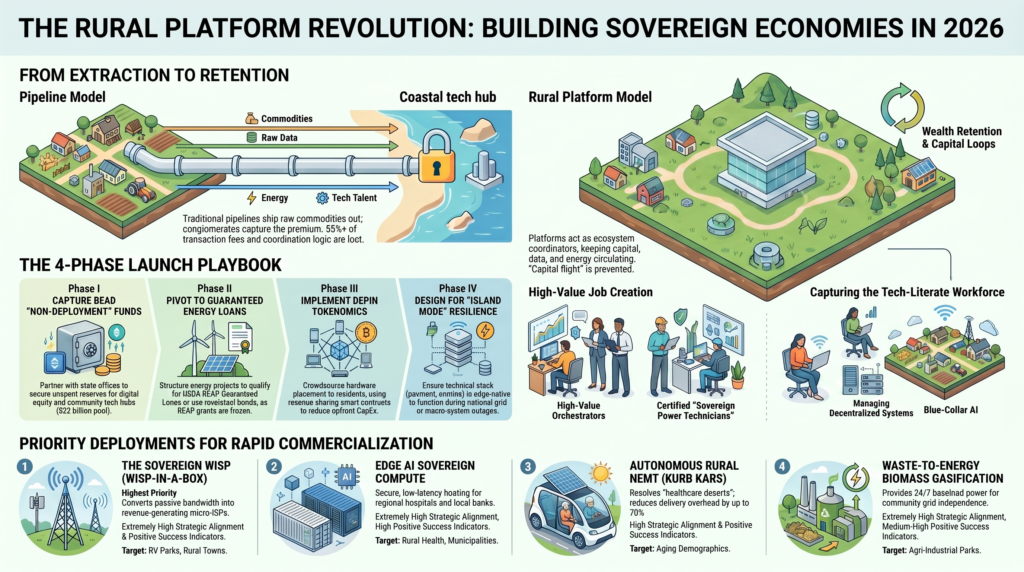
In the landscape of late 2026, the traditional way we power our lives and manage our data is reaching a breaking point. For decades, communities have been trapped in the Pipeline Model—a linear, extractive system where raw commodities, local data, and financial capital are vacuumed out of towns and shipped to centralized headquarters in distant tech hubs. This creates “Linear Fragility,” where a single point of failure in a national grid or a corporate cloud causes the entire community to collapse.
The Sovereign Stack inverts this entirely. It is a unified, self-contained architecture that hyper-converges energy, logistics, connectivity, and artificial intelligence at the edge. By adopting this stack, you transition from a “Passive Consumer” to a “Platform Developer”—the owner and architect of your own utilities.
video
The Model Shift: Pipeline vs. Platform
| Category | Pipeline Model (Traditional) | Platform Model (Sovereign) |
| Asset Ownership | Centralized Conglomerates (AWS, National Grids) | Local Cooperatives, Municipalities, and Individuals |
| Value Direction | External: Value is exported “down the pipe” to shareholders. | Internal: Value circulates within local “Capital & Data Loops.” |
| Capital Flight | High: 95%+ of fees leave the community immediately. | Negligible: Coordination logic and fees remain in the local economy. |
The ultimate goal of this system is achieving “Island Mode.” This is the capacity for a community to autonomously disconnect from national power grids or public cloud providers during a crisis—be it a cyberattack, storm, or market collapse—and continue to function. We call this “Spherical Resilience”: replacing linear vulnerability with a multi-directional, highly redundant mesh of independent nodes.
To manage the immense complexity of an independent community, the system requires a sophisticated “brain” to coordinate every move in real-time.
podcast
2. Pillar One: THE MIND (RIOS & The Edge AI Suite)
The “brain” of the Sovereign Stack is the Rural Infrastructure Operating System (RIOS). Unlike standard software that treats intelligence as a “Brain in a Jar” (logic restricted to remote cloud servers), RIOS is edge-native. It lives on physical, industrial-grade hardware right in your community, enabling what we call “Blue-Collar AI”—intelligence that actually controls physical machinery and manages local resources.
The 3 Sub-Components of the Mind
- Sovereign Sentry: This is the localized hardware gateway (standardized on high-performance NVIDIA Jetson Orin or Rockchip RK3588 silicon to avoid the closed ecosystems of big-tech consumer chips).
- Member Benefit: Privacy from corporate data harvesting. Your sensitive data is processed locally, never touching a corporate data center.
- OpenClaw AI Suite: A collection of specialized, air-gapped agents (like the Field Medic or Industrial Foreman) that handle complex tasks.
- Member Benefit: Operational Autonomy. These agents diagnose broken equipment or optimize crop yields without needing outside consultants or an active internet connection.
- Locutus Ledger: An on-device, decentralized state database that records every transaction and civic decision.
- Member Benefit: Immutable Integrity. It creates an un-hackable “Proof of Labor” and voting record that is immune to macro-internet coordinate attacks or global DNS shutdowns.
Because a sovereign community occasionally needs to utilize the massive logical utility of the large clouds, the system uses a secure interface:
The Digital Airlock: To utilize the logical power of advanced systems like Google’s Project Remy without “leaking” private telemetry, the Sovereign Gateway functions as a physical “Digital Airlock.” Using a Split-Ledger architecture, it strips away all personal context, sending only sterilized logical queries to the cloud. The cloud provides the reasoning, but it never sees the person, the home, or the industrial blueprints behind the request.
While a smart brain is essential, it requires physical power to execute its decisions and move the world.
3. Pillar Two: THE MUSCLE (Agra Dot Energy)
The “muscle” of the Sovereign Stack is Agra Dot Energy. While many 2026 systems are failing because they rely on intermittent solar or wind, Agra Dot Energy provides baseload power—continuous, 24/7 energy that ensures the community never goes dark.
The Power of Plasma Gasification
Using a 1,500°C thermal plasma reactor, the community turns “waste” into “wealth” through a clean, molecular process:
- Feedstock Collection: The community gathers organic waste, such as industrial hemp hurd or municipal trash.
- Molecular Vaporization: Inside the reactor, a blindingly hot electric arc reaching 1,500°C vaporizes the waste into its basic elements.
- Clean Synthesis: This produces high-purity syngas for electric turbines and biochar, a high-value fertilizer for local agrivoltaic fields.
The “So What?” for the Learner
This is a critical strategic move. On March 31, 2026, the USDA halted all direct grants for the REAP (Rural Energy for America Program). This freeze has stalled traditional solar and wind projects. However, because plasma gasification provides continuous baseload power, these projects remain “bankable” for traditional commercial loans and municipal-private partnerships (S-P3), allowing your community to leapfrog the grant-dependency trap.
Once a community has intelligence and power, it needs the “circulatory system” to move resources and people.
4. Pillar Three: THE MOTION (Kurb Kars)
Kurb Kars represent the “motion” layer—a fleet of autonomous, electric pods designed specifically for the “Operational Edge” of rural life.
Rugged Technologies for the Rural Edge
Kurb Kars solve the problems that stop standard self-driving cars:
- NVIDIA Drive for Dirt Roads: AZDOT-approved machine learning models that navigate unpaved “murram” roads and steep desert washes without needing clear street markings.
- Signal Fusion: To stay connected in “dead zones,” pods bond Starlink High-Performance Business satellite data with CAT4 vSIM cellular data, ensuring an unbreakable telemetry link.
- DAOSRUS & RFF: Members use a “Sovereign Badge” for app-less entry. The car uses Radio Frequency Fingerprinting (RFF) to verify the unique electromagnetic transient of your device, unlocking the door as you approach without needing a smartphone or QR code.
The Operational Edge: Ending the “Deadhead Economy”
Traditional rural transport fails because of the “Deadhead Economy”—drivers traveling 50 miles empty to pick up one passenger. By removing the cost of human labor and using zero-marginal-cost fuel from the “Muscle” pillar, Kurb Kars shift industry net margins from a measly 10% to a robust 81%.
When these three pillars work together, they create a reinforcing flywheel of value.
5. The Secret Sauce: How It All Works Together (Synergy)
The true power of the Sovereign Stack is Spherical Resilience, where every interaction between pillars increases the community’s wealth.
The Synergy Master Map
| The Interaction | The Pillars Involved | The Benefit to the Community |
| The Spark Spread | Mind + Muscle | Maximizes profit by arbitrating between energy sales and digital compute. |
| The Infinite Loop | Muscle + Motion | Pods transport waste to fuel the gasifier; the gasifier provides zero-cost fuel for the pods. |
| The Sovereign Badge | Mind + Motion | Secure, app-less access to transport via hardware-based identity (RFF). |
The Spark Spread: Digital Alchemy
The “Spark Spread” is the ultimate tool for financial sovereignty. It is a real-time algorithm that acts as a Digital Alchemist, calculating: Spark Spread = (Value of Compute Tokens) – (On-site Energy Production Cost). Every second, the system decides if it is more profitable to refine its syngas into liquid fuel for the tractors or use that power to run high-margin Edge AI inference on its RIOS supercomputing clusters.
This future is already being deployed in nodes ranging from the smart eco-industrial parks of Uganda to the autonomous corridors of Arizona.
6. Your Path Forward: The 90-Day Blueprint
Transitioning from a consumer to a creator requires a disciplined execution of the “Leapfrog Blueprint.”
- Days 1–30: Asset Audit
- Action Command: Map your local inputs. Identify your available biomass waste and calculate the precise compute needs of your local hospitals and schools.
- Days 31–60: Entity Design
- Action Command: Form your Sovereign-Public-Private Partnership (S-P3). Use a local cooperative structure to ensure the community owns the physical land and energy assets.
- Days 61–90: Deploy & Scale
- Action Command: Provision your first node. Deploy a modular RIOS compute container to activate your local sovereign cloud and begin generating revenue through the Spark Spread.
By following this path, you achieve Spherical Resilience. You stop being a line item on a corporate balance sheet and become the sovereign architect of your community’s future.