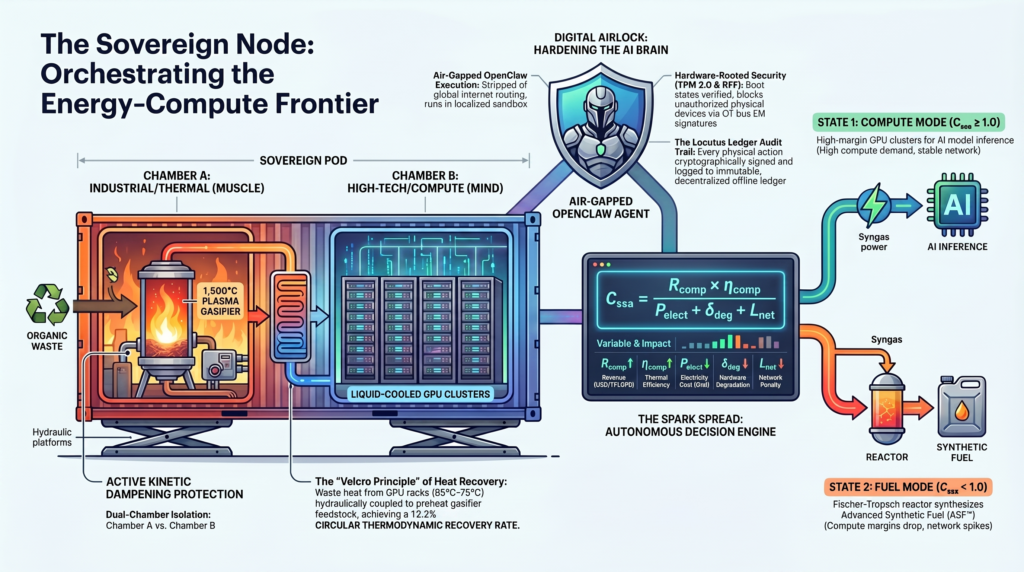
This study guide provides a structured review of the technologies, architectures, and strategic frameworks governing modern Virtual Power Plants (VPPs) and Sovereign Nodes. It synthesizes complex data regarding artificial intelligence implementations, industrial control protocols, and the co-optimization of energy and digital compute.
Part I: Knowledge Assessment Quiz
Instructions: Answer the following ten questions in 2–3 sentences based on the provided source materials.
- What are the three primary technical bottlenecks of Virtual Power Plant (VPP) networks that AI is currently being deployed to resolve?
- Explain the “Velcro Principle” in the context of Sovereign Pod thermodynamics.
- What was the significance of the May 2026 OpenClaw security crisis, and what vulnerability did it expose?
- How do Kolmogorov-Arnold Networks (KAN) improve upon traditional mathematical solvers for grid operations?
- Describe the function of the “Digital Airlock” in DeReticular’s Sovereign Automation framework.
- What is the “Spark Spread Arbitrage Coefficient” (C_{ssa}), and how does it determine a Sovereign Node’s operational state?
- What role does Radio Frequency Fingerprinting (RFF) play in the security of a Sovereign Node?
- How does Zero-Knowledge Federated Reinforcement Learning (ZK-FRL) address the “trilemma” of VPP expansion?
- What are the physical differences between Chamber A and Chamber B in a standardized Sovereign Pod?
- Explain how “agrivoltaic classification” allows VPP developers to bypass the “Permitting Wall” of traditional utility interconnection.
Part II: Answer Key
- Technical Bottlenecks: The primary bottlenecks are latency jitter, protocol fragmentation, and edge-cloud coordination. AI resolves these by deploying edge-native controls to bypass communication delays, using unsupervised learning to automate the mapping of proprietary device registers, and balancing local safety with central economic goals via multi-agent reinforcement learning.
- The Velcro Principle: This principle refers to the thermodynamic coupling of high-density GPU racks in the “Brain” chamber with the feedstock dryers in the “Power Core” chamber. Waste heat from AI model inference (exiting at 65°C to 75°C) is recycled to dry organic agricultural feedstocks, improving gasification efficiency by a circular recovery rate of approximately 12.2%.
- 2026 OpenClaw Crisis: The crisis shattered the “Trusted Environment Fallacy” by demonstrating that cloud-tethered autonomous agents with system-level permissions were vulnerable to remote code injection and data exfiltration. Adversaries were able to harvest cryptographic keys and use agents as lateral pivoting points to breach industrial and municipal networks.
- KAN vs. Traditional Solvers: Traditional AC Optimal Power Flow (AC-OPF) solvers are computationally expensive and slow to converge, limiting real-time responsiveness. KANs mathematically approximate feasible operating boundaries, reducing computational solution time by up to 64.4% with only a negligible divergence from the absolute optimal path.
- Digital Airlock: The Digital Airlock is a hardware-enforced security layer that strips the OpenClaw agent container of global internet routing tables and public DNS resolution. This ensures the agent can only execute local tools within a sandboxed environment, communicating with the outside world only through one-way cryptographic telemetry handshakes.
- Spark Spread (C_{ssa}): This coefficient is a dynamic arbitrage calculation that weighs the revenue of digital compute against the costs of electricity and hardware degradation. If the result is \ge 1.0, the node prioritizes powering GPU racks for AI inference; if it is < 1.0, it diverts syngas to synthesize physical liquid fuels (ASF™).
- Radio Frequency Fingerprinting (RFF): RFF is a physical-layer security measure that authenticates hardware devices by their unique electromagnetic signatures. By monitoring the precise physical impedance of the copper connections on the OT bus, the system can block non-profiled or rogue diagnostic tools from communicating.
- ZK-FRL Trilemma: ZK-FRL balances economic optimization, user privacy, and cybersecurity. It allows edge devices to keep raw customer telemetry local while uploading only model gradients to the central aggregator, using zk-SNARKs to mathematically prove the validity of the updates without revealing private data.
- Chamber A vs. Chamber B: Chamber A (The Power Core) contains high-temperature industrial equipment like the plasma arc gasifier, syngas generators, and Fischer-Tropsch reactors. Chamber B (The Brain) is a physically and electromagnetically isolated zone housing the Sentry Pro servers, liquid-cooled GPU clusters, and RF shielding to protect sensitive IT hardware from the gasifier’s electromagnetic interference.
- Agrivoltaic Classification: By integrating vertical solar arrays with modular waste-to-energy units on agricultural land, deployments maintain their status as farm infrastructure. This allows them to operate under local agricultural easement protections, bypassing the multi-year grid-impact reviews and zoning queues required for industrial data centers.
Part III: Essay Format Questions
- The Architecture of Autonomy: Analyze the shift from “The Line” (linear centralized topology) to “The Node” (spherical decentralized topology). Discuss how this transition impacts grid resilience and data security in the face of macro-grid failures.
- Arbitrage in the Age of AI: Evaluate the “Spark Spread” algorithm as an economic model. How does the ability to shift between physical fuel synthesis and digital compute provide a financial safety net for off-grid infrastructure?
- Security Beyond the Cloud: Discuss the multilayered security approach used in Sovereign Nodes, including TPM 2.0, RFF, and the Locutus Ledger. Why is a “hardware-rooted” identity necessary for autonomous agents managing critical industrial processes?
- Algorithmic Collusion and Regulation: Address the risks of Deep Reinforcement Learning (DRL) agents implicitly colluding in energy markets. What regulatory and technical constraints (such as human-in-the-loop oversight) are being proposed to mitigate anti-competitive behavior?
- The Circular Economy of Energy-Compute Nodes: Examine the “Sovereign Pod” as a closed-loop system. Focus on the integration of carbon-negative feedstocks, waste heat recovery, and the production of Advanced Synthetic Fuel (ASF™).
Part IV: Glossary of Key Terms
Term Definition
AC-OPF AC Optimal Power Flow; a complex mathematical calculation used to determine the most efficient way to route electricity across a grid.
ASF™ Advanced Synthetic Fuel; a carbon-negative synthetic diesel or jet fuel produced from purified syngas via Fischer-Tropsch synthesis.
BiLSTM Bidirectional Long Short-Term Memory; a neural network architecture that processes sequential data in both directions to capture temporal and spatial trends.
CIM / IEC 61968 Common Information Model; a standardized representation for power system entities to facilitate interoperability between different vendors.
DNP3 Distributed Network Protocol; a set of communication protocols used between components in process automation systems, common in North American utilities.
DRL Deep Reinforcement Learning; a type of machine learning where agents learn to make decisions by receiving rewards or penalties based on their actions.
GTL Gas-to-Liquids; a refinery process that converts gaseous hydrocarbons (like syngas) into longer-chain liquid fuels like synthetic diesel.
Island Mode The ability of a microgrid or Sovereign Node to operate at full capacity while completely disconnected from the national electrical grid and public internet.
KAN Kolmogorov-Arnold Networks; an advanced neural network type used to approximate complex physical boundaries and accelerate optimization tasks.
Locutus Ledger A decentralized, offline-first cryptographic ledger used for immutable logging of AI-driven actions and state changes within a node.
MARL Multi-Agent Reinforcement Learning; a framework where multiple AI agents interact and learn to coordinate or compete within a shared environment.
MCP Model Context Protocol; a universal API interface that allows AI agents like OpenClaw to interact with local files, terminals, and hardware registers.
Modbus A legacy industrial communication protocol used for connecting electronic devices, often over serial lines or Ethernet.
PPO / DDPG Proximal Policy Optimization / Deep Deterministic Policy Gradient; specific algorithms used in DRL for stable and efficient policy learning.
RAG-VPP Retrieval-Augmented Generation VPP; a framework that uses LLMs to ingest unstructured data (like weather alerts) to adjust grid risk metrics.
SIDI Sovereign Intelligence & Decentralized Infrastructure; an open technical standard for the deployment and governance of localized AI and energy systems.
Syngas Synthesis Gas; a hydrogen-rich fuel gas produced by the high-temperature gasification of organic feedstock.
TPM 2.0 Trusted Platform Module; a specialized chip on a computer motherboard that stores cryptographic keys and ensures the integrity of the boot process.
zk-SNARK Zero-Knowledge Succinct Non-Interactive Argument of Knowledge; a cryptographic proof that allows one party to prove they know a value without revealing the value itself.