Beyond the Line: A Student’s Guide to Spherical Resilience and Island Mode
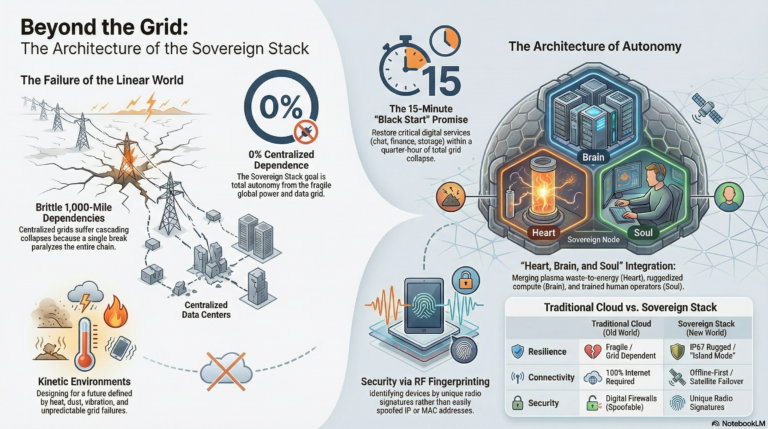
Welcome to the curriculum for the next generation of infrastructure. For over a century, civil engineering has relied on “The Line”—centralized corridors of high-voltage wires and fiber-optic backbones that connect distant production centers to local consumers. While economically efficient in the 20th century, this model is fundamentally fragile. This guide introduces the transition to Spherical Resilience, a model designed for a world of climate anomalies and cyber-physical threats.
1. The Problem of “The Line”: Understanding Linear Fragility
Traditional infrastructure is built on “Linear Fragility.” To understand this, compare a legacy string of holiday lights to a modern parallel circuit. In the legacy string, if a single bulb burns out or the wire is snipped, the entire circuit fails. Our current power grid and internet function similarly: energy and data travel along single, centralized corridors. If a storm knocks down one transmission tower or a cyber-attack hits one transit router, everything “downstream” collapses.
In a linear system, distance equals danger. The longer the transmission line, the higher the statistical probability of a failure event.
deck
Linear vs. Spherical: At a Glance
| Category | Linear Fragility (Legacy) | Spherical Resilience (Future) |
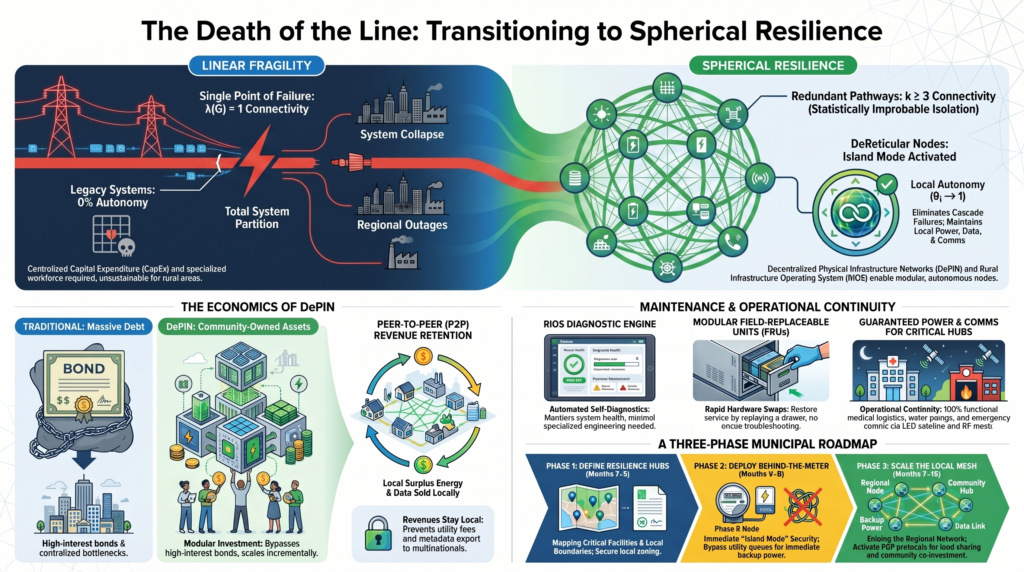
| Structure | Tree/Line Topology (\lambda(G) = 1) | k-connected Mesh (k \ge 3) |
| Point of Failure | Single physical or digital severance cascades | Multiple simultaneous failures required to isolate |
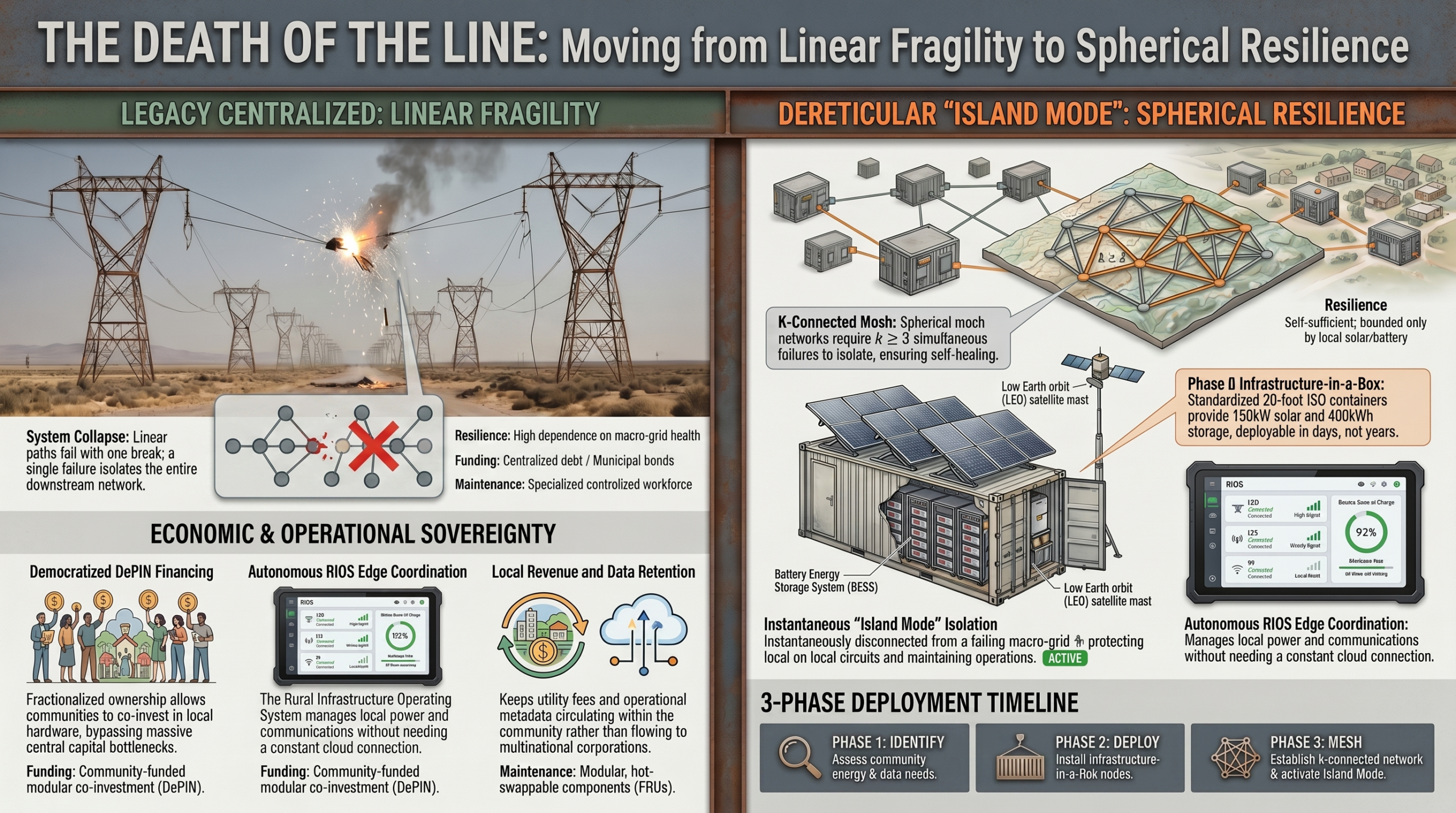
| Consequence | Downstream system collapse | Localized “Island Mode” (Failure Bounding) |
Key Insight: The “Line” is no longer sustainable because it lacks “failure bounding.” In the modern era, we must assume the line will break. Spherical systems don’t just prevent breaks; they ensure that when a break occurs, the system continues to function.
Transition: To move from the physical vulnerability of the line to a system that can survive, we must apply the mathematical principles of Graph Theory.
podcast
2. The Geometry of Safety: Graph Theory Simplified
In Resilient Systems design, we model infrastructure as a graph G = (V, E), where V are nodes (facilities) and E are edges (connections).
- Tree Topology: The legacy model. It is characterized by an edge connectivity of 1 (\lambda(G) = 1). If you cut one edge, the graph is partitioned into disconnected subgraphs.
- k-connected Mesh: The resilient model. We design for k-vertex-connected and k-edge-connected graphs where k \ge 3. This means every facility has at least three independent paths for power and data.
The Math of Survival
Formula 1: Probability of Partition P_{\text{partition}} = 1 – (1 – p)^{|E|}
Plain English Translation: “As your network grows in distance (|E|), the mathematical probability that a single random accident (p) will cut off your town from the grid approaches 100%.”
Formula 2: Probability of Isolation P_{\text{isolation}} = \prod_{j=1}^{k} p_j
Plain English Translation: “In a k-connected mesh, a node only fails if every single independent path (k) fails at once. If you have three or more paths, the chance of total isolation drops toward zero.”
video
3 Most Important Advantages of a k-connected Mesh
- Topological Redundancy: By maintaining k \ge 3, the system possesses at least two “hot-standby” routes at all times.
- Risk Bounding: Because nodes are interconnected rather than strictly downstream, a failure is physically and digitally trapped at its origin point.
- Self-Healing Routing: The system uses dynamic protocols to automatically re-route data and power around damage without human intervention.
Transition: While the mesh provides the pathways, a node requires an autonomous “brain” to execute the transition from grid-connected to independent operation.
3. “Island Mode”: The Superpower of Local Autonomy
“Island Mode” is the ability of a local node to “self-heal” by disconnecting from a failing macro-grid. We measure this through the Autonomy Factor (\theta). In legacy grids, \theta \approx 0 (the node is helpless). In a resilient system, the Rural Infrastructure Operating System (RIOS) pushes \theta \to 1.
The Sequence of an Island Mode Event
- Detection: RIOS senses that upstream power quality or data synchronization has dropped below safe thresholds.
- Isolation: Solid-state transfer switches physically disconnect the facility from the macro-grid in milliseconds to prevent hazardous backfeeding.
- Initialization: The Signal Fusion Engine takes over, aggregating available LEO satellite, LTE, and RF mesh links, while the AMC (Autonomous Machine Coordination) Engine balances local generation against critical loads.
- Synchronization: The node generates its own Reference Voltage Sync and data timing signals, allowing it to function as a sovereign “island.”
- Autonomy: The node utilizes its local solar and battery reserves to maintain 100% service for critical municipal functions.
Key Insight: Island Mode doesn’t just wait for a repair; it “bounds” the failure. It prevents a regional collapse by ensuring that local facilities like water pumps and emergency shelters never lose their “pulse.”
Transition: This sovereign software logic is housed within a ruggedized physical “seed” designed for rapid deployment anywhere on Earth.
4. Infrastructure-in-a-Box: The Phase 0 Seed
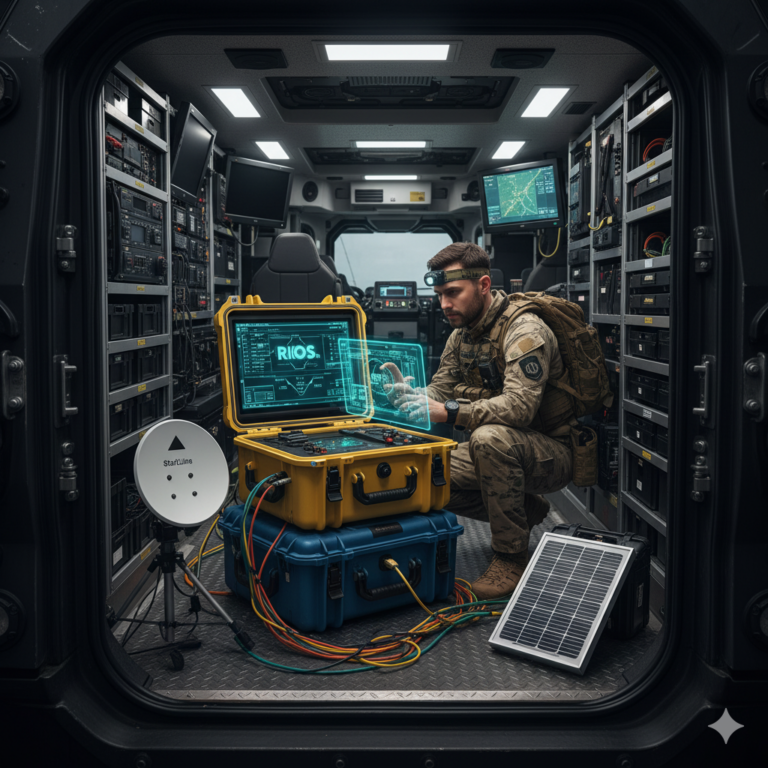
The Phase 0 Node is a standardized 20-foot ISO High-Cube shipping container made of 8-gauge corten steel. This enclosure is designed to protect critical assets from extreme weather (-30°C to +55°C) and physical sabotage.
Physical Anatomy of a Resilient Node
| Component | Specification | Educational Function |
| Solar Array | 150 kW Bifacial Monocrystalline | Energy Generation: Harvests power; mechanical scissor-jack deployment. |
| BESS | 400 kWh LiFePO4 Batteries | Energy Storage: Chosen for thermal stability, low toxicity, and 6,000+ cycle lifespan. |
| Edge Servers | 3-Node RIOS Compute Cluster | Intelligence: Runs the Signal Fusion and AMC Engines; air-gapped local logic. |
| Comms Mast | LEO Sat / RF Mesh / Private LTE | Communication: Maintains connectivity via Babel and OLSRv2 protocols. |
| Aux Generator | 30 kW Hydrogen-Ready | Baseload Support: Provides energy during extended low-solar periods. |
The Strategic Leapfrog
Using a containerized model represents a “Leapfrog Dynamic.” Just as developing regions skipped landlines to go straight to mobile phones, rural and municipal planners can now skip centralized grid dependency to move straight to sovereign mesh networks.
- Rapid Commissioning: Bypasses years of traditional substation construction; can be deployed and operational in days.
- Rugged Sovereignty: The corten steel shell and modular components allow a community to own its own “utility-in-a-box,” protected from external infrastructure collapse.
Transition: The hardware is ready and the math is proven, but the transition requires a new economic engine to fund it.
5. DePIN: The Economic Engine of Resilience
DePIN (Decentralized Physical Infrastructure Networks) is the framework that allows communities to bypass central funding bottlenecks.
How DePIN Flips the Script
- Modular CapEx-to-OpEx Substitution: Traditional infrastructure requires billions in upfront Capital Expenditure (CapEx), which often paralyzes municipal budgets. DePIN allows for modular, step-by-step additions where nodes are deployed as needed.
- Fractional Ownership: Ownership is represented on transparent ledgers. A local farmer or small town can own a “piece” of their own power grid rather than just paying a distant utility company.
- Revenue Retention: Instead of utility fees flowing to a multinational corporation, revenues from energy generation and data routing stay within the community to reward local investors.
Key Insight: DePIN turns infrastructure from a debt-heavy service you pay for into a local asset you own. It replaces the “paralysis” of massive debt with the “momentum” of community investment.
Transition: When we combine k-connected math, containerized hardware, and DePIN economics, we achieve a future of sovereign autonomous infrastructure.
6. Summary Checklist for the Aspiring Infrastructure Designer
To transition a municipality from a fragile line to a resilient sphere, follow this actionable roadmap:
- [ ] Phase 1: Identify Resilience Hubs (Months 1–3) Map regional critical facilities (water pumps, communication towers, emergency shelters). Identify the first points of isolation where “Island Mode” is most critical.
- [ ] Phase 2: Deploy Behind-The-Meter (BTM) Nodes (Months 4–6) Install Phase 0 nodes directly at facility service points. This provides immediate resiliency without waiting for the multi-year utility interconnection queue.
- [ ] Phase 3: Scale the Local Mesh (Months 7–18) Activate P2P protocols (Babel or OLSRv2) to link adjacent nodes. As k increases toward 3, the region transitions into a fully k-connected, spherically resilient network.
Vision Statement Sovereign Autonomous Infrastructure is no longer a futuristic dream. By using commodity hardware, open-source software, and DePIN economics, we eliminate vendor lock-in and build systems that are truly un-stoppable. The barrier is no longer the technology—it is the courage to move beyond the line.